
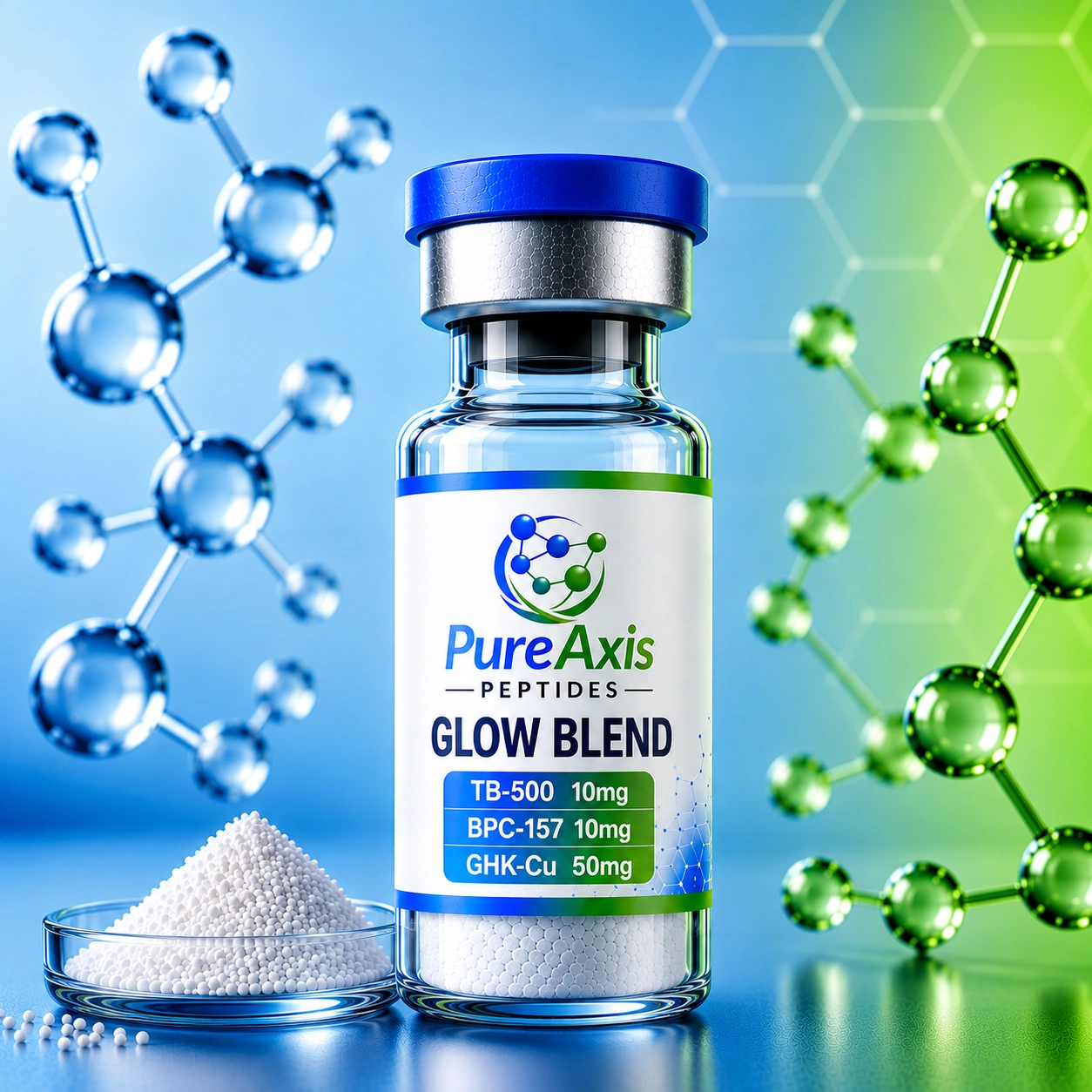

Glow Blend (TB-500 10mg + BPC-157 10mg + GHK-Cu 50mg)
$231.00
Triple peptide regeneration blend for healing research
Quick Specifications
| Purity (%) | 98.9 |
|---|
Glow Blend — SEO Product Content
SEO Title
Glow Blend 70mg | TB-500 + BPC-157 + GHK-Cu Research Peptide
SEO Meta Description
Glow Blend 70mg combines TB-500, BPC-157 and GHK-Cu for laboratory research into tissue repair, wound biology, cellular migration and regenerative pathways.
Suggested URL Slug
/product/glow-blend-tb-500-bpc-157-ghk-cu/
SEO Product Description
Glow Blend — TB-500 10mg + BPC-157 10mg + GHK-Cu 50mg
Glow Blend is a three-peptide research formulation combining TB-500, BPC-157, and GHK-Cu in a single 70 mg blend.
The Pure Axis Peptides formulation contains:
- TB-500 — 10 mg
- BPC-157 — 10 mg
- GHK-Cu — 50 mg
- Total peptide content — 70 mg
The blend is designed for laboratory research involving tissue biology, cellular migration, wound-related pathways, extracellular-matrix research and regenerative signaling.
Pure Axis Peptides offers Glow Blend strictly as a research-use material for qualified laboratory and scientific investigations.
What Is Glow Blend?
Glow Blend combines three peptides that have each been investigated in different areas of tissue and cellular biology.
TB-500, commonly associated with thymosin beta-4 research, is studied in relation to cell migration, angiogenesis, tissue remodeling and wound biology.
BPC-157 is a 15-amino-acid peptide that has been extensively investigated in preclinical models involving tissue injury, vascular responses, inflammation and wound repair.
GHK-Cu is a copper-binding tripeptide complex associated with research into collagen synthesis, extracellular-matrix remodeling, skin biology and wound-related processes.
The combination creates a research model in which multiple peptide pathways can be studied simultaneously.
TB-500 Research Component
TB-500 is commonly used as a research designation for a peptide associated with thymosin beta-4. Thymosin beta-4 is a naturally occurring peptide/protein studied for its involvement in cell migration, actin regulation, angiogenesis and tissue repair.
Experimental research has investigated thymosin beta-4 in dermal and other tissue-repair models, including mechanisms involving epithelial-cell migration, angiogenesis and inflammatory signaling.
For the individual product, researchers can also explore TB-500 (Thymosin Beta-4).
BPC-157 Research Component
BPC-157 is a synthetic pentadecapeptide that has been extensively studied in animal and cellular models of tissue injury.
Research has investigated BPC-157 in connection with wound healing, tendon biology, cellular migration, angiogenesis and inflammatory responses. For example, experimental tendon research has examined cell survival and migration, while other models have investigated vascular signaling and wound repair.
A recent review emphasizes that the existing BPC-157 literature remains predominantly preclinical and that the peptide has not been established as an approved therapeutic treatment.
Explore the individual BPC-157 research peptide for additional information.
GHK-Cu Research Component
GHK-Cu, or glycyl-L-histidyl-L-lysine copper complex, is a naturally occurring copper-binding peptide complex studied extensively in skin and connective-tissue research.
Laboratory studies have investigated GHK-Cu’s relationship with collagen synthesis, extracellular-matrix accumulation and wound biology. Early fibroblast research demonstrated stimulation of collagen synthesis, while animal wound models investigated changes in collagen, protein and glycosaminoglycan production.
More recent reviews have examined GHK and GHK-Cu in the context of skin regeneration, tissue remodeling and inflammatory pathways.
Researchers can also explore the individual GHK-Cu research peptide.
Glow Blend and Tissue-Repair Research
The three components of Glow Blend provide researchers with complementary areas of investigation:
Cellular Migration: TB-500/thymosin beta-4 research has investigated pathways associated with cell movement and tissue remodeling.
Wound Biology: BPC-157 and thymosin beta-4 have both been examined in experimental wound models.
Extracellular Matrix: GHK-Cu research has investigated collagen and glycosaminoglycan production.
Angiogenesis: Experimental studies involving thymosin beta-4 and BPC-157 have investigated endothelial-cell migration, vascular formation and angiogenic signaling.
Inflammatory Signaling: All three peptides have been studied in experimental contexts involving inflammatory and tissue-response pathways.
These areas make Glow Blend an interesting experimental formulation for researchers examining the interaction between multiple regenerative and tissue-associated peptide pathways.
Glow Blend Research Applications
Glow Blend may be relevant to laboratory studies involving:
- Tissue-repair biology
- Wound-healing models
- Cellular migration
- Angiogenesis research
- Fibroblast biology
- Collagen research
- Extracellular-matrix remodeling
- Inflammatory signaling
- Peptide combination research
- Regenerative biology
- Skin and connective-tissue research
- Peptide structure-function studies
Glow Blend and Extracellular-Matrix Research
The GHK-Cu component provides particular relevance to extracellular-matrix research.
Studies of GHK-Cu have investigated collagen synthesis and the production of extracellular-matrix components in fibroblast and wound models. Research has also examined changes in glycosaminoglycans and proteoglycans following exposure to GHK-Cu.
This provides a useful biochemical context for researchers investigating how peptide-based compounds interact with connective-tissue pathways.
Glow Blend and Cellular Migration
Cell migration is another important area of research surrounding the components of Glow Blend.
Thymosin beta-4 research has associated the peptide with cell migration and tissue remodeling, while BPC-157 studies have investigated migration of endothelial and tendon-related cells in experimental models.
Researchers can therefore use the individual components and combination formulation to investigate how multiple peptide signals may interact within experimental cellular systems.
Important Research Distinction
While each individual component has been studied in laboratory or preclinical models, that does not establish that the specific Glow Blend combination has equivalent or additive effects.
There is currently no basis for representing the 10 mg TB-500 + 10 mg BPC-157 + 50 mg GHK-Cu formulation as a clinically validated treatment or claiming that the three-peptide combination has been proven to accelerate healing in humans.
For scientific work, researchers should evaluate the blend according to the exact formulation, experimental model, batch documentation and certificate of analysis.
Glow Blend Product Specification
According to the Pure Axis Peptides catalog:
| Component | Amount |
|---|---|
| TB-500 | 10 mg |
| BPC-157 | 10 mg |
| GHK-Cu | 50 mg |
| Total | 70 mg |
Product SKU: BBG70
The product is listed as a 70 mg triple-peptide blend.
Researchers should verify current labeling, storage requirements and batch-specific analytical documentation before use.
Explore Related Research Peptides
Explore the individual components:
- TB-500 — thymosin beta-4/tissue-repair research
- BPC-157 — tissue and wound-biology research
- GHK-Cu — copper-peptide and extracellular-matrix research
Researchers interested in a related four-peptide formulation can also explore Klow Blend, which combines TB-500, BPC-157, GHK-Cu and KPV.
For additional research materials, browse the Healing Peptides collection or the broader Peptides collection.
Visit Shop All Products for the complete Pure Axis Peptides catalog.
Research Use Only
Glow Blend supplied by Pure Axis Peptides is intended strictly for laboratory and scientific research. It is not intended for human consumption, self-administration, injection into humans or animals, diagnosis, treatment, cure, or prevention of any disease or medical condition. Research findings concerning individual peptide components should not be interpreted as proof of efficacy for the specific Glow Blend combination. Researchers should evaluate all materials according to their experimental requirements, product documentation and applicable laboratory procedures.
Internal Linking Recommendations
High-Priority Internal Links
- TB-500 →
https://pureaxispeptides.com/product/tb-500-thymosin-beta-4/ - BPC-157 →
https://pureaxispeptides.com/product/bpc-157/ - GHK-Cu →
https://pureaxispeptides.com/product/ghk-cu/ - Klow Blend →
https://pureaxispeptides.com/product/klow-blend/ - Healing Peptides →
https://pureaxispeptides.com/product-category/peptides/healing-peptides/ - Peptides →
https://pureaxispeptides.com/product-category/peptides/ - Shop All Products →
https://pureaxispeptides.com/shop/
Internal Linking Strategy
This product should become the hub page for the three individual peptides.
Recommended structure:
Glow Blend
→ TB-500
→ BPC-157
→ GHK-Cu
→ Healing Peptides
→ Klow Blend
Then link the three individual product pages back to Glow Blend using descriptive anchors such as:
- “TB-500 + BPC-157 + GHK-Cu blend”
- “triple-peptide research blend”
- “Glow Blend 70mg”
This creates a strong topical cluster around regenerative peptide research and gives Google clear semantic relationships between the individual products and the blend.
Verify all live WooCommerce URLs before publishing.
External Scientific References
- PubMed — Thymosin beta-4 and tissue repair:
https://pubmed.ncbi.nlm.nih.gov/31649007/ - PubMed — Thymosin beta-4 regenerative research:
https://pubmed.ncbi.nlm.nih.gov/23050815/ - PubMed — BPC-157 and tendon healing:
https://pubmed.ncbi.nlm.nih.gov/21030672/ - PubMed — BPC-157 and wound-healing research:
https://pubmed.ncbi.nlm.nih.gov/25995620/ - PubMed — BPC-157 literature review:
https://pubmed.ncbi.nlm.nih.gov/40005999/ - PubMed — GHK-Cu and collagen synthesis:
https://pubmed.ncbi.nlm.nih.gov/3169264/ - PubMed — GHK-Cu and experimental wound repair:
https://pubmed.ncbi.nlm.nih.gov/8227353/ - PubMed — GHK and skin regeneration:
https://pubmed.ncbi.nlm.nih.gov/26236730/
Product Tags
Glow Blend, Glow Blend 70mg, Glow Peptide Blend, Glow Research Peptide, TB-500, TB500, Thymosin Beta-4, BPC-157, BPC157, GHK-Cu, GHK Cu, Copper Peptide, TB-500 BPC-157 GHK-Cu, TB-500 BPC-157 GHK-Cu Blend, Triple Peptide Blend, Regenerative Peptide, Regenerative Peptide Blend, Tissue Repair Research, Wound Healing Research, Cellular Migration, Angiogenesis Research, Collagen Research, Extracellular Matrix Research, Fibroblast Research, Skin Research, Healing Peptide, Research Peptide, Laboratory Research
| Purity (%) | 98.9 |
|---|---|
| Lab Tested | yes |
| Research Grade | yes |
| Third Party Tested | yes |
Be the first to review “Glow Blend (TB-500 10mg + BPC-157 10mg + GHK-Cu 50mg)”
Need Assistance?
Our research specialists are here to help with product selection and technical questions.
Related products

Blends
BlendsCagrilintide 5mg + Semaglutide 5mg Blend
$176.00Dual metabolic peptide blend for weight management research

Blends
BlendsCJC-1295 without DAC 5mg + Ipamorelin 5mg Blend
$122.00Growth hormone secretagogue blend for GH research

Antimicrobial & Immunology
Antimicrobial & Immunology $70.00Anti-inflammatory tripeptide for gut and skin research

Antimicrobial & Immunology
Antimicrobial & Immunology Price range: $33.00 through $65.00Copper peptide for skin regeneration and wound healing research
Healing Peptides
Healing Peptides Price range: $49.00 through $176.00Synthetic Thymosin Beta-4 for regeneration and healing research

Blends
BlendsKlow Blend (TB-500 10mg + BPC-157 10mg + GHK-Cu 50mg + KPV 10mg)
$250.00Klow Blend is a premium quad-peptide formulation combining TB-500 (10mg), BPC-157 (10mg),...

Healing Peptides
Healing Peptides Price range: $41.00 through $68.00Gastric pentadecapeptide for tissue healing research

 Glow Blend (TB-500 10mg + BPC-157 10mg + GHK-Cu 50mg)
$231.00
Glow Blend (TB-500 10mg + BPC-157 10mg + GHK-Cu 50mg)
$231.00
Reviews
There are no reviews yet.