

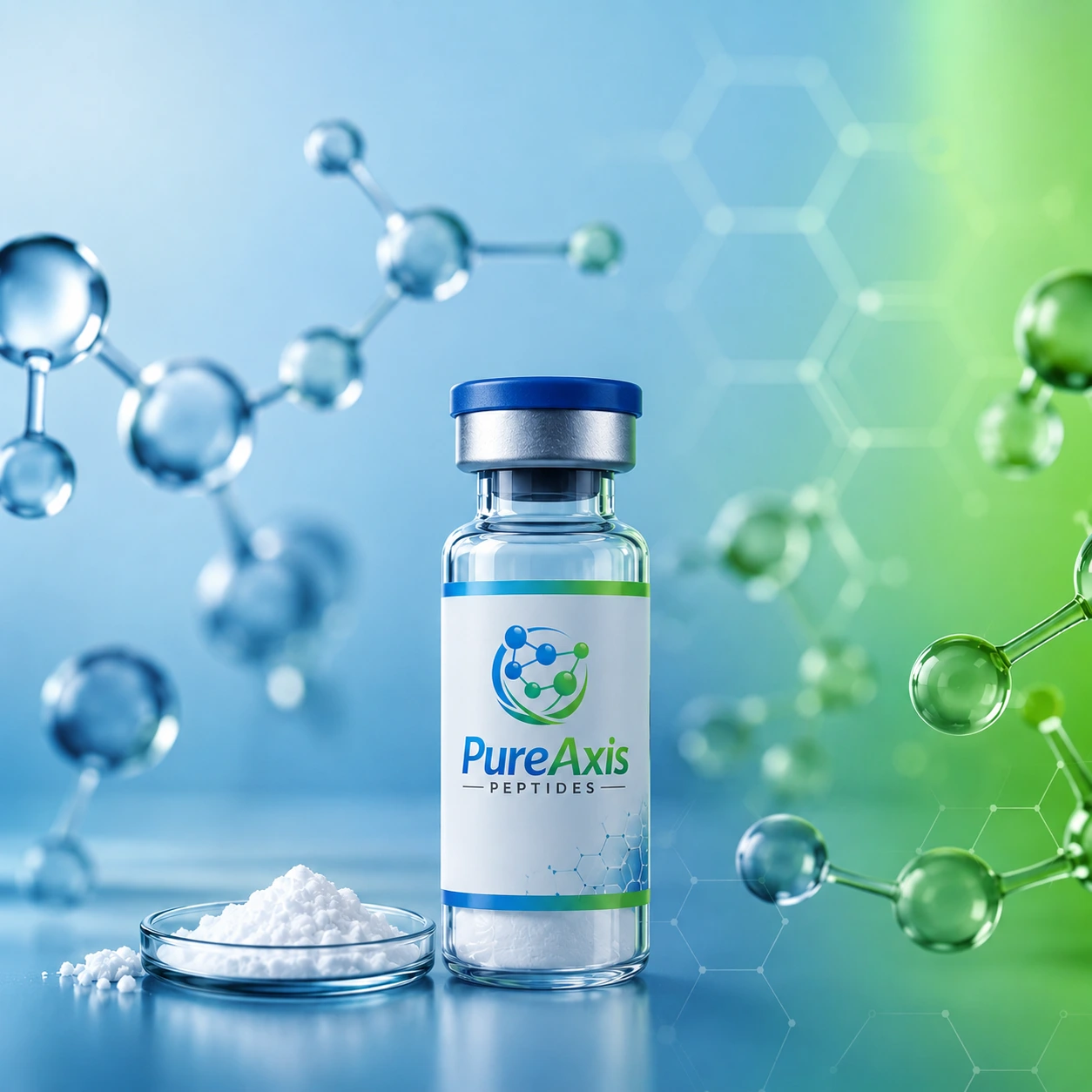


Quick Specifications
| Purity (%) | 98.9 |
|---|
GHK-Cu — SEO Product Content
SEO Title
GHK-Cu Peptide | Copper Peptide for Skin & Tissue Research
SEO Meta Description
GHK-Cu copper peptide for research into collagen synthesis, skin regeneration, extracellular matrix remodeling, wound healing and tissue biology.
Suggested URL Slug
/product/ghk-cu/
SEO Product Description
GHK-Cu Copper Peptide Research Material
GHK-Cu, also known as copper tripeptide or glycyl-L-histidyl-L-lysine copper complex, is a copper-binding peptide extensively studied in skin biology, extracellular-matrix research, wound repair and tissue remodeling.
The underlying peptide, GHK (glycyl-L-histidyl-L-lysine), is a naturally occurring tripeptide with a strong affinity for copper(II) ions. GHK-Cu has been investigated for its effects on collagen synthesis, fibroblast activity, glycosaminoglycans, extracellular-matrix organization and tissue repair.
Pure Axis Peptides offers GHK-Cu as research material for qualified laboratory and scientific investigations.
What Is GHK-Cu?
GHK-Cu is a complex formed between the tripeptide glycyl-L-histidyl-L-lysine (GHK) and Cu²⁺.
GHK was originally identified in human plasma and has subsequently been investigated in numerous experimental models of tissue repair and regeneration. Research suggests that the peptide’s copper-binding properties are central to many of its biological activities.
GHK-Cu research has focused on:
- Collagen synthesis
- Fibroblast biology
- Extracellular-matrix remodeling
- Wound healing
- Skin regeneration
- Glycosaminoglycan synthesis
- Dermal tissue biology
- Inflammatory signaling
- Cellular repair
- Tissue remodeling
GHK-Cu and Collagen
One of the best-established areas of GHK-Cu research is collagen biology.
Collagen is a major structural protein within connective tissue and provides mechanical strength and organization to skin and other tissues.
An early experimental study demonstrated that GHK-Cu stimulated collagen synthesis in cultured fibroblasts, providing important evidence for its activity in extracellular-matrix research.
This makes GHK-Cu particularly relevant to research involving:
- Type I collagen
- Type III collagen
- Fibroblast activity
- Collagen biosynthesis
- Extracellular-matrix formation
- Dermal remodeling
GHK-Cu and Fibroblast Research
Fibroblasts are connective-tissue cells responsible for producing and organizing components of the extracellular matrix.
GHK-Cu has been investigated for its effects on fibroblast function and collagen production.
Experimental wound models have demonstrated increases in collagen, total protein, DNA and glycosaminoglycan accumulation following GHK-Cu exposure.
This creates a strong research pathway:
GHK-Cu → fibroblast signaling → extracellular matrix → collagen remodeling
GHK-Cu and Extracellular Matrix Research
The extracellular matrix (ECM) is the structural network surrounding cells.
It includes:
- Collagen
- Elastin
- Glycosaminoglycans
- Proteoglycans
- Structural signaling molecules
GHK-Cu has been investigated for its ability to influence multiple components of this network.
Research has reported effects involving collagen, dermatan sulfate, chondroitin sulfate and decorin, demonstrating that GHK-Cu research extends beyond collagen alone.
GHK-Cu and Skin Regeneration
GHK-Cu has become particularly prominent in skin biology research.
Experimental literature has investigated its effects on:
- Dermal fibroblasts
- Collagen production
- Extracellular-matrix remodeling
- Skin repair
- Tissue regeneration
- Cellular signaling
A review of GHK research describes activity involving collagen, glycosaminoglycans, proteoglycans and fibroblast function, as well as experimental evidence across multiple tissue-repair models.
GHK-Cu and Wound-Healing Research
Wound healing is a complex biological process involving inflammation, cellular migration, extracellular-matrix deposition and tissue remodeling.
GHK-Cu has been studied across several stages of this process.
In an experimental rat wound model, GHK-Cu produced concentration-dependent increases in:
- Dry tissue mass
- DNA
- Total protein
- Collagen
- Glycosaminoglycans
The study also reported increased type I and type III collagen mRNA.
These findings make GHK-Cu relevant to wound-healing and tissue-repair research.
GHK-Cu and Type I Collagen
Type I collagen is the predominant structural collagen in many connective tissues.
Research using cultured fibroblasts has demonstrated stimulation of collagen synthesis by GHK-Cu.
In experimental wound models, GHK-Cu has also been associated with increased type I collagen mRNA.
Potential research endpoints include:
- Type I collagen expression
- Collagen deposition
- Fibroblast activity
- Extracellular-matrix accumulation
- Tissue remodeling
GHK-Cu and Type III Collagen
Type III collagen is another important extracellular-matrix component, particularly during tissue repair and remodeling.
Experimental wound research has reported increased type III collagen mRNA following GHK-Cu exposure.
This makes GHK-Cu useful for studies examining coordinated regulation of multiple collagen types.
GHK-Cu and Glycosaminoglycans
GHK-Cu research extends beyond collagen to glycosaminoglycans (GAGs).
GAGs are important components of the extracellular matrix and contribute to tissue hydration, organization and signaling.
Experimental work has reported increased glycosaminoglycan accumulation in GHK-Cu-treated wound models.
Research can therefore investigate:
- GAG synthesis
- Dermatan sulfate
- Chondroitin sulfate
- Proteoglycan biology
- Extracellular-matrix organization
GHK-Cu and Decorin
Decorin is a small proteoglycan involved in extracellular-matrix organization and collagen regulation.
Reviews of GHK biology have reported stimulation of decorin and other extracellular-matrix components.
This provides another mechanism through which GHK-Cu can be investigated in connective-tissue research.
GHK-Cu and Dermatan Sulfate
Dermatan sulfate is a sulfated glycosaminoglycan associated with extracellular-matrix organization.
Experimental wound research reported an increase in the relative amount of dermatan sulfate following GHK-Cu treatment.
This makes dermatan sulfate another useful research endpoint when studying GHK-Cu-mediated matrix remodeling.
GHK-Cu and Tissue Remodeling
Tissue regeneration is not simply a process of continuously producing new matrix.
Normal tissue repair requires a coordinated sequence involving:
Inflammation → cellular recruitment → matrix deposition → matrix remodeling → tissue organization
GHK-Cu has been investigated across several of these processes.
Research has described effects on collagen synthesis and breakdown, glycosaminoglycan production and matrix metalloproteinase/inhibitor activity.
This makes tissue remodeling research a particularly appropriate description of GHK-Cu biology.
GHK-Cu and Matrix Metalloproteinases
Matrix metalloproteinases (MMPs) are enzymes involved in extracellular-matrix turnover.
MMP activity is essential for normal tissue remodeling but must be carefully regulated.
Research reviews have described GHK as a modulator of metalloproteinases and their endogenous inhibitors.
This suggests that GHK-Cu research should not be reduced to simply “increasing collagen.” Its experimental biology involves the broader balance between matrix synthesis and matrix remodeling.
GHK-Cu and Fibroblast Activity
Fibroblasts are central to connective-tissue repair.
GHK-Cu has been investigated for its ability to alter fibroblast activity, collagen expression and extracellular-matrix production.
Experimental studies have observed effects on fibroblast cultures and connective-tissue accumulation in animal wound models.
Potential research endpoints include:
- Fibroblast proliferation
- Collagen expression
- Matrix deposition
- Proteoglycan production
- Cellular signaling
- Tissue organization
GHK-Cu and Inflammatory Research
Inflammation is an essential component of wound healing but excessive or prolonged inflammation can interfere with normal tissue repair.
GHK-Cu has been investigated for potential anti-inflammatory and cell-protective effects in experimental models. A review describes GHK-Cu as influencing inflammatory pathways alongside tissue-remodeling mechanisms.
Research applications may include:
- Inflammatory signaling
- Cytokine biology
- Oxidative stress
- Cellular stress responses
- Tissue-repair signaling
GHK-Cu and Oxidative Stress Research
Oxidative stress can influence cellular viability and tissue repair.
Experimental literature has described antioxidant and cell-protective properties associated with GHK/GHK-Cu.
This creates opportunities for studies involving:
- Reactive oxygen species
- Oxidative stress
- Cellular protection
- Redox signaling
- Tissue injury
These findings remain primarily experimental and should not be presented as evidence of a clinically established antioxidant therapy.
GHK-Cu and Angiogenesis Research
New blood-vessel formation is an important part of tissue regeneration.
Experimental literature has investigated GHK-related effects on endothelial and vascular processes, including the recruitment and growth of endothelial cells.
This makes GHK-Cu relevant to research involving:
- Endothelial-cell biology
- Angiogenesis
- Vascular remodeling
- Wound repair
- Tissue regeneration
GHK-Cu and Hair-Follicle Research
Hair follicles are specialized mini-organs involving epithelial cells, dermal fibroblasts and complex signaling networks.
GHK-Cu has generated research interest in hair and follicular biology because of its reported effects on cellular signaling, tissue remodeling and skin biology.
Potential experimental areas include:
- Hair-follicle biology
- Dermal papilla research
- Follicular signaling
- Skin regeneration
- Extracellular-matrix biology
Claims of human hair regrowth should nevertheless be distinguished from experimental evidence.
GHK-Cu and Skin Aging Research
GHK levels naturally decline with age, and this observation has contributed to research into its potential role in age-associated tissue changes.
Experimental studies have investigated GHK-Cu in relation to:
- Collagen production
- Skin elasticity
- Extracellular-matrix remodeling
- Fibroblast function
- Photodamage
- Tissue regeneration
A review of the literature identifies GHK-Cu as a candidate for further investigation in skin aging and tissue-repair research.
GHK-Cu and Cosmetic Research
GHK-Cu has also been studied in cosmetic formulations.
Research reviews have described experimental and cosmetic observations involving:
- Skin firmness
- Elasticity
- Fine lines
- Photodamage
- Skin density
- Hyperpigmentation
These findings make GHK-Cu particularly relevant to cosmetic science and dermatological research, although results from topical cosmetic formulations should not automatically be extrapolated to other routes of administration.
GHK-Cu and Copper Biology
The defining biochemical characteristic of GHK is its strong affinity for Cu²⁺.
Copper is an essential trace element involved in numerous biological processes, including enzymes associated with connective-tissue formation and oxidative metabolism.
GHK’s ability to bind copper creates the GHK-Cu complex that has been extensively investigated in tissue biology.
This makes the peptide relevant to research into:
- Copper binding
- Metal-peptide interactions
- Copper-dependent enzymes
- Connective-tissue biology
- Peptide-metal complexes
GHK-Cu vs. GHK
GHK and GHK-Cu should not be treated as identical terms.
GHK
- Glycyl-L-histidyl-L-lysine
- Three-amino-acid peptide
- Naturally occurring
- Strong affinity for copper
GHK-Cu
- GHK complexed with Cu²⁺
- Commonly referred to as copper tripeptide
- Extensively investigated in tissue-remodeling research
The presence of copper is an important part of the molecular identity and biological research surrounding GHK-Cu.
GHK-Cu vs. GHK-Cu Acetate
Product naming should reflect the actual material supplied.
If a product is specifically supplied as GHK-Cu, it should not automatically be described as GHK-Cu acetate unless the formulation and chemical identity confirm that designation.
This distinction is especially important for:
- Product specifications
- Certificates of analysis
- Molecular characterization
- SEO product naming
- Research reproducibility
GHK-Cu and BPC-157 Research
GHK-Cu and BPC-157 are frequently grouped within tissue-repair discussions, but they are structurally and biologically distinct.
GHK-Cu
- Copper-binding tripeptide
- Strong research focus on collagen and extracellular matrix
- Skin and connective-tissue research
- Wound-repair research
BPC-157
- Distinct synthetic peptide
- Investigated primarily in experimental tissue-repair and gastrointestinal models
Explore BPC-157 if available in the Pure Axis catalog.
GHK-Cu and TB-500 Research
GHK-Cu and TB-500 are also distinct experimental peptides.
GHK-Cu research emphasizes:
- Collagen
- Fibroblasts
- Extracellular matrix
- Skin regeneration
- Copper-dependent biology
TB-500 research is associated with thymosin-beta-4-derived biology, cellular migration and tissue-repair pathways.
Explore TB-500 if available in the Pure Axis catalog.
GHK-Cu in Combination Research
GHK-Cu is frequently investigated alongside other tissue-repair peptides in experimental settings.
For Pure Axis’s catalog architecture, it can be grouped conceptually with:
- BPC-157
- TB-500
- KPV
- Related regenerative peptides
Your Glow Blend and Klow Blend products provide particularly relevant internal-linking opportunities where GHK-Cu is one component of a broader research formulation.
Explore Glow Blend and Klow Blend if those products are currently published at those URLs.
GHK-Cu Research Applications
GHK-Cu may be relevant to laboratory studies involving:
Collagen Research: Investigating collagen synthesis and extracellular-matrix deposition.
Fibroblast Research: Studying connective-tissue cell activity.
Wound-Healing Research: Investigating tissue-repair processes.
Skin Biology: Studying dermal remodeling and regeneration.
Extracellular-Matrix Research: Investigating collagen, glycosaminoglycans and proteoglycans.
Tissue Remodeling: Studying matrix synthesis and degradation.
Copper-Peptide Research: Investigating peptide-metal interactions.
Inflammation Research: Studying inflammatory signaling in tissue repair.
Oxidative-Stress Research: Investigating cellular stress pathways.
Angiogenesis Research: Studying endothelial and vascular responses.
Hair-Follicle Research: Investigating follicular and dermal biology.
Cosmetic Science: Studying skin elasticity, firmness and matrix biology.
Regenerative Biology: Investigating cellular and extracellular mechanisms of tissue repair.
GHK-Cu Research Material
Researchers should verify the current Pure Axis Peptides product specification, chemical identity, copper content, purity, formulation, storage requirements and batch-specific certificate of analysis (COA) before laboratory use.
For research reproducibility, the exact form of the material should be documented, including whether the product is supplied as a defined GHK-Cu complex or another formulation.
Explore Related Research
GHK-Cu fits naturally into a broader skin, regenerative and extracellular-matrix research cluster.
Explore BPC-157 for related experimental tissue-repair research.
Explore TB-500 for thymosin-beta-4-derived tissue-research pathways.
Explore KPV for related inflammatory and tissue-biology research.
Explore the Glow Blend for a formulation containing GHK-Cu alongside TB-500 and BPC-157.
Explore the Klow Blend for a formulation containing GHK-Cu, TB-500, BPC-157 and KPV.
Browse the Peptides collection for additional research materials.
Visit Shop All Products for the complete Pure Axis Peptides catalog.
Research Use Only
GHK-Cu supplied by Pure Axis Peptides is intended strictly for laboratory and scientific research. It is not intended for human consumption, self-administration, diagnosis, treatment, cure, or prevention of any disease or medical condition. Experimental studies have investigated GHK-Cu in relation to collagen synthesis, wound repair, extracellular-matrix remodeling, skin biology and tissue regeneration, but these findings should not be interpreted as establishing research-grade GHK-Cu as an approved therapeutic product. Researchers should evaluate all materials according to their experimental requirements, product documentation and applicable laboratory procedures.
Internal Linking Recommendations
Primary Internal Links
- BPC-157 →
https://pureaxispeptides.com/product/bpc-157/ - TB-500 →
https://pureaxispeptides.com/product/tb-500/ - KPV →
https://pureaxispeptides.com/product/kpv/ - Glow Blend → verify current live product URL
- Klow Blend → verify current live product URL
- Peptides →
https://pureaxispeptides.com/product-category/peptides/ - Shop All Products →
https://pureaxispeptides.com/shop/
Verify the exact live WooCommerce URLs before publishing.
Recommended Internal-Link Anchors
Use varied contextual anchors such as:
- “GHK-Cu research peptide”
- “GHK-Cu copper peptide”
- “copper tripeptide research”
- “GHK-Cu research”
- “collagen research peptide”
- “skin regeneration research”
- “extracellular-matrix research”
- “wound-healing research”
- “fibroblast research”
- “tissue-remodeling research”
- “copper peptide research”
- “regenerative peptide research”
Recommended Site Architecture
Build a dedicated skin and regenerative peptide cluster:
GHK-Cu
→ Copper peptide
→ Collagen
→ Fibroblasts
→ Extracellular matrix
→ Glycosaminoglycans
→ Wound healing
→ Skin regeneration
→ Tissue remodeling
→ BPC-157
→ TB-500
→ KPV
→ Glow Blend
→ Klow Blend
A strong supporting article would be:
“GHK-Cu vs BPC-157 vs TB-500: Understanding Experimental Tissue-Repair Peptides”
Another strong article:
“GHK-Cu and Collagen: Understanding Copper Peptide Research in Skin Biology”
This gives the product page a strong topical relationship with your regenerative-peptide catalog while allowing each individual product to rank for its own scientific keywords.
External Scientific References
- PubMed — GHK-Cu and collagen synthesis in fibroblasts:
Stimulation of Collagen Synthesis by GHK-Cu - PubMed — GHK-Cu and connective-tissue accumulation in experimental wounds:
GHK-Cu and Connective Tissue Accumulation - PubMed — GHK and skin regeneration pathways:
GHK Peptide as a Natural Modulator of Multiple Cellular Pathways in Skin Regeneration - PubMed — GHK-Cu and anti-aging research:
The Potential of GHK as an Anti-Aging Peptide - PubMed — GHK-Cu, wound healing and fibroblasts:
Effect of Tripeptide-Copper Complexes on Skin Wound Healing
Product Tags
GHK-Cu, GHK Cu, GHK-Copper, Copper Peptide, Copper Tripeptide, GHK Copper Peptide, Glycyl Histidyl Lysine Copper, Gly-His-Lys-Cu, GHK-Cu Peptide, GHK Peptide, GHK Research, GHK-Cu Research, Copper Peptide Research, Skin Peptide, Skin Research Peptide, Collagen Research, Collagen Peptide, Collagen Synthesis, Fibroblast Research, Extracellular Matrix Research, ECM Research, Wound Healing Research, Wound Repair Research, Skin Regeneration, Tissue Regeneration, Tissue Remodeling, Connective Tissue Research, Glycosaminoglycan Research, Proteoglycan Research, Dermatan Sulfate, Chondroitin Sulfate, Type I Collagen, Type III Collagen, Fibroblast Biology, Skin Biology, Cosmetic Research, Dermatology Research, Copper Biology, Copper Binding Peptide, Angiogenesis Research, Hair Follicle Research, Neurotrophic Research, Inflammation Research, Oxidative Stress Research, Regenerative Peptide, Research Peptide, Laboratory Research
| Purity (%) | 98.9 |
|---|---|
| Lab Tested | yes |
| Research Grade | yes |
| Third Party Tested | yes |
| Strength | 100mg, 50mg |
|---|---|
| Volume | 10 vials |
Be the first to review “GHK-CU”
Need Assistance?
Our research specialists are here to help with product selection and technical questions.
Related products

Blends
BlendsBPC-157 5mg + TB-500 5mg Blend
$110.00Dual peptide healing blend for synergistic tissue repair research

Antimicrobial & Immunology
Antimicrobial & Immunology $68.00Thymic peptide bioregulator for immune system research
Blends
BlendsBPC-157 10mg + TB-500 10mg Blend
$214.00High-dose dual peptide healing blend for advanced research
Healing Peptides
Healing Peptides Price range: $49.00 through $176.00Synthetic Thymosin Beta-4 for regeneration and healing research
Antimicrobial & Immunology
Antimicrobial & Immunology $98.00Human cathelicidin antimicrobial peptide for immunology research

Antimicrobial & Immunology
Antimicrobial & Immunology $190.00VIP (Vasoactive Intestinal Peptide) research peptide for laboratory studies of neuropeptide signaling,...


 GHK-CU
Price range: $33.00 through $65.00
GHK-CU
Price range: $33.00 through $65.00
Reviews
There are no reviews yet.