

Quick Specifications
| Purity (%) | 98.9 |
|---|
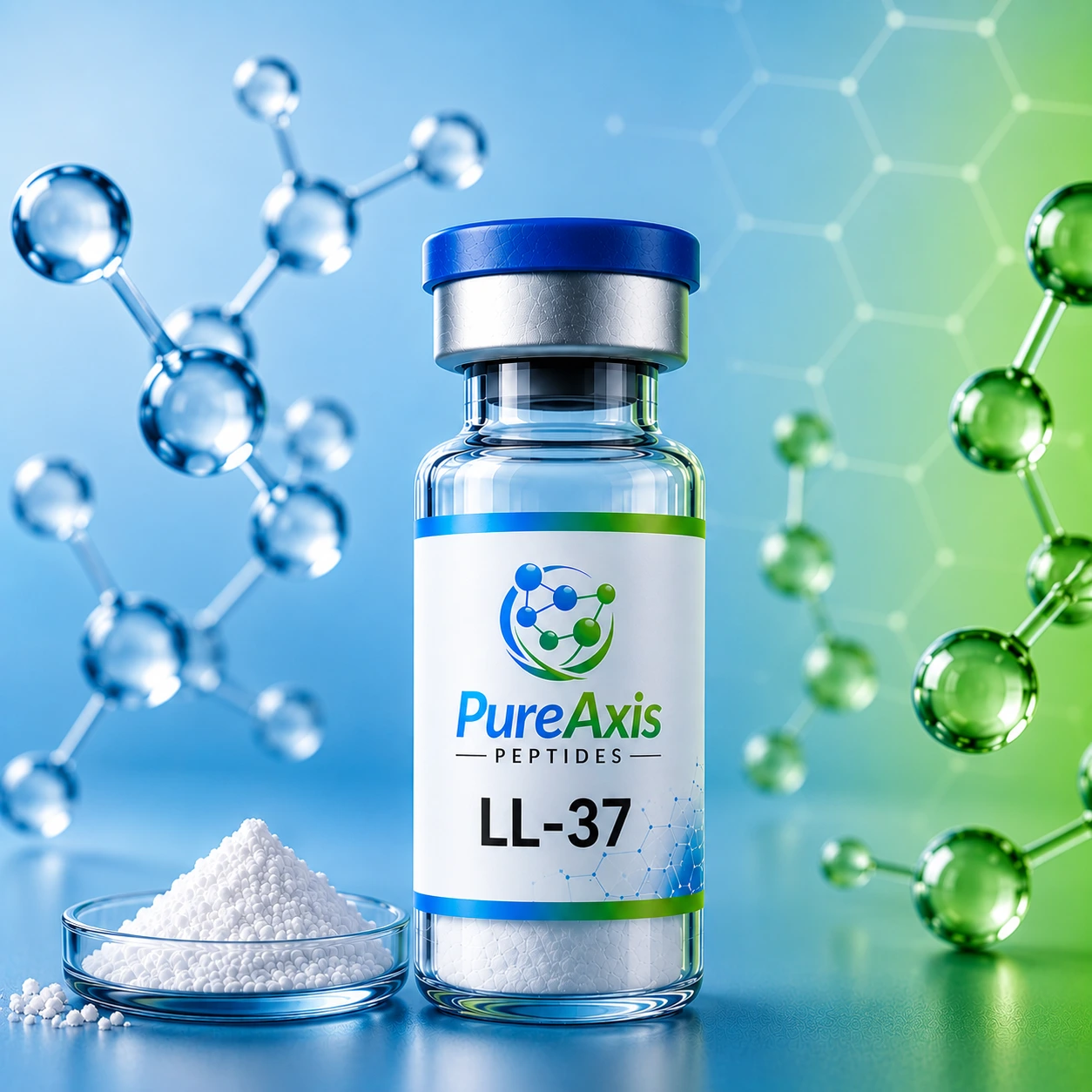
LL-37 Peptide — Human Cathelicidin Research Peptide
LL-37 is a naturally occurring 37-amino-acid antimicrobial peptide and the only member of the cathelicidin family identified in humans. It is produced from the precursor protein human cathelicidin antimicrobial protein 18 (hCAP18) and has been extensively studied for its roles in innate immunity, antimicrobial defense, immune signaling and tissue biology.
Pure Axis Peptides offers LL-37 as a research-use peptide for qualified laboratory investigations involving antimicrobial peptide biology, innate immunity, immunomodulation, epithelial biology and wound-related research.
What Is LL-37?
LL-37 is the C-terminal active peptide generated from the human hCAP18 precursor. It belongs to the cathelicidin family of host-defense peptides and is expressed in tissues and immune cells involved in barrier defense and innate immune responses.
The peptide has an amphipathic, helical structure that contributes to its interactions with biological membranes. Researchers have investigated how LL-37 interacts with microbial membranes as well as host-cell signaling pathways.
LL-37 Antimicrobial Research
One of the major areas of LL-37 research is its broad antimicrobial activity. Laboratory studies have examined LL-37 against a variety of microorganisms, including bacteria and fungi, while more recent research has also investigated activity against viral pathogens.
LL-37 is therefore an important experimental molecule for researchers studying:
- Antimicrobial peptide mechanisms
- Bacterial membrane interactions
- Microbial defense
- Biofilm research
- Host-pathogen interactions
- Innate immune defense
- Antimicrobial peptide structure and function
Research into LL-37 derivatives has also focused on modifying its sequence and structure to investigate antimicrobial activity, stability, toxicity and membrane interactions.
LL-37 and Immune Modulation
LL-37 is studied not only for direct antimicrobial activity but also for its immunomodulatory properties. Research has examined its ability to influence chemokine and cytokine signaling, immune-cell recruitment and other components of the innate immune response.
This makes LL-37 particularly relevant to research programs investigating the relationship between antimicrobial peptides and immune signaling.
LL-37 and Wound Biology
LL-37 has also been investigated in experimental wound-healing and epithelial models. Research has associated the peptide with processes including keratinocyte migration, re-epithelialization, angiogenesis and immune-cell recruitment.
These findings make LL-37 an interesting research tool for studying the interaction between antimicrobial defense, inflammation and tissue repair.
Importantly, these findings come from experimental and preclinical research. They should not be interpreted as evidence that commercially supplied LL-37 is an approved treatment for wounds, infections or other medical conditions.
LL-37 Research Applications
LL-37 may be relevant to laboratory studies involving:
Antimicrobial Peptide Research: Investigating peptide-membrane interactions and antimicrobial mechanisms.
Immunology: Studying innate immune signaling, chemotaxis and immune-cell responses.
Microbiology: Examining host-pathogen interactions, microbial susceptibility and biofilm biology.
Wound Biology: Investigating epithelial migration, re-epithelialization and tissue-response pathways.
Angiogenesis Research: Exploring interactions between antimicrobial peptides and vascular signaling.
Peptide Structure Research: Studying how peptide sequence, charge and amphipathic structure influence biological activity.
LL-37 and Host Defense
As a naturally occurring human host-defense peptide, LL-37 provides researchers with a useful model for investigating how endogenous peptides contribute to protection at epithelial barriers.
LL-37 has been identified in association with tissues including the skin, gastrointestinal tract and respiratory tract, as well as immune-cell populations such as neutrophils and monocytes.
This broad distribution helps explain why LL-37 remains an active subject of research across microbiology, immunology, dermatology, epithelial biology and peptide science.
Explore Related Research Peptides
Researchers interested in LL-37 can explore the Antimicrobial & Immunology Peptides collection for related research compounds.
For additional compounds involving tissue and cellular research, explore the Healing Peptides collection.
Researchers can also browse the broader Peptides collection or Research Chemicals collection.
Visit Shop All Products to explore the complete Pure Axis Peptides research catalog.
Research Use Only
LL-37 supplied by Pure Axis Peptides is intended strictly for laboratory and scientific research. It is not intended for human consumption, self-administration, diagnosis, treatment, cure, or prevention of any disease or medical condition. Experimental findings should not be interpreted as established clinical efficacy or safety. Researchers should evaluate all materials according to their experimental requirements, product documentation and applicable laboratory procedures.
Internal Linking Recommendations
Primary Internal Links
- Antimicrobial & Immunology Peptides →
https://pureaxispeptides.com/product-category/peptides/antimicrobial-immunology/ - Healing Peptides →
https://pureaxispeptides.com/product-category/peptides/healing-peptides/ - Peptides →
https://pureaxispeptides.com/product-category/peptides/ - Research Chemicals →
https://pureaxispeptides.com/product-category/research-chemicals/ - Shop All Products →
https://pureaxispeptides.com/shop/
Internal Linking Strategy
The strongest contextual links should be Antimicrobial & Immunology Peptides, Healing Peptides, and Peptides. These connect LL-37 to its most relevant topical clusters and can help build a stronger internal semantic relationship between antimicrobial, immunology and tissue-research products.
External Scientific References
- PubMed — LL-37, the human cathelicidin:
PubMed: LL-37, the only human member of the cathelicidin family - PubMed — Comprehensive LL-37 review:
PubMed: A comprehensive summary of LL-37 - PubMed — Recent LL-37 antimicrobial research:
PubMed: Decoding LL-37 structure and antimicrobial mechanisms - PMC — Antimicrobial peptides and wound healing:
PMC: Antimicrobial peptides in wound healing - PubMed — LL-37 and antimicrobial peptide modifications:
PubMed: Cathelicidin antimicrobial peptides and LL-37 modifications
Product Tags
LL-37, LL37, LL-37 Peptide, LL37 Peptide, LL-37 Research Peptide, Human Cathelicidin, Cathelicidin, Cathelicidin Peptide, Antimicrobial Peptide, Antimicrobial Research, Antimicrobial Peptide Research, Innate Immunity, Immunology Research, Immune Modulation, Host Defense Peptide, Host Defense Research, Wound Biology, Wound Healing Research, Epithelial Research, Angiogenesis Research, Biofilm Research, Peptide Research, Laboratory Research
| Purity (%) | 98.9 |
|---|---|
| Lab Tested | yes |
| Research Grade | yes |
| Third Party Tested | yes |
Be the first to review “LL-37”
Need Assistance?
Our research specialists are here to help with product selection and technical questions.
Related products

Antimicrobial & Immunology
Antimicrobial & Immunology $68.00Thymic peptide bioregulator for immune system research

Antimicrobial & Immunology
Antimicrobial & Immunology Price range: $33.00 through $65.00Copper peptide for skin regeneration and wound healing research


 LL-37
$98.00
LL-37
$98.00
Reviews
There are no reviews yet.