
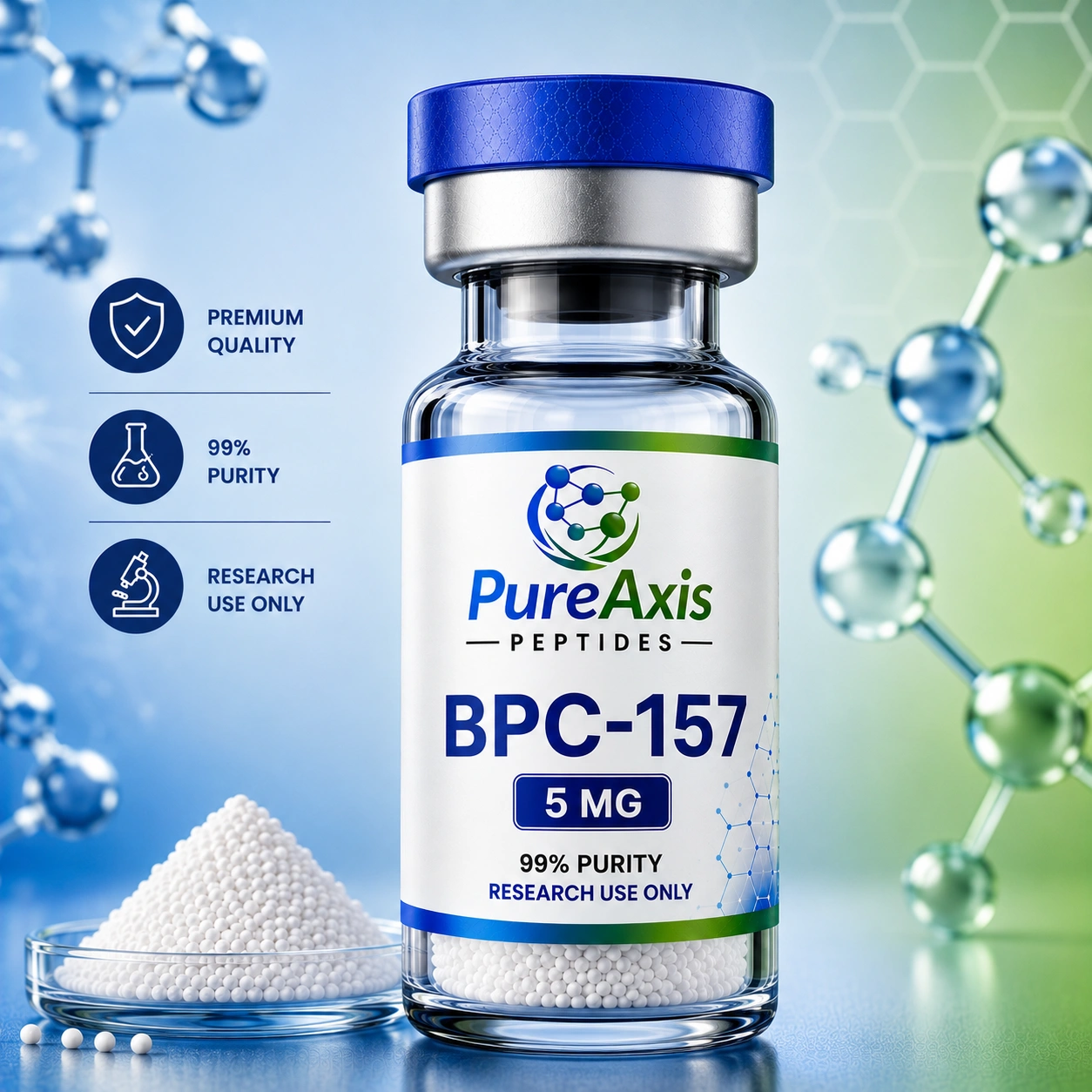


Quick Specifications
| Purity (%) | 98.9 |
|---|
BPC-157 — SEO Product Content
SEO Title
BPC-157 Peptide | Tissue Repair & Regenerative Research
SEO Meta Description
BPC-157 research peptide for laboratory studies of tissue repair, angiogenesis, collagen, fibroblasts, vascular signaling and regenerative biology.
Suggested URL Slug
/product/bpc-157/
BPC-157 Peptide
BPC-157 Research Peptide
BPC-157 is a synthetic 15-amino-acid peptide that has attracted extensive interest in preclinical research involving tissue repair, angiogenesis, vascular biology, collagen formation, cellular migration and regenerative processes.
Also known as Body Protection Compound-157, BPC-157 has been investigated in animal and laboratory models involving soft tissue, tendon, ligament, muscle, gastrointestinal and vascular biology.
Research has particularly focused on the peptide’s relationship with:
- Angiogenesis
- VEGF/VEGFR2 signaling
- Nitric oxide pathways
- Endothelial-cell function
- Fibroblast activity
- Collagen formation
- Tissue remodeling
- Cellular migration
- Wound-healing processes
- Connective-tissue biology
Pure Axis Peptides offers BPC-157 as research material for qualified laboratory and scientific investigations.
What Is BPC-157?
BPC-157 is commonly described as a synthetic pentadecapeptide, meaning it contains 15 amino acids.
The compound has become a significant subject of experimental research because studies in animals and cellular models have reported biological activity across several systems involved in tissue maintenance and repair.
A 2019 review of BPC-157 and musculoskeletal healing reported consistently positive findings across preclinical models involving tendon, ligament and skeletal-muscle injury, while emphasizing that efficacy had not been confirmed in humans.
More recent reviews continue to describe BPC-157 as an investigational compound with robust preclinical interest but limited human evidence.
BPC-157 and Tissue Repair Research
Tissue repair is a complex biological process involving:
Inflammation → cellular proliferation → angiogenesis → extracellular-matrix formation → remodeling
BPC-157 has been investigated across several of these processes.
Experimental models have examined its relationship with:
- Granulation tissue
- Reepithelialization
- Collagen deposition
- Blood-vessel formation
- Fibroblast activity
- Cellular migration
- Tissue organization
A review of BPC-157 research describes extensive animal-model investigation across soft tissues, including tendons, ligaments and skeletal muscle.
This makes tissue-repair biology one of the strongest research themes for a BPC-157 product page.
BPC-157 and Angiogenesis
Angiogenesis refers to the formation of new blood vessels from existing vascular structures.
Adequate vascularization is important during tissue repair because regenerating tissue requires oxygen, nutrients and appropriate blood supply.
BPC-157 has been studied extensively in experimental angiogenesis models.
Research has investigated relationships between BPC-157 and:
- VEGF
- VEGFR2
- Endothelial cells
- Nitric oxide
- Blood-vessel formation
- Vascular stability
- Tissue perfusion
One experimental study found increased vessel density in cellular and animal angiogenesis models and associated BPC-157 activity with VEGFR2-related signaling.
Other research has examined BPC-157-associated modulation of angiogenesis during experimental muscle and tendon healing.
BPC-157 and VEGFR2 Research
VEGFR2 is a major receptor involved in vascular endothelial growth factor signaling.
VEGF/VEGFR2 signaling plays an important role in endothelial-cell proliferation, migration and blood-vessel formation.
Experimental BPC-157 research has investigated activation and upregulation of VEGFR2-related pathways.
A study using endothelial tube-formation and chick chorioallantoic membrane models reported increased vessel density and investigated VEGFR2-associated mechanisms.
This makes the BPC-157 → VEGFR2 → angiogenesis relationship a useful topic for supporting research content.
BPC-157 and Nitric Oxide Research
Nitric oxide (NO) is an important signaling molecule in vascular biology.
It contributes to:
- Vasodilation
- Endothelial signaling
- Blood-flow regulation
- Vascular homeostasis
- Tissue-repair processes
BPC-157 research has investigated interactions between the peptide and nitric-oxide-related pathways.
Recent reviews have highlighted proposed relationships involving nitric oxide, eNOS and angiogenic signaling, while emphasizing the predominantly preclinical nature of the evidence.
BPC-157 and Endothelial Cells
Endothelial cells form the inner lining of blood vessels and play an important role in angiogenesis.
Experimental research has examined BPC-157 effects on endothelial-cell:
- Migration
- Proliferation
- Tube formation
- Vascular signaling
- Wound-repair responses
One in-vitro study reported increased migration of human umbilical vein endothelial cells and investigated VEGF and ERK1/2 signaling in connection with BPC-157 treatment.
These findings provide a useful experimental framework for studying BPC-157 in vascular and wound-healing models.
BPC-157 and Fibroblast Research
Fibroblasts are connective-tissue cells responsible for producing important components of the extracellular matrix.
During tissue repair, fibroblasts participate in:
- Collagen production
- Matrix deposition
- Wound contraction
- Tissue remodeling
- Structural organization
BPC-157 research has investigated fibroblast-related mechanisms as part of broader tissue-repair processes.
Potential laboratory endpoints include:
- Fibroblast migration
- Fibroblast proliferation
- Collagen expression
- Matrix deposition
- Growth-factor signaling
BPC-157 and Collagen Research
Collagen is one of the primary structural proteins in connective tissue.
Experimental BPC-157 research has investigated collagen formation in wound and soft-tissue models.
Potential research endpoints include:
- Collagen deposition
- Collagen organization
- Fibroblast activity
- Extracellular-matrix formation
- Tissue tensile strength
- Remodeling
Research in animal wound models has reported changes involving collagen formation and tissue repair.
BPC-157 and Cellular Migration
Cell migration is essential to many stages of tissue repair.
Endothelial cells migrate during angiogenesis, while fibroblasts and other cell populations move into damaged tissue during remodeling.
Experimental BPC-157 research has investigated cellular migration in:
- Endothelial cells
- Wound models
- Connective tissue
- Vascular models
An experimental wound-healing study reported increased HUVEC migration and investigated ERK1/2 signaling, VEGF expression and vascular tube formation.
BPC-157 and Wound-Healing Research
Wound healing involves several overlapping phases.
1. Hemostasis
The initial response to tissue injury.
2. Inflammation
Immune and signaling responses begin clearing damaged material.
3. Proliferation
Fibroblasts, endothelial cells and other cells contribute to tissue reconstruction.
4. Angiogenesis
New vascular structures develop to support regenerating tissue.
5. Remodeling
The extracellular matrix becomes reorganized and strengthened.
BPC-157 has been investigated across several of these biological processes in experimental models.
A study involving an alkali-burn wound model reported effects involving granulation tissue, reepithelialization, dermal remodeling and collagen deposition.
BPC-157 and Connective-Tissue Research
Connective tissue depends heavily on:
- Collagen
- Fibroblasts
- Extracellular matrix
- Vascular supply
- Cellular migration
- Mechanical remodeling
BPC-157 has been studied in experimental models involving:
- Tendons
- Ligaments
- Skeletal muscle
- Soft tissue
A review of the literature concluded that BPC-157 had demonstrated promising effects in animal models of tendon, ligament and skeletal-muscle injury, while emphasizing the lack of adequate human confirmation.
BPC-157 and Tendon Research
Tendons contain relatively low vascularity compared with many other tissues, making tendon healing an important area of regenerative research.
Experimental BPC-157 studies have investigated:
- Tendon repair
- Collagen organization
- Angiogenesis
- Fibroblast activity
- Mechanical strength
- Tissue remodeling
These findings are primarily derived from animal models and should not be presented as proof of clinical efficacy in humans.
BPC-157 and Ligament Research
Ligament repair involves coordinated activity between collagen-producing cells, vascular structures and extracellular-matrix components.
BPC-157 has been investigated experimentally in ligament-injury models.
Potential research endpoints include:
- Collagen organization
- Fibroblast activity
- Vascularization
- Tissue strength
- Remodeling
BPC-157 and Skeletal-Muscle Research
Skeletal muscle repair involves satellite cells, inflammatory signaling, vascular responses and extracellular-matrix remodeling.
BPC-157 research has investigated muscle injury models involving both direct trauma and systemic experimental insults.
A review of the available literature identified experimental evidence involving skeletal-muscle healing, while noting that much of the evidence comes from small animal models.
BPC-157 and Gastrointestinal Research
The name BPC-157 originates from research into a stable gastric pentadecapeptide.
Experimental studies have investigated BPC-157 in models involving:
- Gastrointestinal injury
- Gastric lesions
- Ulceration
- Intestinal tissue
- Vascular responses
- Mucosal repair
A review has examined BPC-157 alongside other angiogenic growth factors in gastrointestinal healing and compared mechanisms across gastrointestinal and musculoskeletal tissues.
However, these experimental findings should not be translated into claims that BPC-157 treats gastrointestinal diseases in humans.
BPC-157 and Cytoprotection Research
Cytoprotection refers broadly to mechanisms that help maintain cellular integrity under stress.
BPC-157 has been investigated in experimental models involving cellular stress and tissue injury.
Research has explored proposed relationships with:
- Oxidative stress
- Nitric oxide signaling
- Endothelial function
- Cellular survival
- Tissue integrity
These mechanisms remain areas of scientific investigation rather than established clinical applications.
BPC-157 and ERK1/2 Signaling
The ERK1/2 pathway is part of the mitogen-activated protein kinase signaling network.
ERK1/2 participates in cellular processes involving:
- Growth
- Migration
- Proliferation
- Differentiation
- Tissue remodeling
Experimental BPC-157 research has investigated ERK1/2 signaling in relation to endothelial-cell migration, VEGF expression and wound healing.
BPC-157 and VEGF Research
Vascular endothelial growth factor (VEGF) is one of the central signaling molecules involved in angiogenesis.
BPC-157 research has investigated relationships between the peptide and VEGF-related pathways.
Potential research endpoints include:
- VEGF expression
- VEGFR2 activation
- Endothelial-cell migration
- Tube formation
- Vessel density
- Tissue perfusion
The evidence remains primarily experimental, with studies conducted in cell and animal models.
BPC-157 and Regenerative Biology
Regenerative biology examines how tissues respond to injury and restore structural and functional integrity.
BPC-157 research intersects with several regenerative-biology fields:
Angiogenesis
New blood-vessel formation.
Fibroblast biology
Extracellular-matrix production.
Collagen biology
Structural tissue formation.
Cellular migration
Movement of cells into damaged tissue.
Vascular biology
Endothelial function and blood-vessel remodeling.
Tissue remodeling
Reorganization of newly formed tissue.
This broad biological profile is one reason BPC-157 has become a widely investigated experimental peptide.
BPC-157 vs. TB-500
BPC-157 and TB-500 are frequently discussed together, but they are distinct research compounds.
BPC-157
Research emphasis includes:
- Angiogenesis
- VEGF/VEGFR2
- Nitric oxide signaling
- Collagen
- Fibroblast activity
- Tissue repair
TB-500
Research surrounding the thymosin-beta-4 pathway emphasizes:
- Actin dynamics
- Cellular migration
- Angiogenesis
- Tissue remodeling
Explore TB-500 for related research.
BPC-157 vs. GHK-Cu
BPC-157 and GHK-Cu are also frequently grouped within regenerative-research discussions.
BPC-157
Research is strongly associated with:
angiogenesis + vascular signaling + tissue repair
GHK-Cu
Research focuses more heavily on:
copper-peptide biology + collagen + extracellular matrix + skin-related pathways
Explore GHK-Cu for copper-peptide research.
BPC-157 vs. BPC-157 + TB-500
BPC-157 alone provides a single-compound experimental model.
A BPC-157 + TB-500 formulation introduces a second peptide associated with different research pathways.
This distinction is useful when designing controlled experiments because researchers can compare:
- Control
- BPC-157
- TB-500
- Combination
Such a design can help determine whether observed effects are associated with one component or the combined formulation.
Explore BPC-157 + TB-500 5mg + 5mg Blend and BPC-157 + TB-500 10mg + 10mg Blend for related Pure Axis research formulations.
BPC-157 Research Applications
BPC-157 may be relevant to laboratory investigations involving:
Tissue Repair Research: Studying biological responses to tissue injury.
Angiogenesis Research: Investigating blood-vessel formation.
Vascular Research: Studying endothelial and vascular signaling.
VEGF Research: Examining VEGF-associated pathways.
VEGFR2 Research: Investigating receptor-mediated angiogenic signaling.
Fibroblast Research: Studying connective-tissue cell activity.
Collagen Research: Investigating extracellular-matrix formation.
Cell Migration Research: Examining movement of endothelial and connective-tissue cells.
Wound-Healing Research: Studying experimental wound-repair mechanisms.
Tendon Research: Investigating tendon-healing models.
Ligament Research: Studying ligament-repair biology.
Skeletal-Muscle Research: Investigating muscle injury and remodeling.
Gastrointestinal Research: Studying experimental gastrointestinal tissue responses.
Cytoprotection Research: Investigating cellular responses to stress.
Regenerative Biology: Examining mechanisms involved in tissue restoration.
Peptide Pharmacology: Characterizing biological activity and signaling pathways.
BPC-157 Research Material
Researchers should verify the current product documentation for:
- Exact chemical identity
- Free-base or acetate designation
- Purity
- Quantity
- Formulation
- Batch number
- Storage conditions
- Certificate of analysis
This distinction is particularly important because FDA’s current evaluation specifically distinguishes BPC-157 free base and BPC-157 acetate as different active pharmaceutical ingredients.
BPC-157 and Human Research
The distinction between preclinical evidence and human evidence is critical.
A 2025 review reported that only a small number of pilot human studies had examined BPC-157, while the overwhelming majority of the literature remains preclinical. The authors emphasized the need for larger, well-designed human trials.
Accordingly, laboratory findings involving animals or cultured cells should not be presented as proof that BPC-157 is effective for treating injuries or diseases in humans.
BPC-157 Regulatory Considerations
BPC-157 is an investigational compound and should not be represented as an FDA-approved treatment.
The FDA has recently evaluated BPC-157-related bulk drug substances and has identified limited safety information, potential immunogenicity concerns and complexities involving peptide impurities and API characterization.
In July 2026, the FDA’s Pharmacy Compounding Advisory Committee considered BPC-157 free base and BPC-157 acetate among substances being evaluated for potential inclusion on the 503A Bulks List.
This ongoing regulatory evaluation reinforces the importance of accurately presenting BPC-157 as research material rather than an approved therapeutic product.
Explore Related Research
BPC-157 is a central product within Pure Axis Peptides’ regenerative-research cluster.
Explore TB-500 for related tissue-remodeling and cellular-migration research.
Explore GHK-Cu for copper-peptide and extracellular-matrix research.
Explore the BPC-157 + TB-500 Blend for a two-peptide tissue-repair research formulation.
Explore the Glow Blend for a formulation combining BPC-157, TB-500 and GHK-Cu.
Explore the Klow Blend for a formulation containing BPC-157, TB-500, GHK-Cu and KPV.
Browse the Peptides collection for additional research materials.
Visit Shop All Products for the complete Pure Axis Peptides catalog.
Research Use Only
BPC-157 supplied by Pure Axis Peptides is intended strictly for laboratory and scientific research. It is not intended for human consumption, self-administration, diagnosis, treatment, cure, or prevention of any disease or medical condition. BPC-157 is an investigational research compound and is not represented as an FDA-approved therapeutic product. Available evidence is predominantly preclinical, and limited human data do not establish clinical efficacy or long-term safety. Researchers should evaluate all materials according to their experimental requirements, product documentation, applicable regulations and laboratory procedures.
Internal Linking Recommendations
Primary Internal Links
- TB-500 →
https://pureaxispeptides.com/product/tb-500/ - GHK-Cu →
https://pureaxispeptides.com/product/ghk-cu/ - BPC-157 + TB-500 Blend → verify current live product URL
- Glow Blend → verify current live product URL
- Klow Blend → verify current live product URL
- Peptides →
https://pureaxispeptides.com/product-category/peptides/ - Shop All Products →
https://pureaxispeptides.com/shop/
Verify the exact live WooCommerce URLs before publishing.
Recommended Internal-Link Anchors
Use varied contextual anchors instead of repeating the exact keyword:
- “BPC-157 research peptide”
- “BPC-157 research material”
- “BPC-157 tissue-repair research”
- “BPC-157 angiogenesis research”
- “BPC-157 vascular research”
- “BPC-157 collagen research”
- “BPC-157 fibroblast research”
- “BPC-157 wound-healing research”
- “BPC-157 regenerative research”
- “BPC-157 and TB-500”
- “tissue-repair peptide research”
- “regenerative peptide research”
Recommended Site Architecture
Build BPC-157 into a dedicated tissue-repair and regenerative-biology topical cluster:
BPC-157
→ Angiogenesis
→ VEGF
→ VEGFR2
→ Nitric oxide
→ Fibroblasts
→ Collagen
→ Cell migration
→ Wound healing
→ Tendon research
→ Ligament research
→ TB-500
→ GHK-Cu
→ BPC-157 + TB-500 Blend
→ Glow Blend
→ Klow Blend
Recommended Supporting Articles
“What Is BPC-157? A Research Overview of the 15-Amino-Acid Peptide”
“BPC-157 and Angiogenesis: Understanding VEGF and VEGFR2 Research”
“BPC-157 and Collagen: What Does the Preclinical Research Show?”
“BPC-157 vs TB-500: Comparing Experimental Tissue-Repair Peptides”
“BPC-157 and GHK-Cu: Comparing Two Regenerative Research Pathways”
“BPC-157 Human Research: What Is Actually Known?”
The last article is particularly valuable for E-E-A-T because it allows Pure Axis to capture high-intent informational searches while being transparent about the limitations of the evidence.
External Scientific References
- PubMed — BPC-157 and Musculoskeletal Soft-Tissue Healing
- PubMed — BPC-157 and VEGFR2/Angiogenesis Research
- PubMed — BPC-157 and Endothelial Migration/Wound Healing
- PubMed — BPC-157 and Angiogenesis in Muscle/Tendon Healing
- PubMed — Recent BPC-157 Musculoskeletal Review
- FDA — BPC-157 Compounding Safety Evaluation
- FDA — 2026 BPC-157 Briefing Document
Product Tags
BPC-157, BPC 157, BPC157, BPC-157 Peptide, BPC-157 Research, BPC-157 Research Peptide, BPC-157 Research Material, BPC-157 Peptide Research, Body Protection Compound 157, Body Protective Compound 157, BPC-157 15 Amino Acid Peptide, Pentadecapeptide BPC-157, BPC-157 Tissue Repair, BPC-157 Angiogenesis, BPC-157 VEGF, BPC-157 VEGFR2, BPC-157 Collagen, BPC-157 Fibroblast, BPC-157 Cell Migration, BPC-157 Wound Healing, BPC-157 Regenerative Research, BPC-157 Vascular Research, BPC-157 Tissue Research, BPC-157 Tendon Research, BPC-157 Ligament Research, BPC-157 Muscle Research, BPC-157 Gastrointestinal Research, Angiogenesis Research, VEGF Research, VEGFR2 Research, Collagen Research, Fibroblast Research, Cell Migration Research, Tissue Repair Research, Wound Healing Research, Regenerative Biology, Vascular Biology, Peptide Research, Experimental Peptide, Laboratory Research
| Purity (%) | 98.9 |
|---|---|
| Lab Tested | yes |
| Research Grade | yes |
| Third Party Tested | yes |
| Strength | 10mg, 5mg |
|---|---|
| Volume | 10 vials |
Be the first to review “BPC-157”
Need Assistance?
Our research specialists are here to help with product selection and technical questions.
Related products
Blends
BlendsBPC-157 10mg + TB-500 10mg Blend
$214.00High-dose dual peptide healing blend for advanced research

Blends
BlendsGlow Blend (TB-500 10mg + BPC-157 10mg + GHK-Cu 50mg)
$231.00Triple peptide regeneration blend for healing research

Antimicrobial & Immunology
Antimicrobial & Immunology Price range: $33.00 through $65.00Copper peptide for skin regeneration and wound healing research
Healing Peptides
Healing Peptides Price range: $49.00 through $176.00Synthetic Thymosin Beta-4 for regeneration and healing research

Blends
BlendsBPC-157 5mg + TB-500 5mg Blend
$110.00Dual peptide healing blend for synergistic tissue repair research


 BPC-157
Price range: $41.00 through $68.00
BPC-157
Price range: $41.00 through $68.00
Reviews
There are no reviews yet.