


Quick Specifications
| Purity (%) | 98.9 |
|---|
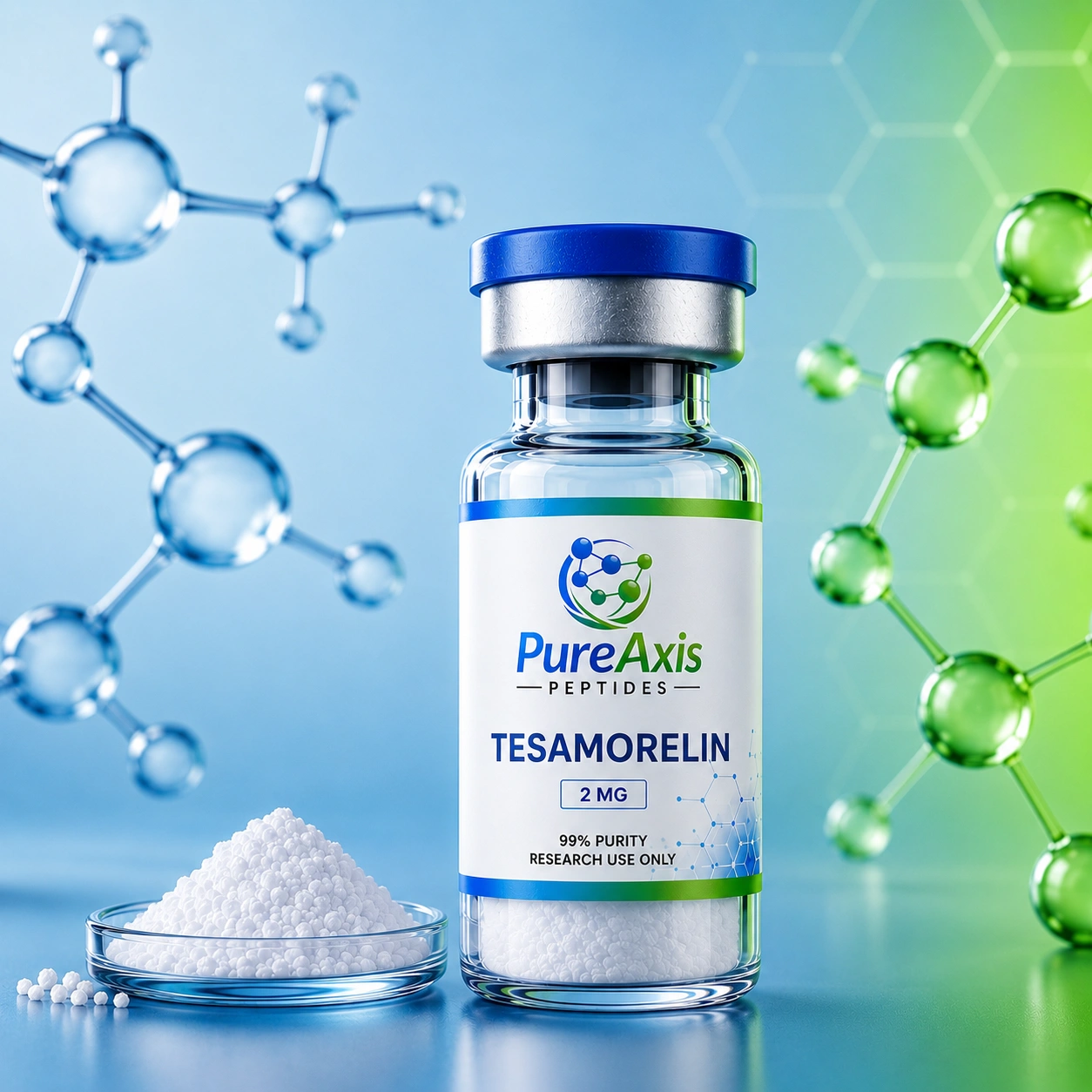
Tesamorelin Research Peptide
Tesamorelin is a synthetic analogue of growth hormone-releasing hormone (GHRH) investigated extensively in growth hormone physiology, endocrine signaling, body-composition research and visceral adipose tissue biology.
Tesamorelin acts through the GHRH receptor to stimulate endogenous growth hormone secretion, which subsequently influences downstream IGF-1 signaling. Clinical research has demonstrated reductions in visceral adipose tissue in adults with HIV-associated abdominal fat accumulation.
Pure Axis Peptides offers Tesamorelin as a research-use peptide for qualified laboratory and scientific investigations.
What Is Tesamorelin?
Tesamorelin is a synthetic GHRH analogue designed to stimulate the body’s endogenous growth hormone pathway.
Rather than supplying growth hormone directly, tesamorelin acts upstream at the GHRH receptor. Activation of this receptor stimulates pituitary somatotrophs and promotes endogenous GH secretion.
The simplified pathway is:
Tesamorelin → GHRH receptor → Growth Hormone → IGF-1 → downstream biological effects
This makes tesamorelin particularly valuable for experimental research into:
- Growth hormone secretion
- GHRH receptor signaling
- IGF-1 regulation
- Visceral adipose tissue
- Endocrine feedback
- Metabolic physiology
- Body-composition biology
Tesamorelin and GHRH Receptor Signaling
The GHRH receptor (GHRHR) is a G-protein-coupled receptor expressed primarily on pituitary somatotroph cells.
Activation of GHRHR stimulates intracellular signaling that promotes growth hormone synthesis and secretion.
Tesamorelin therefore provides a useful experimental model for studying:
- GHRH receptor activation
- Pituitary signaling
- GH secretion
- Somatotroph function
- cAMP signaling
- Endocrine feedback
- GH-axis regulation
The major research distinction between tesamorelin and direct growth-hormone administration is that tesamorelin stimulates the body’s own pituitary GH pathway.
Tesamorelin and Growth Hormone
Growth hormone is a major endocrine regulator involved in metabolism, tissue biology and growth-related signaling.
Tesamorelin stimulates endogenous GH secretion through GHRH receptor activation.
Research can therefore examine:
- GH secretion
- GH pulse dynamics
- Pituitary responsiveness
- GH feedback
- Growth hormone metabolism
- GH-dependent tissue signaling
Because GH secretion is physiologically regulated, the response to a GHRH analogue is influenced by the underlying endocrine state.
Tesamorelin and IGF-1
One of the major downstream effects of increased GH signaling is increased production of insulin-like growth factor-1 (IGF-1).
The GH/IGF-1 axis can be represented as:
GHRH → GH → IGF-1
Tesamorelin research therefore naturally overlaps with IGF-1 biology.
The FDA prescribing information notes that tesamorelin stimulates GH production and increases serum IGF-1, and recommends monitoring IGF-1 during approved pharmaceutical treatment.
This makes IGF-1 regulation an important research endpoint when studying tesamorelin.
Tesamorelin and Visceral Adipose Tissue
One of the most extensively studied effects of tesamorelin is its relationship with visceral adipose tissue (VAT).
Visceral adipose tissue refers to fat stored within the abdominal cavity around internal organs. It differs biologically from subcutaneous fat stored beneath the skin.
Clinical research in HIV-associated abdominal adiposity has demonstrated that tesamorelin can reduce visceral adipose tissue.
In a randomized clinical trial, six months of tesamorelin treatment produced a significantly greater reduction in visceral adipose tissue than placebo. The same study also observed a reduction in liver fat.
Tesamorelin and Abdominal Fat Research
Tesamorelin has a particularly strong research association with abdominal visceral fat, but this should not be confused with general-purpose weight-loss therapy.
The FDA-approved indication is specifically for reducing excess abdominal fat in HIV-infected adults with lipodystrophy. The FDA labeling explicitly states that tesamorelin is not indicated for weight-loss management.
This distinction should be maintained throughout the Pure Axis product page.
Useful research keywords include:
- Visceral adipose tissue research
- Abdominal adiposity research
- Visceral fat biology
- GH-mediated lipolysis
- Body-composition research
- Metabolic research
Tesamorelin and Liver Fat
Tesamorelin has also been studied in relation to hepatic fat accumulation.
In a randomized clinical trial of HIV-infected adults with abdominal fat accumulation, tesamorelin significantly reduced liver fat compared with placebo over six months.
This provides a valuable secondary research angle involving:
- Hepatic lipid metabolism
- Visceral adiposity
- Ectopic fat
- GH signaling
- Metabolic physiology
A subsequent clinical analysis similarly reported reductions in visceral adipose tissue and liver fat in participants receiving tesamorelin.
Tesamorelin and Metabolic Research
Visceral adiposity is closely associated with metabolic regulation.
Researchers have investigated tesamorelin in relation to:
- Visceral fat
- Liver fat
- Glucose metabolism
- Insulin sensitivity
- Lipid metabolism
- Endocrine signaling
- Body composition
Clinical research has reported associations between visceral adipose tissue reduction and changes in metabolic parameters in people with HIV-associated abdominal adiposity.
These findings make tesamorelin relevant to experimental studies connecting GH signaling with adipose-tissue biology.
Tesamorelin and Lipolysis Research
Growth hormone influences lipid metabolism and can promote mobilization of stored fatty acids.
Tesamorelin provides an experimental method for studying how stimulation of the endogenous GH axis influences adipose-tissue biology.
Research can investigate:
- Lipolytic signaling
- Adipocyte metabolism
- Visceral fat metabolism
- GH-dependent lipid mobilization
- Fat distribution
- Energy metabolism
The strongest human evidence concerns visceral adipose tissue rather than generalized reductions in body weight.
Tesamorelin and Body Composition
Tesamorelin has been investigated in relation to changes in body composition, particularly abdominal and visceral fat.
The clinical literature shows that reductions in visceral adipose tissue can occur without the compound being appropriately characterized as a general weight-loss drug. The FDA specifically limits the approved indication to excess abdominal fat associated with HIV lipodystrophy.
This distinction is useful for both scientific accuracy and SEO compliance.
Tesamorelin and HIV-Associated Lipodystrophy
The best-established clinical research area for tesamorelin is HIV-associated lipodystrophy.
Antiretroviral-treated individuals with HIV can develop abnormal patterns of fat accumulation, including increased visceral adipose tissue.
Randomized trials have investigated tesamorelin as a GHRH analogue capable of reducing visceral adiposity in this population.
The FDA subsequently approved Egrifta, a pharmaceutical tesamorelin formulation, in 2010 for reducing excess abdominal fat in HIV-infected adults with lipodystrophy.
Tesamorelin and Long-Term Research
Long-term tesamorelin research is important because manipulating the GH/IGF-1 axis can have effects beyond adipose tissue.
The FDA labeling highlights several considerations associated with pharmaceutical tesamorelin, including:
- Increased IGF-1
- Fluid retention
- Glucose intolerance
- Potential effects related to neoplasms
- Cardiovascular safety considerations
The label states that long-term cardiovascular safety has not been established and recommends monitoring IGF-1.
These considerations reinforce the importance of presenting Pure Axis Tesamorelin as a research material rather than a self-directed therapeutic product.
Tesamorelin and Glucose Research
Growth hormone has important effects on glucose metabolism.
Because tesamorelin stimulates endogenous GH production, researchers can investigate the relationship between GH-axis activation and glucose homeostasis.
Clinical studies have monitored:
- Fasting glucose
- Glucose tolerance
- Insulin sensitivity
- IGF-1
- Metabolic parameters
In the randomized visceral-fat trial, an early increase in fasting glucose was observed, although the overall six-month glucose changes were not statistically significant.
This makes glucose metabolism an important experimental endpoint rather than something that should be ignored in tesamorelin research.
Tesamorelin and Pituitary Research
The pituitary is the central endocrine target through which GHRH analogues stimulate GH secretion.
Tesamorelin research can therefore be used to investigate:
- Somatotroph activity
- GHRH receptor expression
- GH synthesis
- GH secretion
- Pituitary responsiveness
- Endocrine feedback
This also makes tesamorelin highly complementary to research involving other GH-axis peptides.
Tesamorelin vs. CJC-1295
Tesamorelin and CJC-1295 are both GHRH-related research peptides, making them natural comparison targets.
Tesamorelin: A synthetic GHRH analogue extensively studied in clinical research, particularly for visceral adipose tissue in HIV-associated lipodystrophy.
CJC-1295: A modified GHRH analogue studied for its effects on GH secretion and pharmacokinetic behavior.
Their differing molecular characteristics and research histories make them useful for comparative GH-axis studies.
Explore CJC-1295 with DAC and CJC-1295 without DAC for related GHRH research.
Tesamorelin vs. GHRP-2
Tesamorelin and GHRP-2 stimulate the GH axis through different receptor systems.
Tesamorelin: GHRH receptor pathway.
GHRP-2: Growth hormone secretagogue receptor pathway.
This difference makes the two peptides particularly useful in comparative endocrine research.
Explore GHRP-2 Acetate for related growth-hormone secretagogue research.
Tesamorelin vs. GHRP-6
GHRP-6 is another growth hormone secretagogue that operates through the GHS receptor system.
Comparing GHRP-6 with tesamorelin can help researchers investigate differences between:
- GHRH signaling
- GHS-R signaling
- Pituitary GH release
- Receptor pharmacology
- Endocrine feedback
Explore GHRP-6 Acetate for related research.
Tesamorelin and the GH/IGF-1 Research Cluster
Tesamorelin belongs at the center of a broader GH/IGF-1 research cluster.
A useful research pathway is:
Tesamorelin → GHRH receptor → GH → IGF-1 → metabolic/tissue signaling
This creates natural internal links to:
- CJC-1295
- GHRP-2
- GHRP-6
- Hexarelin
- IGF-1 LR3
- MGF
- PEG-MGF
Explore IGF-1 LR3 for downstream IGF research.
Explore PEG-MGF for related IGF/MGF research.
Tesamorelin Research Applications
Tesamorelin may be relevant to laboratory studies involving:
GHRH Research: Investigating growth hormone-releasing hormone pathways.
GHRH Receptor Research: Studying GHRHR activation and signaling.
Growth Hormone Research: Investigating endogenous GH secretion.
IGF-1 Research: Studying downstream GH/IGF-1 signaling.
Visceral Adipose Tissue Research: Investigating abdominal fat biology.
Adipose Biology: Studying visceral adipocyte metabolism.
Liver Fat Research: Investigating hepatic lipid accumulation.
Metabolic Research: Studying interactions between GH signaling and glucose/lipid metabolism.
Body Composition Research: Investigating changes in fat distribution.
Pituitary Research: Studying somatotroph function.
Endocrine Pharmacology: Comparing GHRH analogues and GH-secretagogue pathways.
Tesamorelin Research Material
Researchers should verify the current Pure Axis Peptides product specification, peptide identity, sequence, purity, formulation, storage requirements and batch-specific certificate of analysis (COA) before laboratory use.
Tesamorelin is a biologically active GHRH analogue. Appropriate laboratory procedures and applicable institutional requirements should be followed when handling research material.
Explore Related Research
Tesamorelin fits naturally into a broader GHRH / growth-hormone / IGF-1 research cluster.
Explore CJC-1295 with DAC and CJC-1295 without DAC for related GHRH research.
Explore GHRP-2 Acetate, GHRP-6 Acetate and Hexarelin Acetate for GHS research.
Explore IGF-1 LR3 and PEG-MGF for downstream growth-factor research.
Browse the Peptides collection for additional peptide research materials.
Visit Shop All Products for the complete Pure Axis Peptides catalog.
Research Use Only
Tesamorelin supplied by Pure Axis Peptides is intended strictly for laboratory and scientific research. It is not intended for human consumption, self-administration, diagnosis, treatment, cure, or prevention of any disease or medical condition. Tesamorelin is a biologically active GHRH analogue and is also the active ingredient in an FDA-approved pharmaceutical formulation for a specific medical indication. The FDA-approved indication is reduction of excess abdominal fat in HIV-infected adults with lipodystrophy; it is not indicated for general weight-loss management. Research findings should not be interpreted as establishing safety or efficacy for unapproved uses. Researchers should evaluate all materials according to their experimental requirements, product documentation and applicable laboratory procedures.
Internal Linking Recommendations
Primary Internal Links
- CJC-1295 with DAC →
https://pureaxispeptides.com/product/cjc-1295-with-dac/ - CJC-1295 without DAC →
https://pureaxispeptides.com/product/cjc-1295-without-dac/ - GHRP-2 Acetate →
https://pureaxispeptides.com/product/ghrp-2-acetate/ - GHRP-6 Acetate →
https://pureaxispeptides.com/product/ghrp-6-acetate/ - Hexarelin Acetate →
https://pureaxispeptides.com/product/hexarelin-acetate/ - IGF-1 LR3 →
https://pureaxispeptides.com/product/igf-1-lr3/ - PEG-MGF →
https://pureaxispeptides.com/product/peg-mgf/ - Peptides →
https://pureaxispeptides.com/product-category/peptides/ - Research Chemicals →
https://pureaxispeptides.com/product-category/research-chemicals/ - Shop All Products →
https://pureaxispeptides.com/shop/
Verify all live WooCommerce URLs before publishing.
Recommended Internal-Link Anchors
Use varied contextual anchors such as:
- “Tesamorelin research peptide”
- “GHRH research”
- “growth hormone research”
- “GHRH receptor research”
- “GH/IGF-1 axis research”
- “visceral adipose tissue research”
- “IGF-1 research”
- “growth hormone secretagogue research”
- “GHRH analogue research”
- “metabolic peptide research”
Recommended Site Architecture
Build a dedicated GH / GHRH / IGF-1 topical cluster:
Tesamorelin
→ GHRH receptor
→ Growth hormone
→ IGF-1
→ CJC-1295
→ GHRP-2
→ GHRP-6
→ Hexarelin
→ IGF-1 LR3
→ MGF / PEG-MGF
→ Visceral adipose tissue
→ Metabolic research
This gives Tesamorelin a high-authority central position within the Pure Axis GH research category.
External Scientific References
- FDA — EGRIFTA SV (tesamorelin) prescribing information:
https://www.accessdata.fda.gov/drugsatfda_docs/label/2024/022505s018lbl.pdf - PubMed — Tesamorelin and visceral/liver fat randomized clinical trial:
https://pubmed.ncbi.nlm.nih.gov/25038357/ - PubMed — Tesamorelin and metabolic profile:
https://pubmed.ncbi.nlm.nih.gov/22495074/ - PubMed — Tesamorelin randomized trial and safety extension:
https://pubmed.ncbi.nlm.nih.gov/20101189/ - PubMed — Tesamorelin in people with HIV receiving integrase inhibitors:
https://pubmed.ncbi.nlm.nih.gov/38905488/
Product Tags
Tesamorelin, Tesamorelin Peptide, Tesamorelin Research, Tesamorelin Research Peptide, Tesamorelin GHRH, GHRH Analogue, GHRH Peptide, Growth Hormone Releasing Hormone, Growth Hormone Releasing Factor, GHRH Research, GHRH Receptor, GHRHR, GHRHR Research, Growth Hormone Research, GH Research, Growth Hormone Peptide, GH Axis Research, GH IGF-1 Axis, IGF-1 Research, IGF Research, Visceral Adipose Tissue, Visceral Fat Research, Abdominal Adiposity Research, Adipose Tissue Research, Lipolysis Research, Metabolic Research, Liver Fat Research, Hepatic Fat Research, Body Composition Research, Pituitary Research, Somatotroph Research, Endocrine Research, Endocrine Pharmacology, CJC-1295, GHRP Research, Hexarelin Research, IGF-1 LR3, MGF Research, PEG-MGF, Research Peptide, Laboratory Research
| Purity (%) | 98.9 |
|---|---|
| Lab Tested | yes |
| Research Grade | yes |
| Third Party Tested | yes |
| Strength | 10mg, 2mg, 5mg |
|---|---|
| Volume | 10 vials |
Be the first to review “Tesamorelin”
Need Assistance?
Our research specialists are here to help with product selection and technical questions.
Related products

Growth Hormone Releasing
Growth Hormone Releasing Price range: $27.00 through $54.00Growth hormone releasing peptide for GH axis research

Growth Hormone Releasing
Growth Hormone Releasing Price range: $41.00 through $81.00Selective growth hormone secretagogue for GH research
Growth Hormone Releasing
Growth Hormone Releasing Price range: $76.00 through $157.00GHRH analog for natural growth hormone stimulation research

Growth Hormone Releasing
Growth Hormone Releasing Price range: $27.00 through $54.00Growth hormone releasing hexapeptide for appetite and GH research

Blends
BlendsCJC-1295 without DAC 5mg + Ipamorelin 5mg Blend
$122.00Growth hormone secretagogue blend for GH research

Obesity & Metabolism
Obesity & Metabolism $145.00Pro-apoptotic peptide for targeted fat cell research

Growth Hormone Releasing
Growth Hormone Releasing Price range: $46.00 through $219.00Long-acting insulin-like growth factor for muscle and cell research

 Tesamorelin
Price range: $60.00 through $219.00
Tesamorelin
Price range: $60.00 through $219.00
Reviews
There are no reviews yet.