


Quick Specifications
| Purity (%) | 98.9 |
|---|
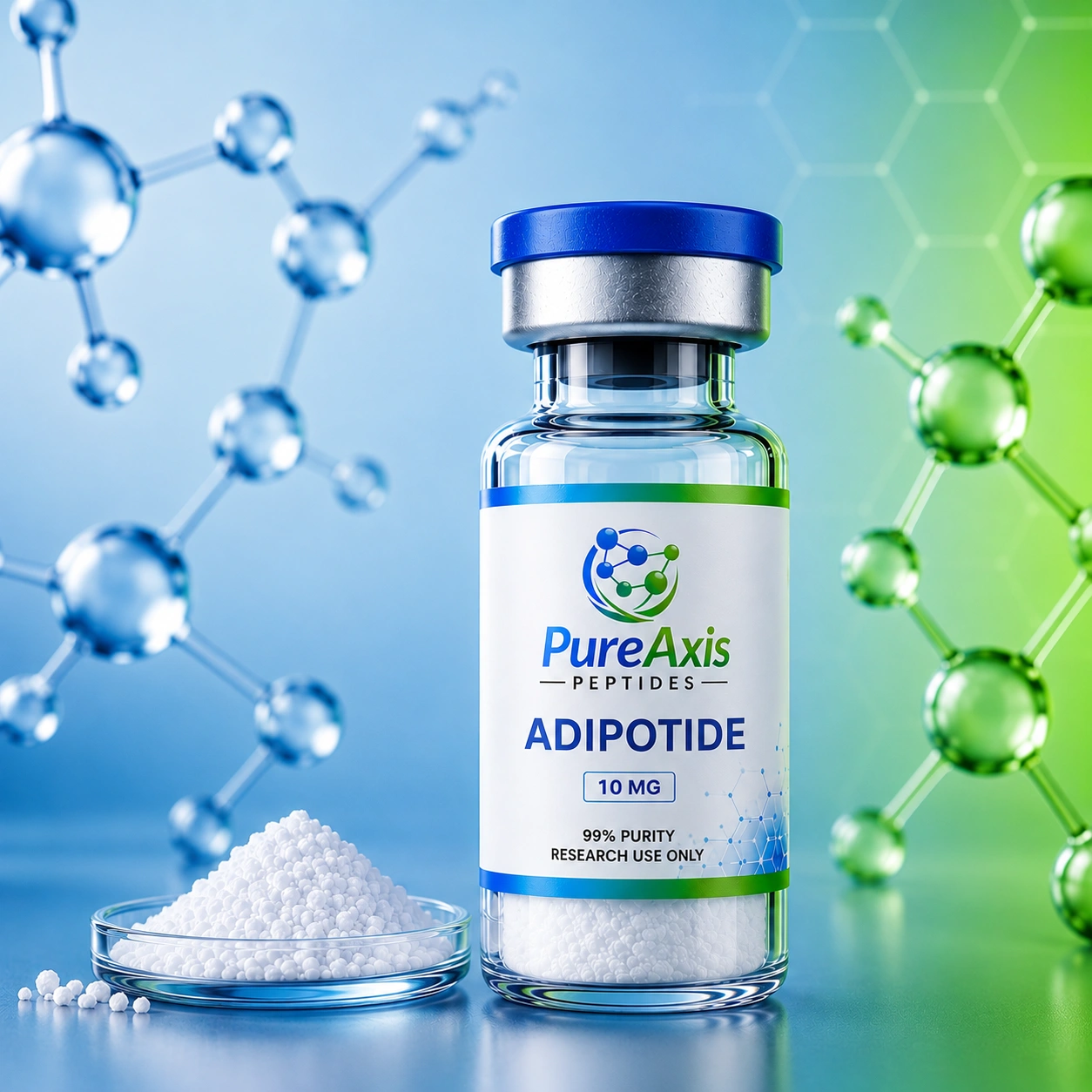
Adipotide (FTPP) Research Peptide
Adipotide, also known as FTPP (Fat-Targeted Pro-Apoptotic Peptide) or prohibitin-targeting peptide, is an experimental chimeric peptidomimetic investigated in adipose-tissue vascular biology and metabolic research.
Unlike conventional weight-management compounds that act through appetite, incretin or endocrine pathways, Adipotide was designed around a targeted vascular approach. Its targeting domain recognizes prohibitin-associated molecular features on the vasculature supplying white adipose tissue, while its pro-apoptotic domain is designed to trigger cellular death after targeting.
Pure Axis Peptides offers Adipotide as a research-use material for qualified laboratory and scientific investigations.
What Is Adipotide?
Adipotide is an experimental chimeric peptidomimetic developed as a vascular-targeting approach to adipose-tissue biology.
It is commonly identified as:
- Adipotide
- FTPP
- Fat-Targeted Pro-Apoptotic Peptide
- Prohibitin-Targeting Peptide
- Prohibitin Targeting Peptide 1
The commonly reported construct contains a CKGGRAKDC targeting motif linked through a short linker to the pro-apoptotic D(KLAKLAK)₂ sequence.
This unusual two-domain design makes Adipotide particularly interesting for research involving:
- Molecular targeting
- Adipose vascular biology
- Prohibitin
- Apoptosis
- Mitochondrial membrane disruption
- Peptide delivery
- Metabolic research
Adipotide and Prohibitin Targeting
A central feature of Adipotide research is its interaction with prohibitin-associated targets on endothelial cells within adipose tissue vasculature.
The targeting sequence was designed to home toward the vasculature associated with white adipose tissue.
This creates a research model for investigating:
Targeting peptide → vascular receptor/target → intracellular delivery → pro-apoptotic signaling
Targeted peptide delivery of this type is relevant to broader research in:
- Molecular targeting
- Vascular biology
- Drug-delivery research
- Tumor targeting
- Tissue-selective peptide design
- Endothelial-cell biology
Adipotide and Adipose Tissue Vasculature
Adipose tissue requires a functioning vascular network to support oxygen delivery, nutrient exchange and tissue maintenance.
Adipotide was designed around the hypothesis that selectively targeting the vasculature supplying white adipose tissue could influence adipose-tissue mass.
Animal research investigated this vascular-targeting strategy in obese models, including rodents and rhesus macaques.
This makes adipose vascular biology one of the strongest scientific SEO themes for the product.
Adipotide and Pro-Apoptotic Signaling
The second component of Adipotide is a pro-apoptotic sequence.
The KLAKLAK-derived domain is designed to disrupt mitochondrial membranes following intracellular delivery, promoting apoptosis in targeted cells.
This gives Adipotide two distinct experimental components:
Targeting: directing the construct toward a selected cellular population.
Effector: triggering intracellular membrane disruption and apoptosis.
This makes the compound relevant to research into:
- Programmed cell death
- Mitochondrial membrane integrity
- Pro-apoptotic peptides
- Targeted apoptosis
- Cell-selective molecular delivery
Adipotide and Mitochondrial Research
Mitochondria play a central role in programmed cell death.
The pro-apoptotic component of Adipotide was designed to disrupt mitochondrial membranes after intracellular delivery.
Consequently, Adipotide can serve as a research model for investigating:
- Mitochondrial membrane disruption
- Apoptotic signaling
- Cellular stress
- Mitochondrial permeability
- Pro-apoptotic peptide mechanisms
This makes mitochondrial biology an important secondary research topic for the product page.
Adipotide and White Adipose Tissue
Adipotide was specifically designed around white adipose tissue (WAT).
White adipose tissue serves as a major energy-storage compartment and also functions as an endocrine organ.
Research involving adipose tissue can examine:
- Adipocyte biology
- Adipose vascularization
- Endothelial signaling
- Lipid storage
- Adipose remodeling
- Metabolic signaling
Adipotide differs from appetite-regulating peptides because its proposed mechanism is based on targeted vascular injury, rather than primarily changing appetite or incretin signaling.
Adipotide and Animal Research
The most notable evidence for Adipotide comes from preclinical animal research.
Studies in obese animal models reported substantial reductions in body weight and adipose tissue following treatment.
Research in obese rhesus monkeys demonstrated significant reductions in body weight and fat mass during a 28-day experimental period. However, the same research also identified important renal toxicity concerns.
This makes the animal literature valuable for understanding Adipotide’s mechanism while simultaneously demonstrating why the compound should not be presented as an established human weight-management therapy.
Adipotide and Metabolic Research
Changes in adipose tissue can influence broader metabolic physiology.
Preclinical Adipotide research has examined relationships between adipose-tissue reduction and metabolic parameters.
Potential research areas include:
- Adipose-tissue metabolism
- Glucose regulation
- Insulin sensitivity
- Lipid metabolism
- Energy balance
- Adipose vascularization
- Body-composition biology
These findings remain primarily experimental and should not be interpreted as evidence for clinical weight-loss use.
Adipotide and Insulin Sensitivity Research
Animal studies involving Adipotide have reported changes in metabolic parameters accompanying reductions in adipose tissue.
This has generated interest in whether targeted manipulation of adipose vasculature can influence broader metabolic physiology.
Potential experimental endpoints include:
- Glucose tolerance
- Insulin sensitivity
- Fasting glucose
- Adipose-tissue mass
- Lipid metabolism
- Metabolic biomarkers
For SEO and scientific accuracy, these should be presented as research endpoints, not promised therapeutic effects.
Adipotide and Body-Composition Research
Adipotide research has attracted interest because of the substantial changes in body weight and fat mass reported in animal models.
However, body-weight reduction should not be presented as evidence of an established human treatment effect.
The most defensible positioning is:
Adipotide → adipose vascular targeting → experimental adipose-tissue remodeling → body-composition research
This distinguishes Adipotide from approved obesity medicines and from research compounds that work primarily through appetite or incretin signaling.
Adipotide and Angiogenesis Research
Because Adipotide targets the vascular system supporting adipose tissue, it is also relevant to research involving angiogenesis and vascular remodeling.
Adipose tissue expansion requires changes in its vascular network, making the relationship between adipocytes and endothelial cells an important area of investigation.
Potential research topics include:
- Adipose angiogenesis
- Endothelial-cell biology
- Vascular remodeling
- Tissue vascularization
- Prohibitin-associated signaling
- Targeted vascular peptides
Adipotide and Endothelial-Cell Research
Endothelial cells form the inner lining of blood vessels and play important roles in vascular homeostasis and tissue remodeling.
Adipotide was designed to interact with targets associated with endothelial cells within adipose vasculature.
This provides a model for investigating:
- Endothelial-cell targeting
- Vascular peptide delivery
- Endothelial apoptosis
- Tissue-selective targeting
- Molecular homing peptides
Adipotide and Targeted Peptide Delivery
One of the most interesting aspects of Adipotide is its bifunctional design.
The targeting sequence and pro-apoptotic sequence perform different roles.
This general design principle is relevant to targeted peptide research:
Homing domain + therapeutic/effector domain = targeted molecular delivery
Adipotide therefore has relevance beyond adipose biology, including research into targeted delivery systems and peptide-based therapeutics.
Adipotide and Mitochondrial Membrane Disruption
The D(KLAKLAK)₂ component is associated with mitochondrial membrane disruption once delivered intracellularly.
This is important because many apoptotic pathways converge on mitochondrial dysfunction and loss of mitochondrial membrane integrity.
Researchers studying Adipotide can therefore investigate:
- Mitochondrial membrane potential
- Apoptosis
- Cellular stress
- Pro-apoptotic peptide activity
- Intracellular peptide delivery
Adipotide and Renal Toxicity
Renal toxicity is an essential part of the Adipotide research story and should not be omitted from the product page.
Preclinical studies identified renal effects associated with Adipotide exposure, and subsequent human development did not result in an approved therapeutic product. Contemporary evidence summaries identify nephrotoxicity as a major limitation that prevented further clinical development.
This is particularly important because some online marketing materials present Adipotide almost exclusively as a “fat-burning peptide.”
A scientifically credible product page should instead make clear that:
- Adipotide is experimental.
- It is not an approved weight-loss medicine.
- Preclinical efficacy does not establish human efficacy.
- Renal toxicity is an important safety concern.
- The human development program was discontinued.
Adipotide and Human Clinical Research
Adipotide progressed beyond purely animal research into early human investigation, but it did not become an approved medicine.
The clinical development program was discontinued, and current sources characterize Adipotide as a research-only compound rather than an established treatment.
This makes it especially important to distinguish preclinical findings from demonstrated clinical efficacy.
The Pure Axis page should never imply that Adipotide has been proven safe or effective for human weight reduction.
Adipotide vs. Tesamorelin
Adipotide and Tesamorelin are both associated with adipose-tissue research but have fundamentally different mechanisms.
Adipotide
- Experimental peptidomimetic
- Targets adipose-associated vasculature
- Contains a pro-apoptotic effector domain
- Primarily supported by preclinical research
- Not an approved human weight-loss treatment
Tesamorelin
- Synthetic GHRH analogue
- Stimulates endogenous GH secretion
- Influences the GH/IGF-1 axis
- Has substantial human clinical research
- Has an FDA-approved pharmaceutical formulation for a specific HIV-associated lipodystrophy indication
Explore Tesamorelin for GHRH and visceral-adipose research.
Adipotide vs. AOD-9604
Adipotide and AOD-9604 represent very different approaches to adipose and metabolic research.
Adipotide was designed around targeted vascular apoptosis.
AOD-9604 is a modified fragment of human growth hormone studied in relation to lipid metabolism.
Researchers should therefore treat them as distinct experimental compounds rather than interchangeable “fat-loss peptides.”
Adipotide vs. GLP-1/GIP Research
Adipotide should also be clearly differentiated from modern incretin-based obesity research.
Compounds such as semaglutide and tirzepatide act through hormone-receptor pathways associated with appetite regulation, glucose metabolism and energy balance.
Adipotide was designed around targeted destruction of adipose-associated vasculature.
This mechanistic distinction provides a useful educational angle for comparative SEO content.
Explore Semaglutide and Tirzepatide for related metabolic research.
Adipotide Research Applications
Adipotide may be relevant to laboratory studies involving:
Adipose Vascular Biology: Investigating the relationship between adipose tissue and its vascular supply.
Prohibitin Research: Studying prohibitin-associated targeting mechanisms.
Targeted Peptide Delivery: Investigating vascular homing and molecular delivery.
Apoptosis Research: Studying targeted pro-apoptotic mechanisms.
Mitochondrial Biology: Investigating mitochondrial membrane disruption.
Endothelial Research: Studying endothelial-cell targeting and apoptosis.
Adipose-Tissue Biology: Investigating white adipose tissue remodeling.
Angiogenesis Research: Studying vascularization of adipose tissue.
Metabolic Research: Investigating relationships between adipose tissue and metabolic parameters.
Peptide Pharmacology: Studying bifunctional peptide design.
Adipotide Research Material
Researchers should verify the current Pure Axis Peptides product specification, identity, sequence, purity, formulation, storage requirements and batch-specific certificate of analysis (COA) before laboratory use.
Because Adipotide is a complex chimeric peptidomimetic, analytical characterization is particularly important. Researchers should confirm that the supplied material corresponds to the intended construct and documented molecular specifications.
Explore Related Research
Adipotide belongs within a broader metabolic and adipose-tissue research cluster.
Explore Tesamorelin for GHRH-mediated visceral-adipose research.
Explore Semaglutide and Tirzepatide for incretin-pathway research.
Browse the Peptides collection for additional research peptides.
Explore Research Chemicals for additional laboratory materials.
Visit Shop All Products for the complete Pure Axis Peptides catalog.
Research Use Only
Adipotide supplied by Pure Axis Peptides is intended strictly for laboratory and scientific research. It is not intended for human consumption, self-administration, weight-loss treatment, diagnosis, treatment, cure, or prevention of any disease or medical condition. Adipotide is an experimental peptidomimetic that has not been approved as a human medicine. Preclinical studies have reported significant effects on adipose tissue and body weight, but these findings cannot be interpreted as establishing human efficacy or safety. Renal toxicity is an important limitation identified during development. Researchers should evaluate all materials according to their experimental requirements, product documentation and applicable laboratory procedures.
Internal Linking Recommendations
Primary Internal Links
- Tesamorelin →
https://pureaxispeptides.com/product/tesamorelin/ - Semaglutide →
https://pureaxispeptides.com/product/semaglutide/ - Tirzepatide →
https://pureaxispeptides.com/product/tirzepatide/ - Peptides →
https://pureaxispeptides.com/product-category/peptides/ - Research Chemicals →
https://pureaxispeptides.com/product-category/research-chemicals/ - Shop All Products →
https://pureaxispeptides.com/shop/
Verify all live WooCommerce URLs before publishing.
Recommended Related-Product Links
If these products are present in the Pure Axis catalog, consider linking Adipotide with:
- AOD-9604
- Tesamorelin
- Lipo-C
- L-Carnitine
- Semaglutide
- Tirzepatide
- Cagrilintide
- Retatrutide
The comparison should emphasize different mechanisms, rather than grouping all of them as equivalent weight-loss compounds.
Recommended Internal-Link Anchors
Use varied contextual anchors such as:
- “Adipotide research peptide”
- “FTPP research”
- “prohibitin-targeting peptide”
- “adipose vascular research”
- “targeted apoptosis research”
- “white adipose tissue research”
- “adipose angiogenesis research”
- “metabolic peptide research”
- “targeted peptide delivery”
- “pro-apoptotic peptide research”
Recommended Site Architecture
Build a dedicated metabolic / adipose research cluster:
Adipotide
→ Prohibitin targeting
→ Adipose vasculature
→ Angiogenesis
→ Apoptosis
→ Mitochondrial signaling
→ White adipose tissue
→ Tesamorelin
→ AOD-9604
→ Lipo-C
→ Incretin research
→ Metabolic research
This creates a useful distinction between adipose-targeting research and the separate GH/incretin/metabolic signaling categories.
External Scientific References
- Research overview — Adipotide/FTPP mechanism and preclinical research:
https://peptidescienceinstitute.org/guides/adipotide (peptidescienceinstitute.org) - Research review — Adipotide, prohibitin targeting and clinical-development limitations:
https://www.peptidestat.com/peptides/adipotide-peptide (peptidestat.com) - Research overview — Adipotide/FTPP and vascular targeting:
https://condorresearch.com/research/what-is-adipotide/ (condorresearch.com)
Product Tags
Adipotide, Adipotide Peptide, Adipotide Research, Adipotide Research Peptide, FTPP, FTPP Peptide, Fat Targeted Pro Apoptotic Peptide, Fat-Targeted Proapoptotic Peptide, Prohibitin Targeting Peptide, Prohibitin-Targeting Peptide, Prohibitin Peptide, Adipose Tissue Research, Adipose Vascular Research, White Adipose Tissue, Adipose Vasculature, Adipose Angiogenesis, Angiogenesis Research, Vascular Targeting Peptide, Targeted Peptide Delivery, Pro Apoptotic Peptide, Proapoptotic Research, Apoptosis Research, Mitochondrial Research, Mitochondrial Membrane Research, Endothelial Cell Research, Endothelial Targeting, Metabolic Research, Adipose Biology, Body Composition Research, Lipid Metabolism Research, Peptide Pharmacology, Experimental Peptide, Research Peptide, Laboratory Research
| Purity (%) | 98.9 |
|---|---|
| Lab Tested | yes |
| Research Grade | yes |
| Third Party Tested | yes |
Be the first to review “Adipotide”
Need Assistance?
Our research specialists are here to help with product selection and technical questions.
Related products


Obesity & Metabolism
Obesity & Metabolism $80.00Fat-dissolving solution for body contouring research

Obesity & Metabolism
Obesity & Metabolism Price range: $88.00 through $136.00NNMT inhibitor for fat metabolism and energy research

Growth Hormone Releasing
Growth Hormone Releasing Price range: $60.00 through $219.00GHRH analog for visceral fat and lipodystrophy research

Obesity & Metabolism
Obesity & Metabolism $80.00Lipotropic injection blend for metabolic research

Neuroscience
Neuroscience $100.00REV-ERB agonist for circadian rhythm and metabolism research

Obesity & Metabolism
Obesity & Metabolism $40.00L-Carnitine 600mg research compound for laboratory studies of fatty acid transport, mitochondrial...


 Adipotide
$145.00
Adipotide
$145.00
Reviews
There are no reviews yet.