

Quick Specifications
| Purity (%) | 98.9 |
|---|
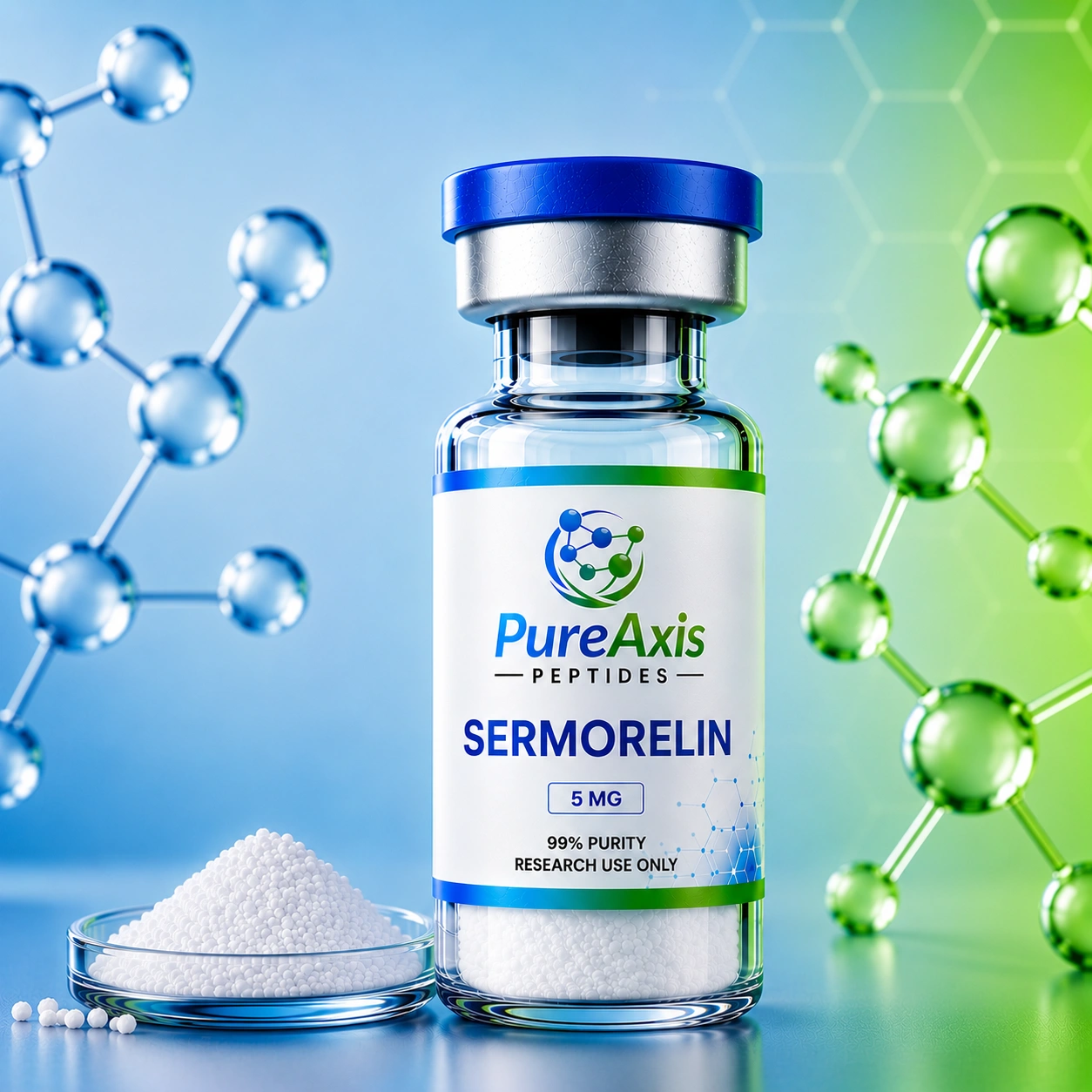
Sermorelin Research Peptide
Sermorelin is a synthetic 29-amino-acid analogue of growth hormone-releasing hormone (GHRH). Also known as GHRH(1-29)NH₂ or GRF(1-29)NH₂, Sermorelin corresponds to the biologically active N-terminal region of naturally occurring human GHRH.
Unlike exogenous growth hormone, Sermorelin acts upstream of GH by interacting with the GHRH receptor on pituitary somatotrophs, making it an important research tool for investigating endogenous growth-hormone secretion and the GH/IGF-1 axis.
Pure Axis Peptides offers Sermorelin as a research-use peptide for qualified laboratory and scientific investigations.
What Is Sermorelin?
Sermorelin is the synthetic 1-29 amino-acid fragment of human growth hormone-releasing hormone, retaining the biological activity necessary to stimulate pituitary GH secretion.
The peptide sequence is:
YADAIFTNSYRKVLGQLSARKLLQDIMSR-NH₂
PubChem identifies Sermorelin as an amidated synthetic 29-amino-acid peptide corresponding to the amino-terminal segment of naturally occurring human GHRH.
Its primary research significance lies in its ability to model GHRH-mediated stimulation of endogenous growth hormone release.
Sermorelin and GHRH
Growth hormone-releasing hormone (GHRH) is produced primarily by the hypothalamus and acts on the anterior pituitary.
The physiological pathway can be represented as:
Hypothalamic GHRH → GHRH receptor → Pituitary somatotroph → GH secretion → IGF-1 signaling
Sermorelin reproduces the biologically active N-terminal portion of GHRH and can therefore be used experimentally to investigate this pathway.
Research applications include:
- GHRH receptor signaling
- Pituitary GH secretion
- Somatotroph biology
- GH pulsatility
- GH/IGF-1 axis research
- Endocrine physiology
Sermorelin and the GHRH Receptor
The GHRH receptor (GHRHR) is expressed on growth-hormone-producing somatotroph cells within the anterior pituitary.
When GHRH or Sermorelin interacts with GHRHR, intracellular signaling promotes growth hormone secretion.
This makes Sermorelin particularly useful for investigating:
- GHRHR activation
- G-protein signaling
- Adenylyl cyclase
- cAMP signaling
- Calcium-dependent pathways
- Somatotroph function
- GH secretion
Sermorelin and Growth Hormone Secretion
One of the defining characteristics of Sermorelin is its ability to stimulate endogenous growth hormone secretion.
Clinical and experimental literature has demonstrated that intravenous and subcutaneous Sermorelin can stimulate GH secretion from the anterior pituitary.
This distinguishes Sermorelin from recombinant GH.
Sermorelin → stimulates endogenous GH release
whereas:
Recombinant GH → supplies exogenous GH
This distinction is central to understanding Sermorelin research.
Sermorelin and the GH/IGF-1 Axis
Growth hormone and insulin-like growth factor 1 (IGF-1) form a major endocrine signaling axis involved in growth and metabolism.
A simplified pathway is:
GHRH → GH → Liver and peripheral tissues → IGF-1
Sermorelin provides an experimental means of stimulating the upstream portion of this pathway.
Research can investigate:
- GH secretion
- IGF-1 production
- Pituitary responsiveness
- Somatotropic signaling
- Endocrine feedback
- GH pulsatility
Sermorelin and Pituitary Research
The anterior pituitary contains specialized somatotroph cells responsible for producing and secreting growth hormone.
Sermorelin interacts with the GHRH signaling pathway controlling these cells.
This makes the peptide relevant to studies involving:
- Somatotroph physiology
- Pituitary hormone secretion
- GHRH signaling
- GH secretory dynamics
- Pituitary responsiveness
Research using Sermorelin can therefore help distinguish hypothalamic, pituitary and peripheral components of the GH axis.
Sermorelin and GH Pulsatility
Growth hormone secretion is naturally pulsatile, rather than continuously constant.
The amplitude and frequency of GH pulses vary with:
- Age
- Sleep
- Sex
- Metabolic state
- Nutritional status
- Circadian biology
- Hypothalamic signaling
Because Sermorelin stimulates the pituitary through the GHRH pathway, it has historically been studied as a tool for investigating GH secretory dynamics.
This makes “GH pulsatility research” a valuable secondary SEO topic.
Sermorelin and IGF-1 Research
IGF-1 is an important downstream component of the somatotropic axis.
Changes in GH secretion can influence circulating IGF-1 concentrations.
Sermorelin research can therefore examine:
- GH/IGF-1 relationships
- Endocrine feedback
- Hepatic IGF-1 production
- Somatotropic signaling
- Growth-hormone physiology
The relationship is not simply linear, however; IGF-1 levels depend on multiple physiological factors beyond a single GH pulse.
Sermorelin and Growth Hormone Deficiency Research
Sermorelin has a substantial history in growth-hormone deficiency research.
A review of clinical studies described Sermorelin as a 29-amino-acid GHRH analogue capable of stimulating GH secretion and discussed its historical use in the diagnosis and treatment of children with idiopathic GH deficiency.
Research involving GH deficiency can examine:
- Pituitary GH reserve
- GHRH responsiveness
- GH secretion
- IGF-1
- Growth physiology
- Endocrine diagnosis
For modern product content, these historical clinical uses should be distinguished from the intended use of Pure Axis research material.
Sermorelin and Endocrine Research
Sermorelin is particularly valuable for endocrine physiology research because it interacts with an established hypothalamic-pituitary pathway.
Potential research areas include:
- Hypothalamic-pituitary signaling
- Growth hormone secretion
- GHRH receptor biology
- Pituitary physiology
- IGF-1 signaling
- Hormonal feedback
- Endocrine pharmacology
Sermorelin and Somatostatin
Growth hormone secretion is regulated by opposing hypothalamic signals.
GHRH stimulates GH secretion, while somatostatin suppresses it.
The simplified regulatory model is:
GHRH → GH secretion ↑
Somatostatin → GH secretion ↓
Sermorelin acts through the stimulatory GHRH pathway.
This makes it useful for experimental studies examining the balance between stimulatory and inhibitory regulation of GH secretion.
Sermorelin and Sleep Research
Growth hormone secretion is closely associated with sleep and circadian physiology.
Large GH pulses commonly occur during deep sleep, making the interaction between sleep architecture and the somatotropic axis an important area of endocrine research.
Sermorelin can therefore be studied in experimental models investigating:
- Sleep-associated GH secretion
- GH pulsatility
- Circadian endocrine rhythms
- Hypothalamic-pituitary signaling
- Somatotropic physiology
Sermorelin and Aging Research
The GH/IGF-1 axis changes with age, including reductions in the amplitude and frequency of GH secretion.
This has generated significant interest in GHRH analogues and GH-secretagogue research.
Sermorelin has consequently been investigated in studies involving:
- Age-related GH changes
- Somatotropic signaling
- Endocrine aging
- GH pulsatility
- IGF-1 physiology
However, evidence for broad anti-aging or longevity benefits should not be presented as established clinical fact.
Sermorelin and Metabolic Research
Growth hormone influences multiple aspects of metabolism.
The GH axis interacts with:
- Lipid metabolism
- Glucose metabolism
- Protein metabolism
- Adipose tissue
- Insulin sensitivity
Sermorelin provides a research model for investigating these relationships through stimulation of endogenous GH signaling.
This creates opportunities for research involving:
- Metabolic endocrinology
- Adipose biology
- Glucose homeostasis
- Lipid metabolism
- Protein turnover
Sermorelin and Body Composition Research
Changes in GH/IGF-1 signaling can influence body composition.
Research may investigate relationships between the somatotropic axis and:
- Fat mass
- Lean mass
- Muscle physiology
- Adipose tissue
- Protein metabolism
These relationships are complex and should not be converted into simplistic claims that Sermorelin directly produces muscle gain or fat loss.
Sermorelin and Muscle Research
GH and IGF-1 are involved in pathways relevant to muscle and connective-tissue physiology.
Sermorelin can therefore be used in experimental studies examining:
- GH signaling
- IGF-1 signaling
- Muscle-cell biology
- Protein metabolism
- Tissue growth
- Endocrine regulation
These are research applications rather than evidence that Sermorelin is an approved muscle-building treatment.
Sermorelin and Growth Hormone Releasing Peptides
Sermorelin belongs to the GHRH analogue family.
This distinguishes it from growth hormone secretagogues (GHSs) such as GHRP-2 and GHRP-6, which act through different receptor pathways.
Sermorelin → GHRH receptor
GHRP-2/GHRP-6 → ghrelin/GHS receptor pathway
This receptor-level distinction creates an excellent internal-linking opportunity within the Pure Axis catalog.
Sermorelin vs. CJC-1295
Sermorelin and CJC-1295 are both related to GHRH signaling, but they are not identical.
Sermorelin
- GHRH(1-29) analogue
- Native GHRH-derived sequence
- Short plasma half-life
- Used extensively in GH-axis research
CJC-1295
- Modified GHRH analogue
- Engineered for altered pharmacokinetic properties
- Available in DAC and non-DAC forms
- Used to study modified GHRH signaling
Research literature describes native GRF(1-29)/Sermorelin as having a short plasma half-life of approximately 10–20 minutes in humans.
Explore CJC-1295 with DAC and CJC-1295 without DAC for related GHRH research.
Sermorelin vs. GHRP-2
Sermorelin and GHRP-2 stimulate GH through different signaling systems.
Sermorelin
→ GHRH receptor
GHRP-2
→ Growth hormone secretagogue receptor / ghrelin receptor pathway
This distinction makes them useful comparative tools in GH-axis research.
Explore GHRP-2 Acetate for related secretagogue research.
Sermorelin vs. GHRP-6
GHRP-6 is another growth hormone secretagogue with a pharmacological mechanism distinct from GHRH analogues.
Sermorelin provides an experimental model of GHRH-mediated stimulation, whereas GHRP-6 provides a model of growth hormone secretagogue receptor signaling.
Explore GHRP-6 Acetate for related research.
Sermorelin vs. Tesamorelin
Both Sermorelin and Tesamorelin are GHRH analogues.
However, they are structurally and pharmacologically distinct.
Sermorelin
- GHRH(1-29)
- 29-amino-acid peptide
- Short-acting GHRH analogue
- Historically studied in GH deficiency and diagnostic settings
Tesamorelin
- Modified GHRH analogue
- Longer-acting than native GHRH(1-29)
- Developed for a specific clinical indication involving excess abdominal fat in adults with HIV-associated lipodystrophy
Explore Tesamorelin for related GHRH research.
Sermorelin and Pharmacokinetics
Native GHRH is rapidly cleared from circulation.
Research on synthetic GRF(1-29), or Sermorelin, has reported a human plasma half-life of approximately 10–20 minutes, reflecting renal clearance and enzymatic degradation.
This short duration is an important characteristic of Sermorelin research and helps distinguish it from engineered long-acting GHRH analogues.
Sermorelin and Structure-Activity Research
Sermorelin provides an important model for understanding the structure-activity relationship of GHRH.
Because the peptide corresponds to the biologically active N-terminal 29 amino acids of GHRH, researchers have used Sermorelin and related analogues to investigate:
- GHRH receptor activation
- Peptide stability
- Receptor binding
- Half-life
- GH secretory activity
- Sequence modifications
Studies of modified GHRH(1-29) analogues have examined how amino-acid substitutions can alter half-life and metabolic clearance.
Sermorelin Research Applications
Sermorelin may be relevant to laboratory studies involving:
GHRH Research: Investigating growth hormone-releasing hormone biology.
GHRHR Research: Studying GHRH receptor activation.
GH Secretion Research: Investigating endogenous growth hormone release.
Pituitary Research: Studying somatotroph function.
GH/IGF-1 Research: Examining the somatotropic axis.
Endocrine Research: Investigating hypothalamic-pituitary signaling.
GH Pulsatility Research: Studying patterns of growth hormone secretion.
Sleep-Endocrine Research: Investigating sleep-associated GH physiology.
Aging Research: Studying age-related changes in the GH axis.
Metabolic Research: Investigating GH-related lipid and glucose metabolism.
Structure-Activity Research: Studying GHRH peptide analogues.
Peptide Pharmacology: Investigating receptor activation and peptide pharmacokinetics.
Sermorelin Research Material
Researchers should verify the current Pure Axis Peptides product specification, peptide identity, sequence, purity, formulation, storage requirements and batch-specific certificate of analysis (COA) before laboratory use.
For sequence verification, the relevant native Sermorelin identity is GHRH(1-29)-NH₂. PubChem lists the 29-amino-acid sequence and identifies Sermorelin acetate as the acetate salt of the amidated synthetic peptide.
Explore Related Research
Sermorelin fits naturally into a broader growth-hormone-axis / GHRH research cluster.
Explore CJC-1295 with DAC for modified long-acting GHRH research.
Explore CJC-1295 without DAC for related short-acting GHRH analogue research.
Explore GHRP-2 Acetate for growth-hormone secretagogue research.
Explore GHRP-6 Acetate for related secretagogue research.
Explore Tesamorelin for another GHRH analogue research model.
Browse the Peptides collection for additional research materials.
Visit Shop All Products for the complete Pure Axis Peptides catalog.
Research Use Only
Sermorelin supplied by Pure Axis Peptides is intended strictly for laboratory and scientific research. It is not intended for human consumption, self-administration, diagnosis, treatment, cure, or prevention of any disease or medical condition. Sermorelin is a biologically active GHRH analogue that has historical clinical and diagnostic research, but those historical uses do not imply that research-grade material is an approved pharmaceutical product. Claims regarding anti-aging, athletic performance, muscle gain, fat loss or other therapeutic benefits should not be inferred from experimental GH-axis research. Researchers should evaluate all materials according to their experimental requirements, product documentation and applicable laboratory procedures.
Internal Linking Recommendations
Primary Internal Links
- CJC-1295 with DAC →
https://pureaxispeptides.com/product/cjc-1295-with-dac/ - CJC-1295 without DAC →
https://pureaxispeptides.com/product/cjc-1295-without-dac/ - GHRP-2 Acetate →
https://pureaxispeptides.com/product/ghrp-2-acetate/ - GHRP-6 Acetate →
https://pureaxispeptides.com/product/ghrp-6-acetate/ - Tesamorelin →
https://pureaxispeptides.com/product/tesamorelin/ - Peptides →
https://pureaxispeptides.com/product-category/peptides/ - Shop All Products →
https://pureaxispeptides.com/shop/
Verify the exact live WooCommerce URLs before publishing.
Recommended Internal-Link Anchors
Use varied contextual anchors such as:
- “Sermorelin research peptide”
- “Sermorelin research”
- “GHRH 1-29”
- “GHRH(1-29) research”
- “growth hormone releasing hormone research”
- “GHRH analogue”
- “growth hormone research”
- “GH/IGF-1 research”
- “pituitary GH research”
- “growth hormone secretagogue research”
- “somatotropic axis research”
- “GHRH receptor research”
Recommended Site Architecture
Build a dedicated GH-axis research cluster:
Sermorelin
→ GHRH(1-29)
→ GHRH receptor
→ Pituitary somatotrophs
→ Growth hormone
→ IGF-1
→ GH pulsatility
→ CJC-1295
→ Tesamorelin
→ GHRP-2
→ GHRP-6
→ GH metabolic research
A strong supporting article would be:
“Sermorelin vs CJC-1295 vs Tesamorelin: Understanding GHRH Analogues”
A second article could target:
“GHRH vs GHRP: Understanding the Different Pathways That Regulate Growth Hormone”
These articles can distribute internal authority across the entire GH-related product cluster.
External Scientific References
- PubMed — Sermorelin review and GH-deficiency research:
Sermorelin: A Review of Its Use in Growth Hormone Deficiency (pubmed.ncbi.nlm.nih.gov) - PubChem — Sermorelin molecular identity and sequence:
PubChem — Sermorelin (pubchem.ncbi.nlm.nih.gov) - NCBI MeSH — Sermorelin / GHRH(1-29):
NCBI MeSH — Sermorelin (ncbi.nlm.nih.gov) - PubMed — Pharmacokinetics of GHRH(1-29)/Sermorelin:
Bioactivity of GHRH(1-29) Analogues (pubmed.ncbi.nlm.nih.gov) - PubMed — Short half-life and pharmacokinetics of Sermorelin:
PEGylation of Growth Hormone-Releasing Hormone Analogues (pubmed.ncbi.nlm.nih.gov)
Product Tags
Sermorelin, Sermorelin Peptide, Sermorelin Research, Sermorelin Research Peptide, Sermorelin Acetate, GHRH, GHRH 1-29, GHRH(1-29), GHRH 1-29 NH2, GRF 1-29, GRF(1-29)NH2, Growth Hormone Releasing Hormone, Growth Hormone Releasing Factor, Growth Hormone Research, GH Research, Growth Hormone Secretion, GHRH Receptor, GHRHR, Pituitary Research, Somatotroph Research, GH/IGF-1 Axis, IGF-1 Research, Growth Hormone Pulsatility, Somatotropic Axis, Endocrine Research, Hypothalamic-Pituitary Research, GH Deficiency Research, Sleep Endocrine Research, Metabolic Endocrinology, Peptide Pharmacology, GHRH Analogue, Growth Hormone Secretagogue Research, Research Peptide, Laboratory Research
| Purity (%) | 98.9 |
|---|---|
| Lab Tested | yes |
| Research Grade | yes |
| Third Party Tested | yes |
| Strength | 10mg, 5mg |
|---|---|
| Volume | 10 vials |
Be the first to review “Sermorelin”
Need Assistance?
Our research specialists are here to help with product selection and technical questions.
Related products

Growth Hormone Releasing
Growth Hormone Releasing $100.00PEGylated mechano growth factor for extended muscle research

Growth Hormone Releasing
Growth Hormone Releasing Price range: $27.00 through $54.00Growth hormone releasing hexapeptide for appetite and GH research

Blends
BlendsCJC-1295 without DAC 5mg + Ipamorelin 5mg Blend
$122.00Growth hormone secretagogue blend for GH research

Growth Hormone Releasing
Growth Hormone Releasing Price range: $41.00 through $81.00Selective growth hormone secretagogue for GH research

Growth Hormone Releasing
Growth Hormone Releasing Price range: $46.00 through $219.00Long-acting insulin-like growth factor for muscle and cell research

Growth Hormone Releasing
Growth Hormone Releasing Price range: $80.00 through $190.00Long-acting GHRH analog for sustained GH research
Growth Hormone Releasing
Growth Hormone Releasing Price range: $43.00 through $85.00Recombinant human growth hormone for endocrine research

Growth Hormone Releasing
Growth Hormone Releasing Price range: $27.00 through $54.00Growth hormone releasing peptide for GH axis research
 Sermorelin
Price range: $76.00 through $157.00
Sermorelin
Price range: $76.00 through $157.00
Reviews
There are no reviews yet.