

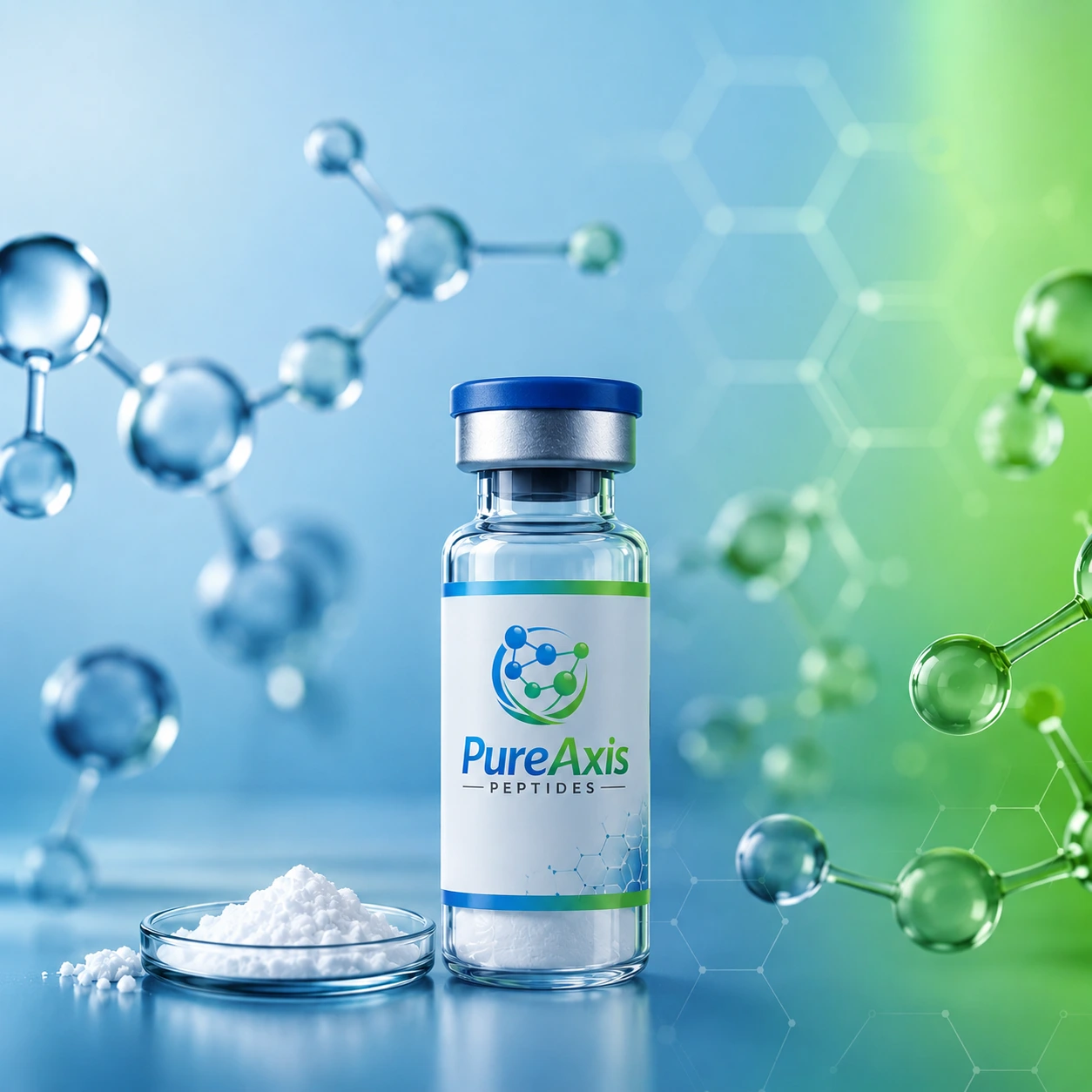


Quick Specifications
| Purity (%) | 98.9 |
|---|
GHRP-6 Acetate Research Peptide
GHRP-6 Acetate, also known as Growth Hormone-Releasing Peptide-6, is a synthetic hexapeptide extensively studied as a growth hormone secretagogue.
GHRP-6 provides researchers with an experimental tool for investigating the growth hormone secretagogue receptor (GHS-R), pituitary signaling, growth hormone release and the relationship between ghrelin-related pathways and endocrine regulation.
Pure Axis Peptides offers GHRP-6 Acetate as a research-use peptide for qualified laboratory and scientific investigations.
What Is GHRP-6?
GHRP-6 is a synthetic peptide belonging to the growth hormone-releasing peptide (GHRP) family.
Unlike growth hormone itself, GHRP-6 is studied as a secretagogue: its research significance comes from its ability to stimulate signaling pathways associated with endogenous growth hormone secretion.
Scientific studies have identified the growth hormone secretagogue receptor, or GHS-R, as a key receptor through which GHRP-6 and related compounds exert their effects. The endogenous hormone ghrelin is also a ligand for this receptor system.
GHRP-6 and the Ghrelin Receptor
One of the most important research areas surrounding GHRP-6 is its relationship with ghrelin receptor signaling.
GHRP-6 has been investigated in receptor-binding and signal-transduction studies examining its interaction with GHS-R. Experimental research has demonstrated that GHRP-6 can activate ghrelin-receptor-associated signaling pathways, while also showing that its signaling behavior can vary depending on the experimental system being studied.
This makes GHRP-6 particularly useful for research into:
- GHS-R signaling
- Ghrelin receptor biology
- Growth hormone secretagogues
- GPCR signaling
- Pituitary endocrinology
- Peptide-receptor interactions
- Signal-transduction pathways
GHRP-6 and Growth Hormone Research
GHRP-6 has been extensively studied for its ability to stimulate growth hormone (GH) secretion.
Human experimental research has demonstrated that endogenous growth hormone-releasing hormone (GHRH) contributes substantially to the GH response produced by GHRP-6. In one controlled study, blocking GHRH markedly reduced the GH response to GHRP-6, demonstrating the importance of interaction between the two regulatory systems.
This provides a useful model for researchers studying the integration of hypothalamic and pituitary signals controlling GH secretion.
GHRP-6 and Pituitary Research
The anterior pituitary contains specialized somatotroph cells responsible for growth hormone production.
Research has demonstrated that GHRP-6 can influence Pit-1, a pituitary transcription factor involved in somatotroph differentiation and GH gene expression.
In cultured rat anterior pituitary cells, GHRP-6 produced time- and dose-dependent activation of Pit-1 expression. Related experiments in GHS-R-expressing cells implicated intracellular pathways including PKC, MAPK and PKA signaling.
These findings make GHRP-6 relevant to molecular research involving endocrine transcription and pituitary-cell signaling.
GHRP-6 and Endocrine Signaling
The physiological regulation of growth hormone involves multiple interacting systems, including:
- Growth hormone-releasing hormone
- Somatostatin
- Ghrelin
- Growth hormone secretagogue receptors
- Pituitary somatotroph cells
- Growth hormone
- IGF-1
GHRP-6 provides researchers with a tool for investigating the GHS-R/ghrelin component of this regulatory network.
Research comparing GHRP-6 with other growth hormone secretagogues can also help characterize differences in receptor signaling, ligand selectivity and downstream cellular responses.
GHRP-6 Research Applications
GHRP-6 Acetate may be relevant to laboratory studies involving:
Growth Hormone Research: Investigating mechanisms controlling GH secretion.
GHS-R Research: Studying the growth hormone secretagogue receptor.
Ghrelin Biology: Examining ghrelin-receptor signaling and ligand interactions.
Pituitary Research: Investigating somatotroph-cell signaling and Pit-1 regulation.
Endocrinology: Studying hypothalamic-pituitary hormone regulation.
Signal Transduction: Examining PKC, PKA and MAPK-associated pathways.
Peptide Pharmacology: Investigating structure-function relationships between peptide ligands and GPCRs.
GHRP-6 and GHRH Interaction
An important feature of GHRP-6 research is its interaction with the GHRH system.
GHRP-6 does not simply operate as an isolated GH signal. Experimental evidence indicates that endogenous GHRH is required for much of the GH response to GHRP-6 in humans. This highlights the interconnected nature of hypothalamic and pituitary regulation of GH secretion.
For researchers, this makes GHRP-6 useful in experimental models examining the interaction between GHRH-mediated and GHS-R-mediated signaling.
GHRP-6 and Ghrelin Signaling
Ghrelin is an endogenous peptide hormone and a natural ligand for GHS-R.
Research comparing GHRP-6 and ghrelin has examined whether synthetic growth hormone secretagogues reproduce, modify or otherwise interact with endogenous ghrelin signaling.
Studies have found that GHRP-6 can influence ghrelin-receptor signaling in ways that depend on the particular signaling pathway being measured.
This makes the peptide valuable for receptor pharmacology and comparative ligand research.
GHRP-6 Acetate Research Applications
Researchers may investigate GHRP-6 Acetate in:
- Growth hormone secretion models
- Pituitary-cell research
- GHS-R receptor studies
- Ghrelin signaling
- Endocrine pharmacology
- GPCR signaling
- Peptide-receptor binding
- Pit-1 transcription research
- MAPK signaling
- PKA/PKC signaling
- Hypothalamic-pituitary research
- Growth hormone secretagogue comparisons
GHRP-6 Acetate vs. Other GH Research Peptides
GHRP-6 belongs to a broader group of experimental compounds affecting the GH axis.
For SEO and scientific organization, related products can be internally connected around distinct mechanisms:
GHRP-6 → GHS-R / ghrelin receptor signaling
GHRH analogues → GHRH receptor signaling
GH-related peptides → downstream growth-hormone biology
This distinction helps researchers understand that different peptide classes can interact with different parts of the endocrine regulatory network.
Research Use Only
GHRP-6 Acetate supplied by Pure Axis Peptides is intended strictly for laboratory and scientific research. It is not intended for human consumption, self-administration, diagnosis, treatment, cure, or prevention of any disease or medical condition. GHRP-6 is a pharmacologically active growth hormone secretagogue and should be handled by appropriately qualified personnel according to applicable laboratory procedures, institutional requirements and product documentation.
Internal Linking Recommendations
Primary Internal Links
- Growth Hormone / GH Peptides →
[INSERT LIVE CATEGORY URL] - Peptides →
https://pureaxispeptides.com/product-category/peptides/ - Research Chemicals →
https://pureaxispeptides.com/product-category/research-chemicals/ - Shop All Products →
https://pureaxispeptides.com/shop/
If the catalog contains related products such as GHRP-2, Ipamorelin, CJC-1295, or Sermorelin, those pages should be linked from this product and should link back to GHRP-6 using descriptive anchors such as:
- “GHRP-6 growth hormone secretagogue”
- “GHS-R research peptide”
- “GHRP-6 acetate”
- “ghrelin receptor research”
Verify the live WooCommerce URLs before publishing.
External Scientific References
- PubMed — GHRP-6 and Pit-1 regulation:
https://pubmed.ncbi.nlm.nih.gov/11518797/ - PubMed — GHRP-6 and GHRH interaction in humans:
https://pubmed.ncbi.nlm.nih.gov/9543138/ - PubMed — GHRP-6 and ghrelin receptor biology:
https://pubmed.ncbi.nlm.nih.gov/11322507/ - PubMed — GHRP-6 and GHS-R signal transduction:
https://pubmed.ncbi.nlm.nih.gov/15905359/
Product Tags
GHRP-6, GHRP 6, GHRP-6 Acetate, GHRP6 Acetate, Growth Hormone Releasing Peptide-6, Growth Hormone-Releasing Peptide 6, GHRP-6 Peptide, GHRP-6 Research Peptide, GHRP Research, Growth Hormone Secretagogue, GH Secretagogue, Growth Hormone Research, GHS-R, GHS-R Research, Ghrelin Receptor, Ghrelin Research, Ghrelin Signaling, Pituitary Research, Pit-1 Research, Endocrine Research, Growth Hormone Signaling, GHRH Research, GPCR Research, Peptide Pharmacology, Peptide-Receptor Research, Laboratory Research
| Purity (%) | 98.9 |
|---|---|
| Lab Tested | yes |
| Research Grade | yes |
| Third Party Tested | yes |
| Strength | 10mg, 5mg |
|---|---|
| Volume | 10 vials |
Be the first to review “GHRP-6 Acetate”
Need Assistance?
Our research specialists are here to help with product selection and technical questions.
Related products

Growth Hormone Releasing
Growth Hormone Releasing Price range: $80.00 through $190.00Long-acting GHRH analog for sustained GH research

Growth Hormone Releasing
Growth Hormone Releasing $90.00Growth hormone secretagogue for cardiac and GH research

Blends
BlendsCJC-1295 without DAC 5mg + Ipamorelin 5mg Blend
$122.00Growth hormone secretagogue blend for GH research

Growth Hormone Releasing
Growth Hormone Releasing $100.00PEGylated mechano growth factor for extended muscle research
Growth Hormone Releasing
Growth Hormone Releasing Price range: $76.00 through $157.00GHRH analog for natural growth hormone stimulation research

Growth Hormone Releasing
Growth Hormone Releasing Price range: $27.00 through $54.00Growth hormone releasing peptide for GH axis research
Growth Hormone Releasing
Growth Hormone Releasing Price range: $43.00 through $85.00Recombinant human growth hormone for endocrine research
 GHRP-6 Acetate
Price range: $27.00 through $54.00
GHRP-6 Acetate
Price range: $27.00 through $54.00
Reviews
There are no reviews yet.