
Quick Specifications
| Purity (%) | 98.9 |
|---|
NAD+ Research Material
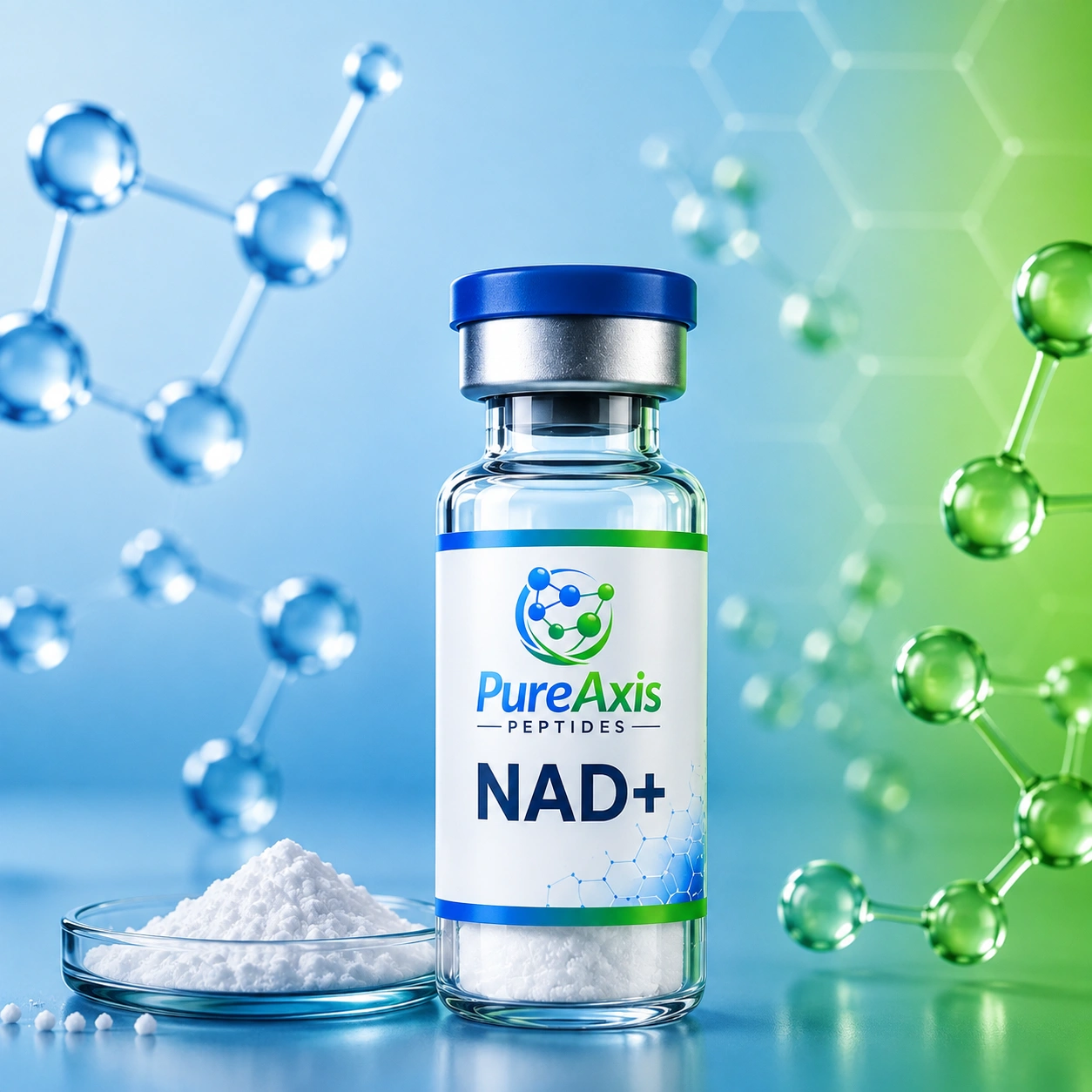
NAD+ (nicotinamide adenine dinucleotide) is an essential cellular cofactor involved in energy metabolism, redox reactions, DNA repair, mitochondrial function and cell-signaling pathways.
NAD+ exists in oxidized and reduced forms, NAD+ and NADH, allowing it to participate in reversible electron-transfer reactions throughout cellular metabolism.
Pure Axis Peptides offers NAD+ as a research-use material for qualified laboratory and scientific investigations involving cellular metabolism, mitochondrial biology, redox signaling and NAD+-dependent biochemical pathways.
What Is NAD+?
Nicotinamide adenine dinucleotide is a small molecule present in virtually all living cells.
Its central biological role is as a redox cofactor, allowing electrons to be transferred during metabolic reactions. NAD+ is particularly important in pathways involved in glycolysis, the citric-acid cycle and oxidative phosphorylation.
Beyond metabolism, NAD+ also functions as a substrate for several enzyme families involved in cellular regulation, including sirtuins, PARPs and CD38/CD157.
This combination of metabolic and signaling functions makes NAD+ an important subject in modern cellular-biology research.
NAD+ and Cellular Energy Metabolism
NAD+ is central to the conversion of nutrients into usable cellular energy.
During metabolic reactions, NAD+ accepts electrons and becomes NADH. NADH can subsequently transfer those electrons through mitochondrial pathways involved in ATP production.
Researchers studying NAD+ can therefore investigate relationships between:
NAD+ ↔ NADH → metabolic oxidation → mitochondrial electron transport → ATP production
Changes in NAD+/NADH balance can provide information about cellular metabolic state and redox conditions.
NAD+ and Mitochondrial Research
Mitochondria depend heavily on NAD+-linked metabolic reactions.
NADH generated through glycolysis and the citric-acid cycle supplies reducing equivalents to the mitochondrial electron-transport chain. NAD+ availability therefore has an important relationship with cellular respiration and mitochondrial metabolism.
Research involving NAD+ can examine:
- Mitochondrial metabolism
- Oxidative phosphorylation
- Cellular respiration
- ATP production
- Redox balance
- Metabolic stress
- Mitochondrial signaling
- Energy homeostasis
NAD+ metabolism is also being investigated in relation to mitochondrial dysfunction and age-associated cellular changes.
NAD+ and Sirtuin Research
One of the most important signaling connections involving NAD+ is the sirtuin family of NAD+-dependent enzymes.
Mammalian sirtuins, including SIRT1 through SIRT7, use NAD+ as a substrate during protein deacetylation and related reactions.
Because sirtuin activity depends on NAD+ availability, researchers have investigated whether changes in NAD+ metabolism can influence:
- Protein acetylation
- Gene regulation
- Mitochondrial function
- Stress responses
- Metabolic signaling
- Cellular aging
This relationship has made the NAD+–sirtuin axis a major area of aging and metabolic research.
NAD+ and DNA Repair
NAD+ is also consumed by enzymes involved in DNA-damage responses.
The poly(ADP-ribose) polymerase (PARP) family uses NAD+ during the synthesis of poly(ADP-ribose), an important cellular response to DNA damage.
Consequently, DNA damage and NAD+ metabolism are biologically interconnected.
Researchers can investigate how changes in NAD+ availability affect:
- PARP activity
- DNA-damage responses
- Genome maintenance
- Cellular stress
- NAD+ consumption
- Cellular survival pathways
This provides another major research application for NAD+ beyond its traditional role as a metabolic cofactor.
NAD+ and CD38
CD38 is another important NAD+-consuming enzyme.
CD38 can metabolize NAD+ and generate signaling molecules involved in calcium-related cellular processes.
The balance between NAD+ synthesis and consumption by enzymes including PARPs, sirtuins and CD38 is therefore an important component of cellular NAD+ homeostasis.
This makes NAD+ relevant to experimental studies investigating how cellular NAD+ pools are regulated.
NAD+ and Redox Biology
The NAD+/NADH couple is one of the fundamental redox systems in biology.
Researchers can measure NAD+ and NADH to investigate cellular oxidation-reduction status and metabolic changes.
NAD+-related redox research may involve:
- Oxidative stress
- Redox homeostasis
- Metabolic flexibility
- Mitochondrial function
- Reactive oxygen species
- Cellular stress responses
- Energy metabolism
Because NAD+ participates in both metabolic and signaling reactions, its concentration alone does not necessarily provide a complete picture of cellular redox status.
NAD+ and Cellular Aging
NAD+ has become an important subject in cellular aging and longevity research.
Preclinical studies have reported age-associated changes in NAD+ metabolism and have investigated whether restoring NAD+ availability can influence mitochondrial function, metabolic health and other age-related biological processes.
However, the human evidence is more complicated.
A 2025 review concluded that evidence for an age-related decline in NAD+ in humans remains limited to a relatively small number of studies and that clinical trials involving NAD+ precursors have generally shown limited efficacy for broader health outcomes.
A large 2026 analysis further reported that whole-blood NAD+ levels remained remarkably stable with age across seven human cohorts, challenging the assumption that blood NAD+ universally declines with aging.
For this reason, the scientifically appropriate positioning is “NAD+ longevity research” rather than claiming that NAD+ itself reverses aging.
NAD+ and Longevity Research
NAD+ research has become closely associated with the broader study of longevity because NAD+-dependent enzymes participate in mitochondrial regulation, DNA repair, cellular stress responses and metabolism.
Research programs may investigate NAD+ alongside:
- Sirtuins
- PARP enzymes
- CD38
- Mitochondrial function
- Cellular senescence
- DNA repair
- Metabolic aging
- Oxidative stress
- Cellular energy metabolism
The relationship between NAD+ and aging is an active research field rather than an established clinical anti-aging intervention.
NAD+ vs. NAD+ Precursors
NAD+ should be distinguished from compounds commonly described as NAD+ precursors.
Important NAD-related molecules include:
- Nicotinamide riboside (NR)
- Nicotinamide mononucleotide (NMN)
- Nicotinamide
- Nicotinic acid
These compounds participate in pathways that can contribute to NAD+ biosynthesis.
Research on NR and NMN is therefore related to NAD+ biology but should not be presented as identical to research involving NAD+ itself. Recent human evidence has demonstrated biochemical NAD-related target engagement with some precursor interventions, while broader clinical outcomes remain heterogeneous.
NAD+ Research Applications
NAD+ may be relevant to laboratory studies involving:
Cellular Metabolism: Investigating metabolic reactions and NAD+/NADH balance.
Mitochondrial Biology: Studying oxidative phosphorylation, respiration and energy metabolism.
Redox Research: Examining cellular oxidation-reduction processes.
DNA Repair: Investigating NAD+-dependent PARP activity and DNA-damage responses.
Sirtuin Biology: Studying NAD+-dependent deacetylation and cellular signaling.
Aging Research: Examining NAD+ metabolism in cellular and age-related models.
Metabolic Research: Investigating relationships between NAD+ availability and metabolic regulation.
Cellular Stress: Studying how NAD+ metabolism responds to oxidative and metabolic stress.
NAD+ and Cellular Health Research
NAD+ represents an intersection between several major fields of modern molecular biology.
Its roles in metabolism, mitochondrial function, DNA repair and enzyme signaling mean that changes in NAD+ availability can potentially influence multiple cellular pathways simultaneously.
For laboratory researchers, this makes NAD+ valuable as both a biochemical substrate and a marker of cellular metabolic state.
Research Material
Researchers should verify the current Pure Axis Peptides product specification, chemical identity, purity, formulation, storage requirements and batch-specific certificate of analysis (COA) before laboratory use.
NAD+ is chemically distinct from its reduced form, NADH, as well as from NAD+ precursors such as NR and NMN. Analytical verification is therefore important when precise biochemical identity is required.
Explore Related Research
NAD+ fits naturally into a broader longevity, cellular health and metabolic research cluster.
Explore the Longevity & Cellular Health collection for related research compounds.
Researchers interested in metabolic pathways can explore the Obesity & Metabolism collection.
Browse the broader Peptides collection or Research Chemicals for additional laboratory materials.
Visit Shop All Products for the complete Pure Axis Peptides catalog.
Research Use Only
NAD+ supplied by Pure Axis Peptides is intended strictly for laboratory and scientific research. It is not intended for human consumption, self-administration, diagnosis, treatment, cure, or prevention of any disease or medical condition. Research concerning NAD+ metabolism, longevity or cellular aging should not be interpreted as establishing that NAD+ administration reverses aging, extends human lifespan or treats disease. Researchers should evaluate all materials according to their experimental requirements, product documentation and applicable laboratory procedures.
Internal Linking Recommendations
Primary Internal Links
- Longevity & Cellular Health →
https://pureaxispeptides.com/product-category/peptides/longevity-cellular-health/ - Obesity & Metabolism →
https://pureaxispeptides.com/product-category/peptides/obesity-metabolism/ - Peptides →
https://pureaxispeptides.com/product-category/peptides/ - Research Chemicals →
https://pureaxispeptides.com/product-category/research-chemicals/ - Shop All Products →
https://pureaxispeptides.com/shop/
Verify the live WooCommerce URLs before publishing.
Recommended Internal-Link Anchors
Use varied contextual anchors such as:
- “NAD+ research”
- “cellular metabolism research”
- “longevity and cellular health”
- “mitochondrial research”
- “redox biology research”
- “metabolic research compounds”
- “cellular aging research”
If the catalog contains NMN, NR, NADH, or related NAD-pathway products, link those pages to NAD+ and create a dedicated NAD+ metabolism topical cluster.
External Scientific References
- PubMed — NAD+ metabolism and cellular processes during aging:
https://pubmed.ncbi.nlm.nih.gov/37848251/ - PubMed — NAD+ metabolism and sirtuin signaling:
https://pubmed.ncbi.nlm.nih.gov/23742622/ - PubMed — NAD metabolism, aging and longevity:
https://pubmed.ncbi.nlm.nih.gov/29883761/ - PubMed — NAD+ precursor supplementation and human aging, 2025:
https://pubmed.ncbi.nlm.nih.gov/41083806/ - PubMed — NAD+ supplementation systematic review, 2026:
https://pubmed.ncbi.nlm.nih.gov/41655607/ - PubMed — Human whole-blood NAD+ levels and aging, 2026:
https://pubmed.ncbi.nlm.nih.gov/42135539/ - PubMed — NAD+ metabolism and neurodegeneration:
https://pubmed.ncbi.nlm.nih.gov/28548540/
Product Tags
NAD+, NAD Plus, NAD, Nicotinamide Adenine Dinucleotide, NAD+ Research, NAD Research, NAD+ Research Compound, NAD+ Peptide, Cellular Energy, Cellular Metabolism, NAD+ Metabolism, NADH, NAD NADH, Redox Biology, Redox Homeostasis, Oxidative Stress Research, Mitochondrial Research, Mitochondrial Biology, Mitochondrial Function, Sirtuin Research, SIRT1, Sirtuin Signaling, PARP Research, DNA Repair Research, CD38 Research, Cellular Aging, Aging Research, Longevity Research, Cellular Health, Metabolic Research, Energy Metabolism, Research Compound, Laboratory Research
| Purity (%) | 98.9 |
|---|---|
| Lab Tested | yes |
| Research Grade | yes |
| Third Party Tested | yes |
| Strength | 1000mg, 100mg, 500mg |
|---|---|
| Volume | 10 vials |
Be the first to review “NAD+”
Need Assistance?
Our research specialists are here to help with product selection and technical questions.
Related products

Longevity & Cellular Health
Longevity & Cellular Health $380.00Senolytic peptide for cellular senescence and aging research

Longevity & Cellular Health
Longevity & Cellular Health Price range: $70.00 through $244.00Mitochondrial peptide for exercise mimetic and longevity research
Longevity & Cellular Health
Longevity & Cellular Health Price range: $40.00 through $98.00Master antioxidant tripeptide for oxidative stress research

Longevity & Cellular Health
Longevity & Cellular Health Price range: $38.00 through $176.00Tetrapeptide for telomerase activation and aging research
Longevity & Cellular Health
Longevity & Cellular Health Price range: $105.00 through $407.00Mitochondria-targeted peptide for cardiolipin and aging research
 NAD+
Price range: $54.00 through $176.00
NAD+
Price range: $54.00 through $176.00
Reviews
There are no reviews yet.