




Quick Specifications
| Purity (%) | 98.9 |
|---|
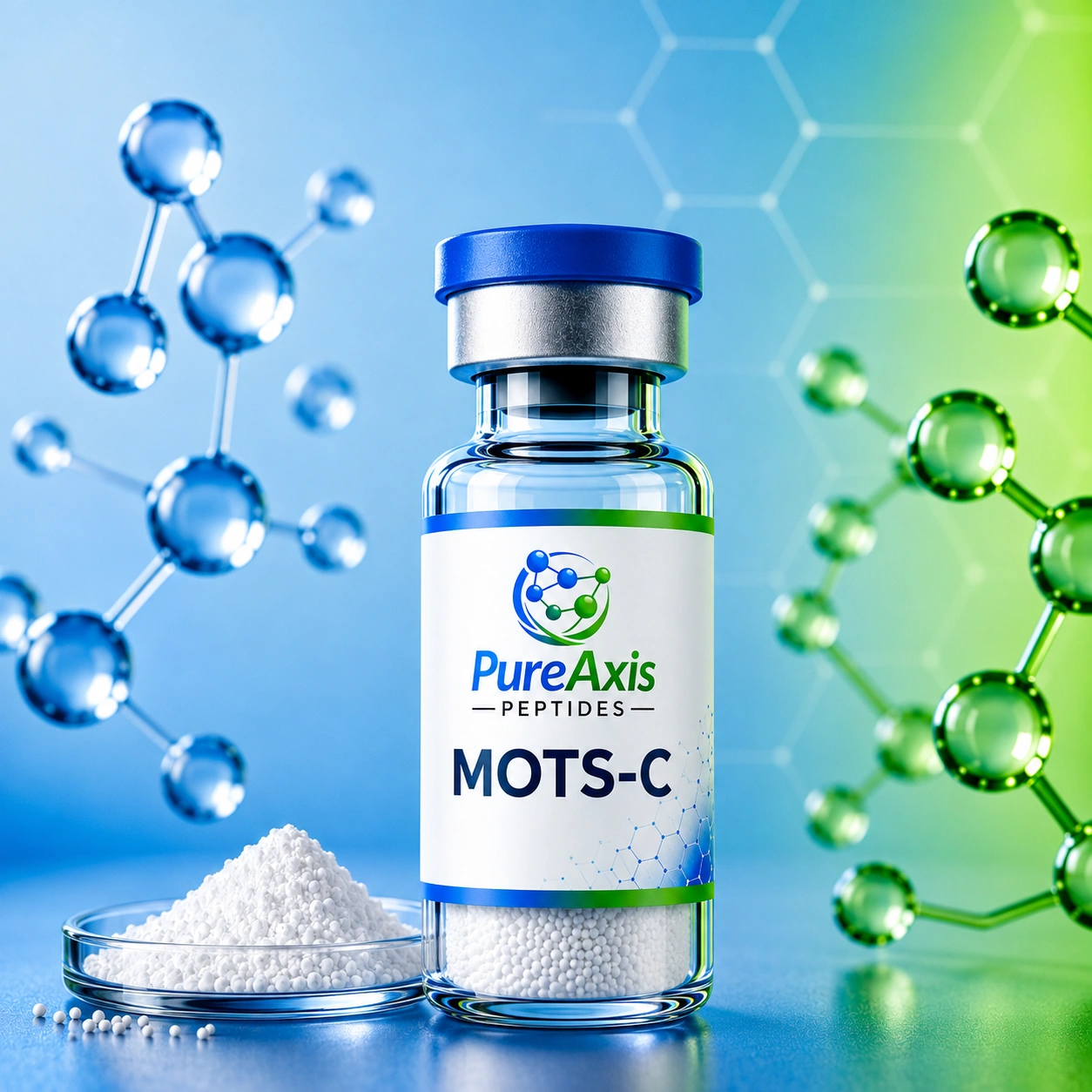
MOTS-C Research Peptide
MOTS-C is a naturally occurring mitochondrial-derived peptide encoded by a short open reading frame within the mitochondrial 12S rRNA region. The 16-amino-acid peptide has attracted significant interest in mitochondrial biology, metabolic research, cellular stress responses and longevity science.
Pure Axis Peptides offers MOTS-C as a research-use peptide for qualified laboratory and scientific investigations.
What Is MOTS-C?
MOTS-C stands for Mitochondrial Open Reading Frame of the 12S rRNA-c. Unlike conventional peptides encoded by nuclear genes, MOTS-C is encoded within the mitochondrial genome.
MOTS-C belongs to the growing family of mitochondrial-derived peptides (MDPs), which includes other signaling peptides such as Humanin. These molecules are being investigated for their potential roles in communication between mitochondria and the rest of the cell.
Research has identified MOTS-C in circulation and multiple tissues, with experimental work investigating how its expression and signaling change in response to metabolic and cellular stress.
MOTS-C and Mitochondrial Research
Mitochondria play central roles in cellular energy production, metabolism and stress responses.
MOTS-C has become an important research molecule because experimental studies suggest that it can influence metabolic signaling and cellular responses to stress.
Research has investigated MOTS-C in relation to:
- Mitochondrial signaling
- Cellular energy metabolism
- Metabolic homeostasis
- Oxidative stress
- AMPK signaling
- AKT signaling
- Insulin sensitivity
- Cellular stress responses
- Exercise biology
- Aging research
These areas make MOTS-C particularly relevant to laboratories studying the relationship between mitochondrial function and cellular metabolism.
MOTS-C and Metabolic Signaling
One of the major research areas surrounding MOTS-C is metabolic regulation.
Experimental literature has linked MOTS-C with signaling pathways involved in glucose utilization, energy balance and metabolic stress. Human observational research has also examined circulating MOTS-C in relation to metabolic conditions.
For example, a human study investigating individuals with obesity found lower circulating MOTS-C levels in obese male children and adolescents and reported associations with markers including insulin resistance and HbA1c. These findings are observational and do not establish that MOTS-C supplementation or administration produces the opposite effect.
Another human study examining PCOS and healthy participants investigated how insulin and lipid exposure affected circulating MOTS-C concentrations, providing additional evidence that MOTS-C is responsive to metabolic conditions.
MOTS-C and AMPK Research
AMP-activated protein kinase (AMPK) is a major cellular energy sensor.
MOTS-C research has focused on the relationship between mitochondrial-derived signaling and AMPK-dependent metabolic pathways. This makes the peptide relevant to experimental studies investigating how cells respond when energy availability changes.
Research programs may examine MOTS-C alongside:
- AMPK activation
- AKT signaling
- Glucose metabolism
- Insulin signaling
- Cellular energy status
- Mitochondrial function
- Metabolic stress
The interaction between MOTS-C and these pathways remains an active research area.
MOTS-C and Cellular Stress
Mitochondrial-derived peptides are increasingly studied as signaling molecules involved in cellular responses to physiological stress.
MOTS-C research has examined how mitochondrial stress can influence peptide signaling and how MOTS-C may subsequently affect nuclear and metabolic pathways.
This provides a useful model for studying mitochondria-to-nucleus communication, cellular adaptation and metabolic stress responses.
MOTS-C and Exercise Research
Exercise is another important area of MOTS-C research.
Human research has measured circulating MOTS-C before and after exercise and investigated changes in mitochondrial-derived peptide levels following endurance and resistance exercise.
A controlled human study found that acute endurance exercise altered circulating mitochondrial-derived peptide levels, with a trend toward increased MOTS-C following endurance exercise. The researchers did not find a simple relationship between circulating MDP levels and fitness outcomes.
This makes MOTS-C useful for experimental research examining the relationship between exercise, mitochondrial signaling and metabolic adaptation.
MOTS-C and Skeletal Muscle Research
MOTS-C has also been investigated directly in human skeletal muscle models.
A 2026 study examined MOTS-C in cultured human skeletal myotubes exposed to dexamethasone. In that experimental system, MOTS-C co-treatment preserved myotube area and fusion index and altered signaling associated with muscle atrophy.
These findings are useful for understanding MOTS-C’s potential role in muscle-cell metabolism and stress responses, while remaining experimental rather than evidence of a clinically established treatment.
MOTS-C and Cellular Aging
MOTS-C is frequently discussed within longevity and aging research because mitochondrial dysfunction and metabolic stress are closely connected with biological aging.
Research has investigated MOTS-C levels in relation to age and age-associated conditions. Reviews have highlighted its potential role in metabolic regulation and cellular homeostasis, while emphasizing the need for further research.
For SEO purposes, terms such as “longevity research,” “mitochondrial aging,” and “cellular health research” are appropriate. Claims that MOTS-C reverses aging or extends human lifespan should not be made.
MOTS-C and Mitochondrial-Derived Peptide Research
MOTS-C is part of a broader group of mitochondrial-derived peptides.
These peptides are particularly interesting because they challenge the traditional view of mitochondria as purely energy-producing organelles. Research increasingly investigates mitochondria as sources of signaling molecules capable of communicating metabolic and stress information throughout the cell and organism.
MOTS-C and Humanin are two prominent examples of this research field.
MOTS-C and Longevity Research
MOTS-C has attracted attention in longevity research because mitochondrial function, metabolic regulation and cellular stress responses are all important areas of aging biology.
However, the distinction between longevity research and an established anti-aging treatment is critical.
Current literature provides mechanistic, cellular, animal and observational evidence supporting continued investigation of MOTS-C, but this does not establish that the peptide extends human lifespan or reverses biological aging.
MOTS-C Research Applications
MOTS-C may be relevant to laboratory research involving:
- Mitochondrial-derived peptides
- Mitochondrial biology
- Metabolic signaling
- AMPK research
- AKT signaling
- Insulin signaling
- Glucose metabolism
- Cellular energy homeostasis
- Oxidative stress
- Cellular stress responses
- Skeletal muscle research
- Exercise biology
- Cellular aging
- Longevity research
- Mitochondria-to-nucleus signaling
- Metabolic neuroscience
- Peptide signaling
MOTS-C and Emerging Research
MOTS-C remains an active research area, with new studies continuing to examine its role in different cellular systems.
Recent work has investigated MOTS-C in human mesenchymal stromal cells, finding effects on metabolic signaling while also demonstrating that its biological effects can be context-dependent.
Other 2026 research investigated MOTS-C in relation to ferroptosis and spermatogenesis, identifying SLC7A11 as a potential mechanistic target in an experimental model.
These studies illustrate why MOTS-C should be approached as an experimental research peptide, with biological effects evaluated according to the specific model and conditions rather than generalized into broad therapeutic claims.
MOTS-C Research Material
Researchers should verify the current Pure Axis Peptides product specification, peptide purity, storage requirements and batch-specific certificate of analysis (COA) before laboratory use.
For experiments involving MOTS-C, analytical confirmation of peptide identity and purity is particularly important because mitochondrial-derived peptides are often studied at the molecular and cellular level.
Explore Related Research Peptides
MOTS-C fits naturally into a broader longevity, mitochondrial and metabolic research cluster.
Explore the Longevity & Cellular Health collection for related research compounds.
Researchers investigating metabolic signaling can also explore the Obesity & Metabolism collection.
For additional peptide research materials, browse the Peptides collection.
Visit Shop All Products for the complete Pure Axis Peptides catalog.
Research Use Only
MOTS-C supplied by Pure Axis Peptides is intended strictly for laboratory and scientific research. It is not intended for human consumption, self-administration, diagnosis, treatment, cure, or prevention of any disease or medical condition. Research involving MOTS-C should not be interpreted as establishing human therapeutic efficacy, anti-aging effects, lifespan extension, or treatment of metabolic disease. Researchers should evaluate all materials according to their experimental requirements, product documentation and applicable laboratory procedures.
Internal Linking Recommendations
Primary Internal Links
- Longevity & Cellular Health →
https://pureaxispeptides.com/product-category/peptides/longevity-cellular-health/ - Obesity & Metabolism →
https://pureaxispeptides.com/product-category/peptides/obesity-metabolism/ - Peptides →
https://pureaxispeptides.com/product-category/peptides/ - Research Chemicals →
https://pureaxispeptides.com/product-category/research-chemicals/ - Shop All Products →
https://pureaxispeptides.com/shop/
Verify the live WooCommerce URLs before publishing.
Recommended Internal Anchor Text
Use contextual links such as:
- “mitochondrial-derived peptide research”
- “longevity and cellular health peptides”
- “metabolic research peptides”
- “mitochondrial research”
- “cellular aging research”
- “metabolic signaling research”
Avoid repeatedly linking with the exact-match phrase “MOTS-C peptide”; varied semantic anchors will produce a more natural internal-link profile.
External Scientific References
- PubMed — MOTS-c and human aging/age-related disease research:
https://pubmed.ncbi.nlm.nih.gov/36233287/ - PubMed — MOTS-c and longevity research:
https://pubmed.ncbi.nlm.nih.gov/26289118/ - PubMed — MOTS-c, obesity and insulin resistance:
https://pubmed.ncbi.nlm.nih.gov/29691953/ - PubMed — Lipids, insulin and MOTS-c in humans:
https://pubmed.ncbi.nlm.nih.gov/31066084/ - PubMed — MOTS-c and exercise in humans:
https://pubmed.ncbi.nlm.nih.gov/34351816/ - PubMed — MOTS-c and human skeletal muscle cells, 2026:
https://pubmed.ncbi.nlm.nih.gov/41732124/ - PubMed — MOTS-c and mitochondrial/stromal-cell research, 2026:
https://pubmed.ncbi.nlm.nih.gov/42324588/ - PubMed — MOTS-c, ferroptosis and spermatogenesis, 2026:
https://pubmed.ncbi.nlm.nih.gov/41933740/
Product Tags
MOTS-C, MOTS C, MOTS-c Peptide, MOTS-C Research Peptide, MOTS-C Research, Mitochondrial-Derived Peptide, Mitochondrial Derived Peptide, MDP, Mitochondrial Peptide, Mitochondrial Research, Mitochondrial Biology, Metabolic Research, Metabolic Peptide, Metabolic Signaling, AMPK Research, AMPK Signaling, AKT Signaling, Insulin Signaling, Glucose Metabolism, Energy Homeostasis, Cellular Stress, Oxidative Stress Research, Skeletal Muscle Research, Exercise Research, Cellular Aging, Longevity Research, Mitochondria-to-Nucleus Signaling, Cellular Health, Research Peptide, Laboratory Research
| Purity (%) | 98.9 |
|---|---|
| Lab Tested | yes |
| Research Grade | yes |
| Third Party Tested | yes |
| Strength | 10mg, 40mg |
|---|---|
| Volume | 10 vials |
Be the first to review “MOTS-C”
Need Assistance?
Our research specialists are here to help with product selection and technical questions.
Related products

Longevity & Cellular Health
Longevity & Cellular Health Price range: $54.00 through $176.00Essential coenzyme for cellular energy and longevity research

Longevity & Cellular Health
Longevity & Cellular Health $380.00Senolytic peptide for cellular senescence and aging research
Longevity & Cellular Health
Longevity & Cellular Health Price range: $105.00 through $407.00Mitochondria-targeted peptide for cardiolipin and aging research
Longevity & Cellular Health
Longevity & Cellular Health Price range: $40.00 through $98.00Master antioxidant tripeptide for oxidative stress research

Longevity & Cellular Health
Longevity & Cellular Health Price range: $38.00 through $176.00Tetrapeptide for telomerase activation and aging research
 MOTS-C
Price range: $70.00 through $244.00
MOTS-C
Price range: $70.00 through $244.00
Reviews
There are no reviews yet.