


Quick Specifications
| Purity (%) | 98.9 |
|---|
Melatonin — SEO Product Content
SEO Title
Melatonin Research | MT1/MT2 Receptor & Circadian Rhythm Research
SEO Meta Description
Melatonin research material for studies of MT1 and MT2 receptors, circadian rhythms, sleep-wake regulation, chronobiology, pineal signaling and neuroendocrine biology.
Suggested URL Slug
/product/melatonin/
SEO Product Description
Melatonin Research Material
Melatonin is an endogenous indoleamine hormone best known for its role in regulating circadian timing, sleep-wake physiology and photoperiodic signaling.
Chemically known as N-acetyl-5-methoxytryptamine, melatonin is produced primarily by the pineal gland, with synthesis and release strongly influenced by the light-dark cycle. Circulating melatonin concentrations are typically low during the daytime and rise during darkness.
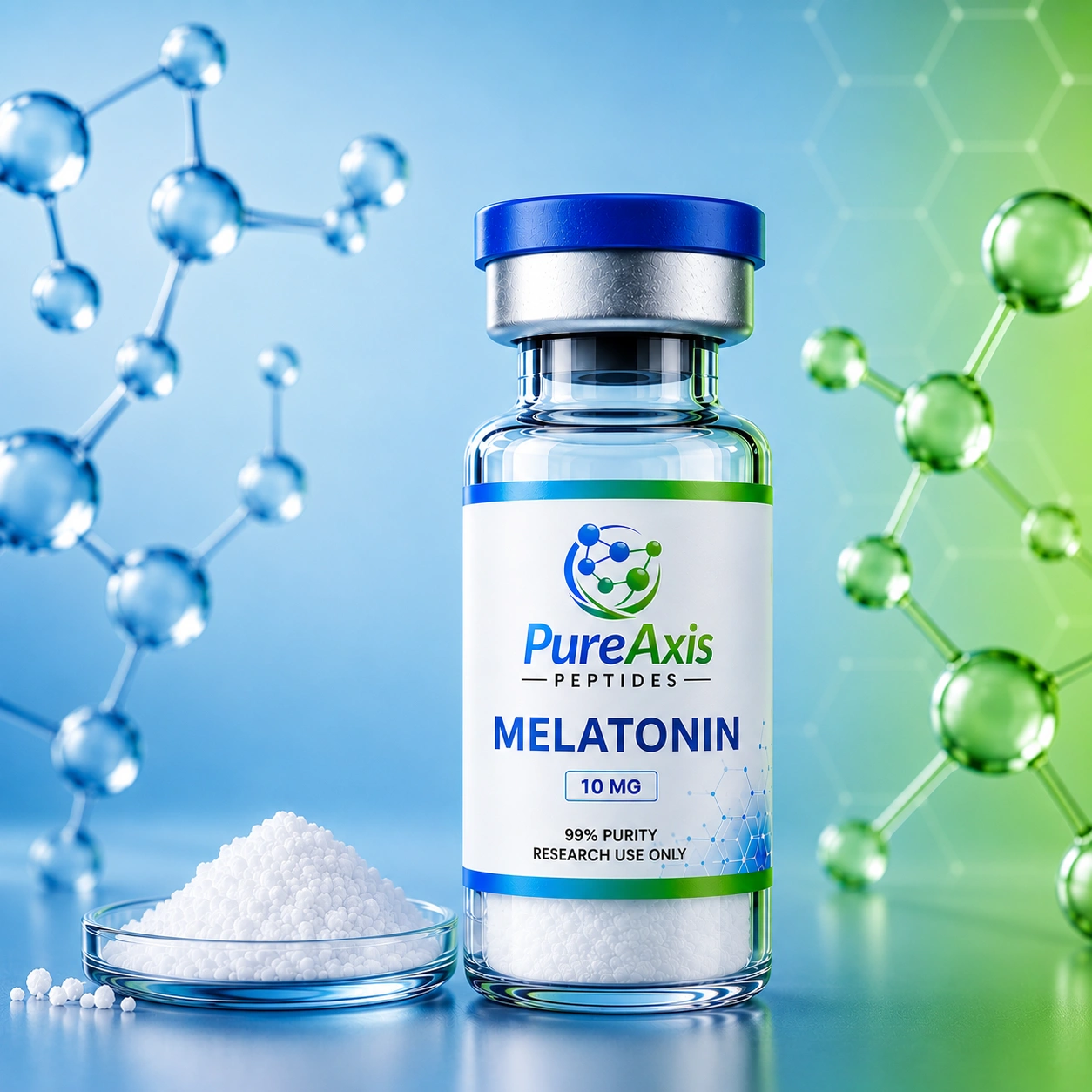
Pure Axis Peptides offers Melatonin as a research-use material for qualified laboratory and scientific investigations.
What Is Melatonin?
Melatonin is a naturally occurring hormone derived from tryptophan through the serotonin pathway.
Its production is closely associated with the body’s central circadian timing system.
A simplified pathway is:
Light/Dark Cycle → Circadian Clock → Pineal Gland → Melatonin → MT1/MT2 Receptors → Circadian & Sleep Responses
This makes melatonin an important experimental molecule for investigating:
- Circadian rhythm biology
- Sleep-wake regulation
- Chronobiology
- MT1 receptor signaling
- MT2 receptor signaling
- Neuroendocrine physiology
- Photoperiodic signaling
- Biological timing
Melatonin and the Circadian Rhythm
One of the most important functions studied with melatonin is its relationship with the circadian rhythm.
The circadian system generates approximately 24-hour biological cycles that regulate sleep, hormone secretion, body temperature, metabolism and other physiological processes.
Melatonin acts as an important biochemical signal of darkness and provides timing information to tissues throughout the body.
Research has demonstrated that melatonin interacts with the suprachiasmatic nucleus (SCN), the central circadian pacemaker located in the hypothalamus.
Melatonin and the Suprachiasmatic Nucleus
The suprachiasmatic nucleus (SCN) is considered the master circadian clock in mammals.
Light information reaching the retina influences the SCN, which subsequently regulates the timing of pineal melatonin production.
Melatonin then feeds timing information back into the circadian system through its receptors.
This creates an important experimental pathway:
Light → Retina → SCN → Pineal Melatonin → MT1/MT2 → Circadian Timing
Researchers can use melatonin systems to investigate:
- Circadian phase
- Clock synchronization
- Photoperiodic signaling
- Sleep timing
- Biological rhythms
- Circadian entrainment
Melatonin and MT1 Receptors
Melatonin acts primarily through two high-affinity G-protein-coupled receptors:
MT1 (MTNR1A)
and
MT2 (MTNR1B).
MT1 receptor activation is associated with inhibition of neuronal activity within circadian structures and contributes to regulation of sleep-related and circadian processes.
Research involving MT1 can investigate:
- GPCR signaling
- Adenylyl cyclase inhibition
- Neuronal activity
- Circadian regulation
- Sleep physiology
- Receptor desensitization
Melatonin and MT2 Receptors
The MT2 receptor is another high-affinity melatonin GPCR.
MT2 signaling has an important role in circadian phase shifting and modulation of biological timing.
Experimental studies have identified differences between MT1 and MT2 receptor functions, emphasizing that the two receptor systems should not simply be treated as interchangeable.
MT2 research can examine:
- Circadian phase shifting
- Sleep regulation
- NREM sleep
- GPCR signaling
- cAMP pathways
- Circadian entrainment
Melatonin and Sleep Research
Melatonin is widely studied in relation to sleep-wake regulation.
Importantly, melatonin should not simply be characterized as a conventional sedative.
Its physiological role is strongly connected to timing—particularly the biological signal that corresponds to darkness.
Research can therefore investigate:
- Sleep onset
- Sleep timing
- Sleep-wake cycles
- Circadian phase
- Sleep architecture
- NREM sleep
- REM sleep
- Circadian sleep disorders
The distinct functions of MT1 and MT2 receptors help explain why melatonin’s effects involve both sleep regulation and circadian timing.
Melatonin and Sleep Architecture
Sleep architecture describes the organization of different sleep stages during a sleep period.
Melatonin research has examined its relationship with:
- NREM sleep
- REM sleep
- Sleep onset
- Sleep maintenance
- Sleep timing
- EEG activity
Research indicates that MT1 and MT2 receptors can contribute differently to sleep physiology, with experimental evidence suggesting distinct effects on REM, NREM and circadian processes.
This makes melatonin sleep research an important but scientifically nuanced research area.
Melatonin and NREM Sleep
NREM sleep includes the deeper stages of sleep associated with slow-wave activity.
Experimental research has investigated how melatonin receptor signaling affects NREM sleep.
Studies examining MT1 and MT2 receptor function suggest that these receptor systems can have different effects on NREM-related sleep physiology.
This creates research opportunities involving:
- NREM sleep
- Slow-wave activity
- Sleep-stage transitions
- MT2 signaling
- Circadian timing
Melatonin and REM Sleep
Melatonin receptor signaling has also been investigated in relation to REM sleep.
Research comparing MT1 and MT2 receptors suggests that receptor subtype activity may influence REM and NREM sleep differently.
This makes melatonin valuable for experimental research into:
- REM sleep regulation
- Sleep architecture
- Receptor-specific signaling
- Sleep-stage physiology
- Neuropharmacology
The available literature does not support reducing melatonin to a simple “REM enhancer” or “deep-sleep peptide.”
Melatonin and Chronobiology
Chronobiology is the study of biological rhythms and their timing.
Melatonin is one of the most widely studied biological markers and regulators of circadian timing.
Research can investigate:
- Circadian phase
- Daily hormonal rhythms
- Light-dark cycles
- Biological clocks
- Sleep timing
- Seasonal rhythms
- Peripheral clocks
This makes melatonin chronobiology research one of the strongest semantic topics for the product page.
Melatonin and Dim-Light Melatonin Onset
Dim-light melatonin onset (DLMO) is widely used as a marker of circadian phase.
DLMO refers to the rise in endogenous melatonin secretion under controlled low-light conditions.
Research involving DLMO can help investigate:
- Circadian phase
- Delayed sleep timing
- Shift-work biology
- Jet-lag physiology
- Circadian misalignment
- Individual differences in biological timing
Melatonin is therefore not only a signaling molecule but also an important circadian biomarker.
Melatonin and Photoperiodic Signaling
Melatonin translates information about the light-dark cycle into an endocrine signal.
This is especially important in seasonal biology.
Melatonin signaling has been studied in relation to:
- Seasonal reproduction
- Photoperiod
- Seasonal endocrine changes
- Biological timing
- Circannual rhythms
The melatonin system therefore provides a valuable experimental model for studying how environmental light influences endocrine physiology.
Melatonin and Neuroendocrine Research
Melatonin sits at the intersection of the nervous and endocrine systems.
Its production is controlled by neural circadian pathways, while its downstream effects are mediated through hormone receptors expressed in the central nervous system and peripheral tissues.
This makes melatonin relevant to:
- Neuroendocrinology
- Endocrine signaling
- Circadian neuroscience
- Hormonal rhythms
- Brain-body communication
Melatonin receptors have been identified in numerous central and peripheral tissues, demonstrating that melatonin signaling extends beyond sleep regulation alone.
Melatonin Receptor Signaling
MT1 and MT2 are G-protein-coupled receptors.
Their activation can influence intracellular signaling pathways involving:
- cAMP
- cGMP
- Calcium
- Protein kinase pathways
- G-protein signaling
- Receptor desensitization
The downstream response depends on receptor subtype, tissue, circadian timing and cellular context.
This makes melatonin useful for experimental receptor-pharmacology research.
Melatonin and GPCR Research
The MT1 and MT2 receptors make melatonin particularly useful for GPCR research.
Researchers can investigate:
- Ligand-receptor interactions
- Receptor selectivity
- G-protein coupling
- Second-messenger signaling
- Receptor internalization
- Desensitization
- Circadian receptor pharmacology
The two receptor subtypes provide a useful comparative model for studying how closely related GPCRs can produce distinct physiological effects.
Melatonin and Retinal Biology
Melatonin is also produced locally within the retina, and melatonin receptors are expressed in retinal tissues.
Research has investigated melatonin signaling in relation to:
- Retinal circadian rhythms
- Dopamine signaling
- Photoreceptor biology
- Light adaptation
- Ocular chronobiology
MT2 receptor signaling, in particular, has been associated with modulation of retinal dopamine release.
Melatonin and Metabolic Research
Melatonin receptors are expressed in peripheral tissues involved in metabolism.
Research has investigated melatonin signaling in:
- Liver
- Pancreatic tissue
- Adipose tissue
- Skeletal muscle
- Gastrointestinal tissues
This has generated interest in relationships between circadian timing and:
- Glucose metabolism
- Insulin signaling
- Energy balance
- Lipid metabolism
- Peripheral clocks
The metabolic effects of melatonin are complex and strongly dependent on timing, tissue and receptor signaling.
Melatonin and Mitochondrial Research
Melatonin has also attracted considerable interest in cellular and mitochondrial biology.
Research has investigated its relationship with:
- Mitochondrial function
- Oxidative stress
- Cellular redox signaling
- Mitochondrial metabolism
- Cellular stress responses
These effects are an important area of experimental research, although they should not be presented as proof that melatonin is a general-purpose antioxidant treatment.
Melatonin and Cellular Signaling
Melatonin receptor activation can influence intracellular signaling pathways beyond circadian regulation.
Experimental research has examined effects involving:
- cAMP
- cGMP
- Calcium signaling
- Protein kinase C
- G-protein signaling
- Transcriptional regulation
These pathways provide useful experimental endpoints for studying melatonin pharmacology.
Melatonin and Aging Research
The relationship between melatonin, circadian rhythms and aging is an active research area.
Age-related changes in sleep timing, circadian amplitude and melatonin secretion have prompted research into how the melatonin system changes across the lifespan.
Potential research topics include:
- Circadian aging
- Pineal function
- Sleep changes with age
- Biological-clock regulation
- Cellular aging
- Neuroendocrine aging
These findings are an area of scientific investigation and should not be translated into claims that melatonin reverses aging.
Melatonin and Neuroprotection Research
Melatonin has been investigated in experimental neuroscience because of its receptor-mediated signaling and effects on cellular stress pathways.
Research has explored relationships with:
- Neuronal signaling
- Oxidative stress
- Mitochondrial biology
- Neuroinflammation
- Neurodegenerative models
These areas remain active research fields and should be presented as experimental rather than established clinical applications.
Melatonin and Seasonal Reproduction
Melatonin is involved in the biological response to photoperiod and has an established role in seasonal reproductive physiology in many mammals.
Changes in night length alter the duration of melatonin secretion, which can subsequently influence neuroendocrine pathways involved in seasonal reproduction.
This makes melatonin particularly useful in research involving:
- Photoperiodic reproduction
- Seasonal endocrinology
- Reproductive timing
- Circannual biology
- Neuroendocrine photoperiodism
Melatonin Research Applications
Melatonin may be relevant to laboratory studies involving:
Circadian Biology: Investigating biological clocks and daily rhythms.
Sleep Research: Studying sleep timing and sleep architecture.
MT1 Research: Investigating MT1 receptor signaling.
MT2 Research: Studying MT2 receptor signaling and circadian phase shifting.
GPCR Research: Examining melatonin receptor pharmacology.
Chronobiology: Investigating biological timing and circadian phase.
DLMO Research: Studying dim-light melatonin onset as a circadian biomarker.
Neuroendocrinology: Investigating interactions between neural and endocrine signaling.
Photoperiod Research: Studying light-dependent biological rhythms.
Retinal Research: Investigating ocular melatonin signaling.
Metabolic Research: Studying circadian control of peripheral metabolism.
Mitochondrial Research: Investigating cellular energy and redox biology.
Neuroscience: Studying melatonin receptor signaling in the CNS.
Melatonin Research Material
Researchers should verify the current Pure Axis Peptides product specification, chemical identity, purity, formulation, storage requirements and batch-specific certificate of analysis (COA) before laboratory use.
Because melatonin is a small-molecule hormone rather than a conventional peptide, product documentation should accurately identify it as melatonin / N-acetyl-5-methoxytryptamine rather than describing it generically as a peptide.
Melatonin vs. DSIP
Melatonin and DSIP are both associated with sleep research but represent very different biological systems.
Melatonin
- Endogenous indoleamine hormone
- Strongly associated with circadian timing
- Acts primarily through MT1 and MT2 GPCRs
- Important in photoperiodic signaling
DSIP
- Endogenous nonapeptide
- Historically investigated in sleep physiology
- Associated with sleep architecture and EEG research
- Mechanism remains less clearly established
Explore DSIP for related sleep and neuropeptide research.
Melatonin vs. Epitalon
Melatonin and Epitalon are sometimes grouped together in longevity-oriented discussions, but their research profiles are distinct.
Melatonin is primarily associated with:
- Circadian signaling
- Sleep-wake regulation
- MT1/MT2 receptors
- Chronobiology
Epitalon is associated with experimental research into:
- Peptide biology
- Cellular aging
- Telomere-related mechanisms
- Longevity research
Explore Epitalon for related cellular-aging research.
Explore Related Research
Melatonin fits naturally into a broader sleep, circadian and neuropeptide research cluster.
Explore DSIP for sleep-physiology research.
Explore Selank for related neuropeptide and neuroscience research.
Explore Epitalon for cellular-aging and peptide research.
Browse the Peptides collection for additional research materials.
Visit Shop All Products for the complete Pure Axis Peptides catalog.
Research Use Only
Melatonin supplied by Pure Axis Peptides is intended strictly for laboratory and scientific research. It is not intended for human consumption, self-administration, diagnosis, treatment, cure, or prevention of any disease or medical condition. Melatonin is an endogenous hormone and is widely available in consumer and pharmaceutical contexts in some jurisdictions; however, the research material described on this page should not be represented as an approved treatment or as a substitute for medical care. Researchers should evaluate all materials according to their experimental requirements, product documentation and applicable laboratory procedures.
Internal Linking Recommendations
Primary Internal Links
- DSIP →
https://pureaxispeptides.com/product/dsip/ - Selank →
https://pureaxispeptides.com/product/selank/ - Epitalon →
https://pureaxispeptides.com/product/epitalon/ - Peptides →
https://pureaxispeptides.com/product-category/peptides/ - Research Chemicals →
https://pureaxispeptides.com/product-category/research-chemicals/ - Shop All Products →
https://pureaxispeptides.com/shop/
Verify all live WooCommerce URLs before publishing.
Recommended Internal-Link Anchors
Use varied contextual anchors such as:
- “melatonin research”
- “melatonin research material”
- “MT1 receptor research”
- “MT2 receptor research”
- “melatonin receptor research”
- “circadian rhythm research”
- “sleep research”
- “chronobiology research”
- “sleep-wake regulation research”
- “neuroendocrine research”
- “photoperiod research”
- “DLMO research”
Recommended Site Architecture
Build a dedicated sleep / circadian / neuroendocrine cluster:
Melatonin
→ MT1
→ MT2
→ Circadian rhythm
→ SCN
→ DLMO
→ Sleep architecture
→ NREM / REM
→ Chronobiology
→ Photoperiod
→ DSIP
→ Selank
→ Neuroendocrine research
This creates a strong topical cluster around sleep and circadian biology without treating every sleep-related compound as pharmacologically equivalent.
External Scientific References
- PubMed — MT1 and MT2 melatonin receptors:
https://pubmed.ncbi.nlm.nih.gov/26514204/ - PubMed — Melatonin receptors and sleep/circadian regulation:
https://pubmed.ncbi.nlm.nih.gov/18032103/ - PubMed — Differential MT1/MT2 roles in REM and NREM sleep:
https://pubmed.ncbi.nlm.nih.gov/30881340/ - PubMed — Functional MT1 and MT2 receptors:
https://pubmed.ncbi.nlm.nih.gov/16217123/ - PubMed — Melatonin receptor physiology and signal transduction:
https://pubmed.ncbi.nlm.nih.gov/18571301/ - NIH — Melatonin and sleep/circadian research:
https://www.nih.gov/news-events/nih-research-matters/use-melatonin-supplements-rising-among-adults
Product Tags
Melatonin, Melatonin Research, Melatonin Research Material, Melatonin Hormone, Melatonin Molecule, N-Acetyl-5-Methoxytryptamine, MT1, MT2, MT1 Receptor, MT2 Receptor, Melatonin Receptor, Melatonin Receptor Research, MTNR1A, MTNR1B, Circadian Rhythm, Circadian Research, Circadian Biology, Chronobiology, Sleep Research, Sleep-Wake Regulation, Sleep Architecture, NREM Sleep Research, REM Sleep Research, Delta Sleep Research, DLMO, Dim-Light Melatonin Onset, Biological Clock, Circadian Phase, Circadian Entrainment, Suprachiasmatic Nucleus, SCN Research, Photoperiod Research, Photoperiodic Signaling, Neuroendocrine Research, GPCR Research, G Protein Coupled Receptor, Retinal Melatonin, Retinal Research, Metabolic Research, Mitochondrial Research, Neuroprotection Research, Aging Research, Peptide Research, Laboratory Research
| Purity (%) | 98.9 |
|---|---|
| Lab Tested | yes |
| Research Grade | yes |
| Third Party Tested | yes |
Be the first to review “Melatonin”
Need Assistance?
Our research specialists are here to help with product selection and technical questions.
Related products


Antimicrobial & Immunology
Antimicrobial & Immunology $190.00VIP (Vasoactive Intestinal Peptide) research peptide for laboratory studies of neuropeptide signaling,...

Neuroscience
Neuroscience Price range: $49.00 through $80.00Neuropeptide for cognitive enhancement and neuroprotection research

Neuroscience
Neuroscience $100.00REV-ERB agonist for circadian rhythm and metabolism research
Neuroscience
Neuroscience Price range: $49.00 through $80.00Anxiolytic neuropeptide for cognitive and immune research


Neuroscience
Neuroscience Price range: $40.00 through $68.00Neuropeptide hormone for social behavior and bonding research

Neuroscience
Neuroscience Price range: $46.00 through $92.00Delta sleep-inducing peptide for sleep and stress research

 Melatonin
$64.00
Melatonin
$64.00
Reviews
There are no reviews yet.