


Quick Specifications
| Purity (%) | 98.9 |
|---|
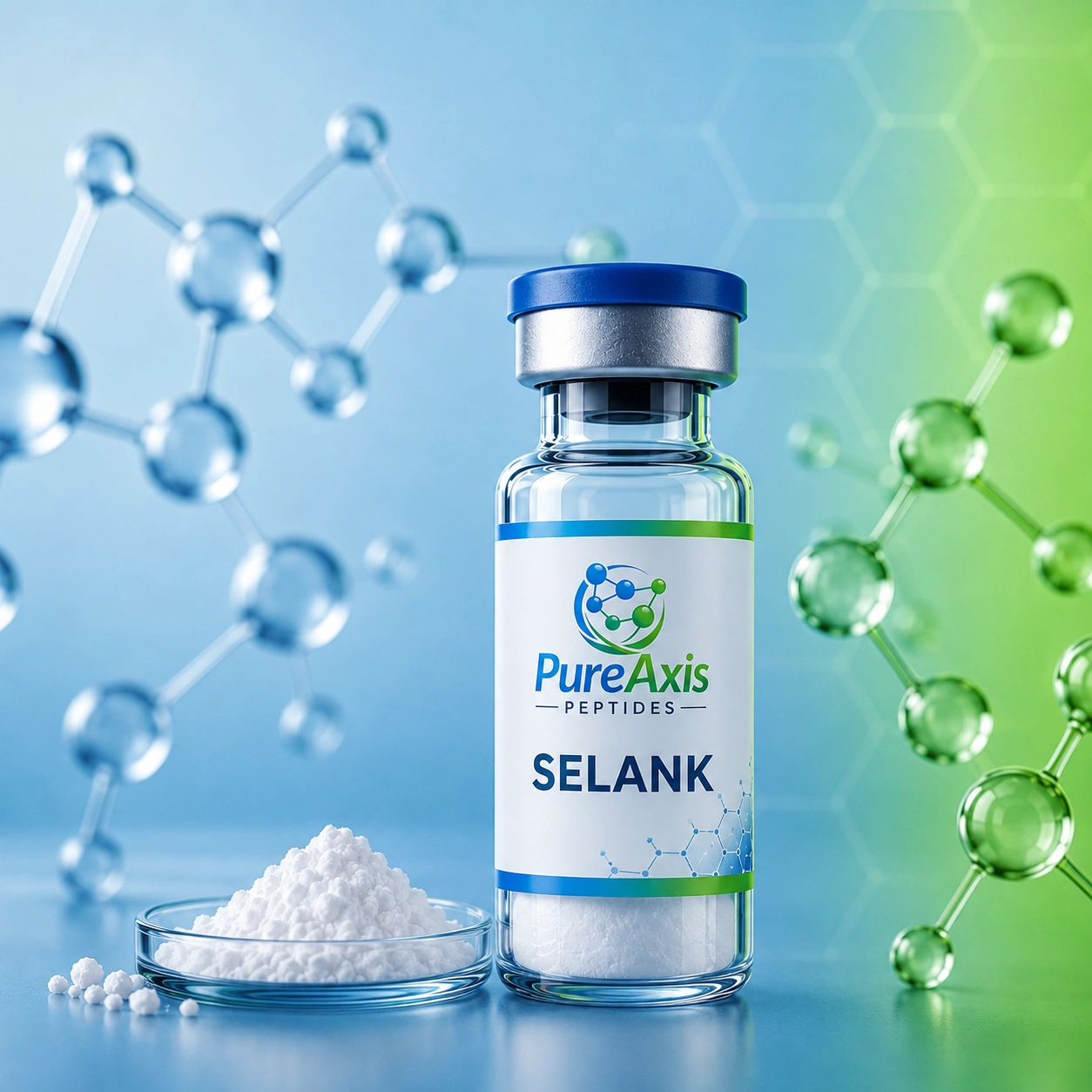
Selank Research Peptide
Selank is a synthetic heptapeptide analogue of tuftsin studied extensively in experimental research involving neuropeptide signaling, GABAergic pathways, stress responses, cognition and immune regulation.
The peptide sequence of Selank is Thr-Lys-Pro-Arg-Pro-Gly-Pro (TKPRPGP). Research has investigated its effects on GABA receptor-associated signaling, behavioral responses to stress and anxiety, cognitive processes and neuroimmune pathways.
Pure Axis Peptides offers Selank as a research-use peptide for qualified laboratory and scientific investigations.
What Is Selank?
Selank is a synthetic heptapeptide developed from the endogenous immune-related peptide tuftsin.
Tuftsin itself is a tetrapeptide associated with immune-system biology. Selank incorporates an extended peptide sequence that has been investigated for biological activity in the central nervous system and immune system. Reviews of tuftsin analogues identify Selank as one of the best-known synthetic derivatives investigated for regulatory-peptide activity.
The compound is commonly described in scientific literature as:
- Selank
- Selank peptide
- Selank heptapeptide
- Tuftsin analogue
- TKPRPGP
- Synthetic regulatory peptide
Selank and GABAergic Research
One of the most studied mechanisms associated with Selank involves the gamma-aminobutyric acid (GABA) system.
GABA is the major inhibitory neurotransmitter in the mammalian central nervous system. Research has investigated whether Selank influences GABA receptor function through allosteric modulation.
A molecular study reported that Selank affected radioligand binding to GABA receptors and proposed concentration-dependent allosteric modulation as one possible mechanism underlying its reported anxiolytic activity.
This makes Selank relevant to laboratory studies involving:
- GABA receptor biology
- GABAergic signaling
- Neurotransmitter receptor modulation
- Inhibitory neurotransmission
- Peptide-neurotransmitter interactions
Selank and Neuropsychiatric Research
Selank has been investigated experimentally in models related to stress, anxiety and emotional behavior.
A randomized clinical study published in 2008 compared Selank with medazepam in patients diagnosed with generalized anxiety disorder and neurasthenia. The investigators reported anxiolytic effects in the study population, along with additional behavioral findings.
However, the clinical literature surrounding Selank is considerably smaller than the evidence base for established anxiolytic medications.
For this reason, Selank product content should use terminology such as “anxiety-related research”, “stress-response research” and “neuropeptide research”, rather than claiming that Selank is an established treatment.
Selank and Stress Research
Stress responses involve complex interactions among neurotransmitter, neuroendocrine and immune pathways.
Selank has been investigated in experimental models of behavioral stress and anxiety, providing researchers with a peptide-based tool for studying how regulatory peptides influence these systems.
Experimental studies have reported behavioral effects that vary according to animal strain, administration route and experimental conditions.
This variability is important when interpreting Selank research and makes controlled experimental design particularly important.
Selank and Cognitive Research
Selank has also been investigated in research involving memory, attention and cognitive function.
A rodent study examined Selank in an experimental model of alcohol-associated memory impairment and reported effects on object-recognition performance and brain-derived neurotrophic factor (BDNF) measurements in the hippocampus and frontal cortex.
These findings provide a research basis for investigating Selank in relation to:
- Memory
- Learning
- Attention
- Cognitive behavior
- Neurotrophic signaling
- Hippocampal biology
- Prefrontal-cortex signaling
Importantly, animal findings should not be presented as proof of equivalent cognitive effects in humans.
Selank and BDNF Research
Brain-derived neurotrophic factor (BDNF) is a neurotrophin involved in neuronal survival, synaptic plasticity and learning-related processes.
Experimental research has investigated whether Selank alters BDNF-associated signaling.
In a rat study involving chronic ethanol exposure, Selank affected BDNF levels in the hippocampus and frontal cortex and was associated with changes in memory-related behavioral measures.
This creates a useful research connection between:
Selank → neuropeptide signaling → BDNF-related pathways → cognition
The evidence remains model-dependent and should be described as experimental rather than established clinical pharmacology.
Selank and Enkephalin Research
Another proposed mechanism involves the enkephalin system.
Enkephalins are endogenous opioid peptides involved in pain perception, stress responses and other neurological processes.
An early biochemical study reported that Selank inhibited enzymes responsible for enkephalin degradation in vitro and proposed that altered enkephalin metabolism could contribute to its behavioral effects.
This provides another potential research pathway:
Selank → enkephalin metabolism → neuropeptide signaling
Because this mechanism is based substantially on experimental biochemical evidence, it should not be presented as the definitive mechanism of action.
Selank and Neuroimmune Research
Selank’s origins as a tuftsin analogue also make it relevant to research examining interactions between the nervous and immune systems.
Tuftsin and related peptide analogues have been studied for immunomodulatory properties, while Selank has been investigated in the broader context of regulatory peptide biology.
Potential research areas include:
- Neuroimmune signaling
- Immune-cell regulation
- Cytokine signaling
- Stress and immune interactions
- Regulatory peptides
- Peptide-mediated cellular communication
The phrase “neuroimmune research” is therefore a useful and scientifically defensible SEO term for Selank.
Selank and Immune Research
The connection between Selank and immune biology is partly derived from its relationship with tuftsin, an endogenous peptide associated with immune regulation.
Reviews of tuftsin and its analogues have investigated antimicrobial, anti-inflammatory, immunomodulatory and other biological activities across experimental models.
For Selank specifically, it is better to describe this as an area of experimental interest rather than claiming that Selank clinically strengthens or “boosts” immunity.
Selank and Route-of-Administration Research
Research has investigated Selank using different experimental administration routes.
A mouse study compared intranasal and intraperitoneal administration and found that behavioral and receptor-binding effects differed according to administration route and mouse strain. The authors suggested that pharmacokinetics and biotransformation could contribute to these differences.
This highlights an important research consideration: biological effects observed with one administration route should not automatically be assumed to apply to another.
Selank and Receptor Signaling
Selank does not have one universally established molecular target that explains all reported biological effects.
Experimental research has investigated interactions involving:
- GABA receptors
- Enkephalin metabolism
- Neurotrophic signaling
- Stress-response pathways
- Neuroimmune signaling
A 2018 molecular review specifically discussed Selank’s potential allosteric effects on GABA receptor-associated signaling.
This multi-pathway profile makes Selank an interesting model for studying regulatory peptide pharmacology.
Selank Research Applications
Selank may be relevant to laboratory studies involving:
GABA Research: Investigating GABA receptor modulation and inhibitory neurotransmission.
Neuropeptide Research: Studying interactions between regulatory peptides and neural signaling pathways.
Stress Biology: Examining molecular pathways associated with behavioral stress responses.
Cognitive Research: Investigating memory, attention and neuroplasticity.
BDNF Research: Studying neurotrophin-associated signaling.
Neuroimmune Research: Investigating interactions between nervous and immune systems.
Enkephalin Research: Examining endogenous opioid-peptide metabolism.
Peptide Pharmacology: Studying the biological activity of synthetic regulatory peptides.
Tuftsin Research: Comparing Selank with its endogenous peptide precursor and related analogues.
Selank vs. Tuftsin
Selank should not be confused with tuftsin.
Tuftsin is an endogenous tetrapeptide associated with immune-system biology.
Selank is a synthetic heptapeptide analogue derived from the tuftsin peptide framework.
The two compounds therefore share structural and biological relationships but are not identical research materials.
This distinction is particularly important when documenting experimental compounds or comparing research results.
Selank vs. Semax
Selank and Semax are frequently grouped together in peptide research because both have been investigated for neurological and cognitive effects.
However, they are structurally and pharmacologically distinct.
Selank is a tuftsin-derived heptapeptide primarily investigated in GABAergic, stress-response, neuropeptide and neuroimmune research.
Semax is a synthetic peptide analogue derived from the ACTH(4-7) sequence and is investigated through different experimental pathways.
They should therefore be maintained as separate product and research entities.
Selank Research Material
Researchers should verify the current Pure Axis Peptides product specification, peptide sequence, purity, formulation, storage requirements and batch-specific certificate of analysis (COA) before laboratory use.
Because Selank is a biologically active peptide, analytical confirmation of peptide identity and purity is important when comparing experimental results across laboratories.
Explore Related Research Peptides
Selank fits naturally into a broader neuropeptide and cognitive research cluster.
Researchers can browse the Peptides collection for additional peptide research materials.
If available in the Pure Axis catalog, Semax, DSIP, Epitalon and other neuropeptide products can be linked to this page to create a dedicated neurological research cluster.
For additional laboratory materials, explore Research Chemicals.
Visit Shop All Products for the complete Pure Axis Peptides catalog.
Research Use Only
Selank supplied by Pure Axis Peptides is intended strictly for laboratory and scientific research. It is not intended for human consumption, self-administration, diagnosis, treatment, cure, or prevention of any disease or medical condition. Research involving Selank should not be interpreted as establishing clinical efficacy or safety for anxiety, cognitive disorders, stress-related conditions or immune disorders. Researchers should evaluate all materials according to their experimental requirements, product documentation and applicable laboratory procedures.
Internal Linking Recommendations
Primary Internal Links
- Peptides →
https://pureaxispeptides.com/product-category/peptides/ - Research Chemicals →
https://pureaxispeptides.com/product-category/research-chemicals/ - Shop All Products →
https://pureaxispeptides.com/shop/
Recommended Related-Product Links
If these products exist in the catalog, connect Selank with:
- Semax
- DSIP
- Epitalon
- Other neuropeptides
- Other cognitive research peptides
- Other regulatory peptides
Recommended anchor text:
- “neuropeptide research”
- “cognitive research peptides”
- “GABAergic research”
- “stress-response research”
- “regulatory peptide research”
- “neuroimmune research”
- “Semax research peptide”
- “peptide research compounds”
Recommended Site Architecture
Selank
→ Tuftsin
→ GABAergic signaling
→ Neurotransmitter research
→ Stress biology
→ Cognitive research
→ Neuroimmune research
→ Neuropeptides
→ Peptides
This structure creates a semantic cluster around Selank’s actual research literature rather than relying heavily on unsupported “anti-anxiety” or “nootropic” marketing claims.
External Scientific References
- PubMed — Molecular aspects of Selank biological activity:
https://pubmed.ncbi.nlm.nih.gov/30255741/ - PubMed — Selank and enkephalin-degrading enzymes:
https://pubmed.ncbi.nlm.nih.gov/11550013/ - PubMed — Clinical study of Selank in anxiety-related disorders:
https://pubmed.ncbi.nlm.nih.gov/18454096/ - PubMed — Selank, memory and BDNF research:
https://pubmed.ncbi.nlm.nih.gov/31625062/ - PubMed — Intranasal vs. intraperitoneal Selank research:
https://pubmed.ncbi.nlm.nih.gov/29787664/ - PubMed — Tuftsin and its analogues:
https://pubmed.ncbi.nlm.nih.gov/28745220/
Product Tags
Selank, Selank Peptide, Selank Research, Selank Research Peptide, Selank Heptapeptide, Selank Peptide Research, Selank Tuftsin Analogue, Tuftsin Analogue, Tuftsin Peptide, TKPRPGP, Neuroactive Peptide, Neuropeptide Research, GABA Research, GABAergic Research, GABA Receptor Research, GABA Modulation, Cognitive Research, Memory Research, Stress Research, Anxiety Research, Neurotransmitter Research, BDNF Research, Neurotrophin Research, Neuroimmune Research, Immunomodulatory Peptide, Enkephalin Research, Regulatory Peptide, Peptide Pharmacology, Brain Research, Neuroscience Research, Nootropic Research, Neurobiology Research, Research Peptide, Laboratory Research
| Purity (%) | 98.9 |
|---|---|
| Lab Tested | yes |
| Research Grade | yes |
| Third Party Tested | yes |
| Strength | 10mg, 5mg |
|---|---|
| Volume | 10 vials |
Be the first to review “Selank”
Need Assistance?
Our research specialists are here to help with product selection and technical questions.
Related products


Neuroscience
Neuroscience Price range: $46.00 through $92.00Delta sleep-inducing peptide for sleep and stress research


Antimicrobial & Immunology
Antimicrobial & Immunology $190.00VIP (Vasoactive Intestinal Peptide) research peptide for laboratory studies of neuropeptide signaling,...
Neuroscience
Neuroscience $49.00Cerebrolysin is a multi-modal neuropeptide preparation containing low-molecular-weight peptides and free amino...

Neuroscience
Neuroscience Price range: $40.00 through $68.00Neuropeptide hormone for social behavior and bonding research

Neuroscience
Neuroscience $100.00REV-ERB agonist for circadian rhythm and metabolism research

Neuroscience
Neuroscience Price range: $49.00 through $80.00Neuropeptide for cognitive enhancement and neuroprotection research
 Selank
Price range: $49.00 through $80.00
Selank
Price range: $49.00 through $80.00
Reviews
There are no reviews yet.