


Quick Specifications
| Purity (%) | 98.9 |
|---|
PT-141 (Bremelanotide) — SEO Product Content
SEO Title
PT-141 Bremelanotide | Melanocortin Receptor Research Peptide
SEO Meta Description
PT-141 (Bremelanotide) research material for studies of melanocortin receptors, MC4R signaling, neuroendocrine pathways and sexual-function biology.
Suggested URL Slug
/product/pt-141-bremelanotide/
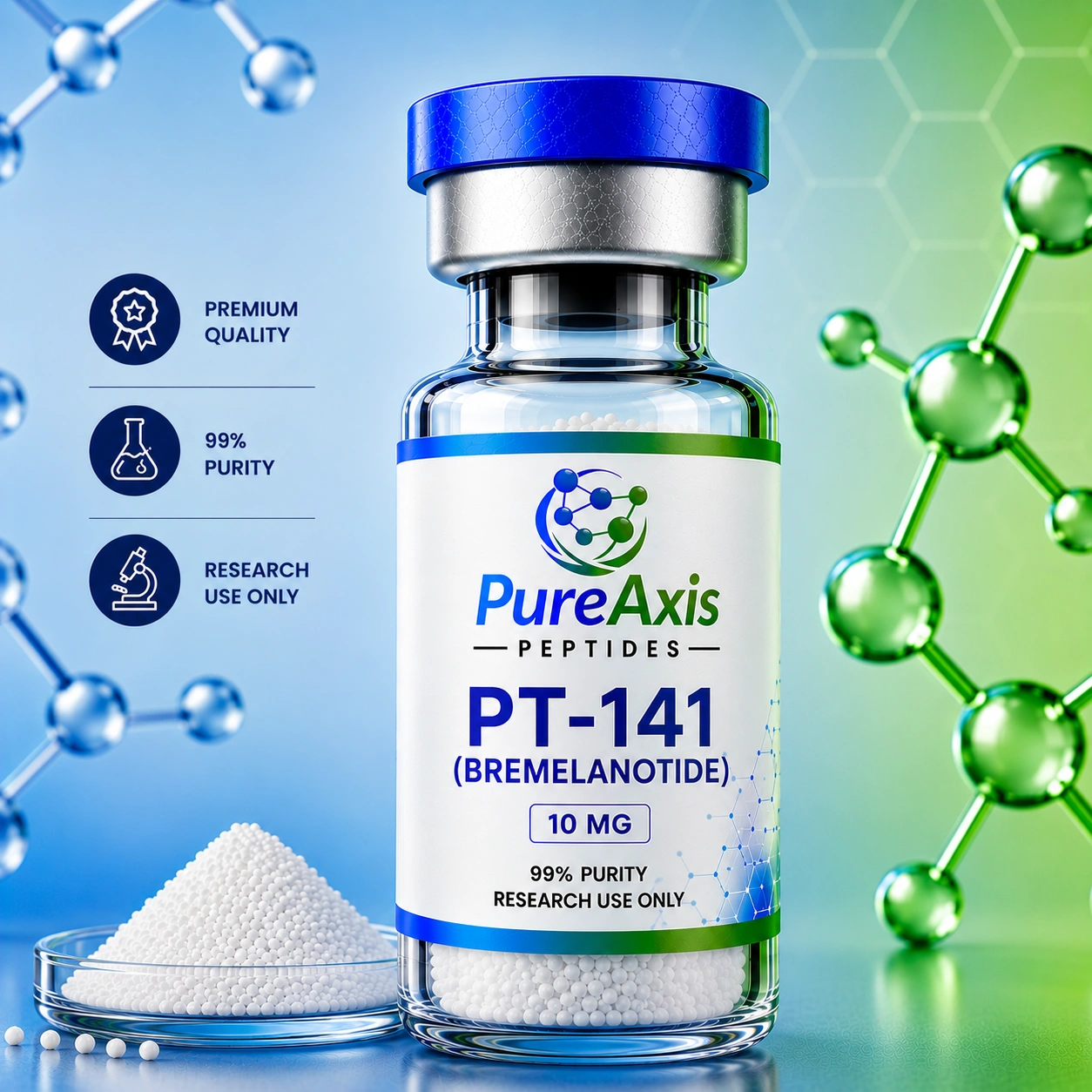
PT-141 (Bremelanotide)
PT-141 Bremelanotide Research Material
PT-141, commonly known as Bremelanotide, is a synthetic cyclic heptapeptide and melanocortin receptor agonist investigated extensively in neuroendocrine and sexual-function research.
Bremelanotide is structurally related to alpha-melanocyte-stimulating hormone (α-MSH) and interacts with several melanocortin receptor subtypes, with MC1R and MC4R particularly relevant to its pharmacology.
Research involving PT-141 has examined:
- Melanocortin receptor signaling
- MC4R biology
- Central nervous system signaling
- Sexual desire and arousal
- Neuroendocrine regulation
- Sexual-function biology
- Appetite and feeding pathways
- Melanocortin pharmacology
Pure Axis Peptides offers PT-141 (Bremelanotide) as research material for qualified laboratory and scientific investigations.
What Is PT-141?
PT-141 is the development name for bremelanotide, a synthetic peptide analogue of α-MSH.
Bremelanotide is a cyclic heptapeptide that acts as an agonist at melanocortin receptors. FDA documentation describes activity at MC1R, MC3R, MC4R and MC5R, with MC1R and MC4R being particularly relevant at therapeutic exposure levels.
This makes PT-141 fundamentally different from conventional sex-hormone compounds.
Rather than functioning primarily through androgen or estrogen receptors, bremelanotide is associated with the melanocortin signaling system.
PT-141 and Bremelanotide
The terms are commonly used interchangeably:
PT-141
→ Development/research name
Bremelanotide
→ Generic name
Bremelanotide acetate
→ Salt form used in the approved pharmaceutical product
The FDA-approved pharmaceutical formulation contains bremelanotide equivalent to 1.75mg of bremelanotide in a single-dose autoinjector.
Pure Axis product specifications should always be used to determine the exact form and quantity of the research material being supplied.
PT-141 Structure
Bremelanotide is a synthetic cyclic heptapeptide.
The FDA describes the molecule as:
- A synthetic peptide analogue of α-MSH
- Seven amino acids in its cyclic peptide structure
- A melanocortin receptor agonist
- Related structurally to melanocortin signaling molecules
Its cyclic structure contributes to the pharmacological characteristics that distinguish bremelanotide from linear peptide analogues.
PT-141 and Melanocortin Receptors
The melanocortin receptor system is a family of G-protein-coupled receptors involved in diverse physiological processes.
The receptor family includes:
- MC1R
- MC2R
- MC3R
- MC4R
- MC5R
Bremelanotide activates several melanocortin receptor subtypes, with MC1R and MC4R particularly relevant to its pharmacological activity.
This makes PT-141 useful for experimental research into melanocortin receptor pharmacology.
PT-141 and MC4R Research
Melanocortin-4 receptor (MC4R) is a G-protein-coupled receptor expressed extensively throughout the central nervous system.
MC4R has been investigated in relation to:
- Sexual behavior
- Appetite
- Energy balance
- Feeding behavior
- Neuroendocrine signaling
- Autonomic regulation
Bremelanotide’s MC4R activity is an important component of its pharmacological profile.
This creates several research opportunities involving:
- MC4R activation
- GPCR signaling
- Neural melanocortin pathways
- Sexual-function biology
- Appetite regulation
- Neuroendocrine signaling
PT-141 and MC1R Research
Bremelanotide also interacts with MC1R.
MC1R is expressed on melanocytes and is associated with regulation of melanin production.
FDA documentation notes that MC1R activation by bremelanotide can contribute to increased pigmentation.
This provides a useful distinction between the receptor pathways involved in PT-141 pharmacology:
MC1R → pigmentation-related signaling
MC4R → central melanocortin signaling
PT-141 and Sexual-Function Research
Bremelanotide has been extensively investigated in relation to female sexual desire and sexual-function biology.
Early clinical research evaluated bremelanotide in women with sexual arousal disorders and reported increased subjective measures of sexual desire compared with placebo.
Subsequent phase 3 trials investigated bremelanotide in premenopausal women with hypoactive sexual desire disorder (HSDD).
This makes sexual-function research one of the most important scientific contexts for PT-141.
PT-141 and HSDD Research
Hypoactive sexual desire disorder (HSDD) involves persistently reduced sexual desire associated with clinically significant distress.
Bremelanotide has been studied extensively in premenopausal women with acquired, generalized HSDD.
The two phase 3 RECONNECT trials included more than 1,200 participants in the efficacy population and reported statistically significant improvements in measures of sexual desire and reductions in distress related to low sexual desire compared with placebo.
These studies provide a substantial clinical evidence base for bremelanotide.
PT-141 and Sexual Desire
Sexual desire is influenced by complex interactions among:
- Neurotransmitters
- Hormones
- Brain circuitry
- Psychological factors
- Relationship factors
- Physiological factors
Bremelanotide is particularly interesting because it acts through central melanocortin signaling rather than simply replacing a sex hormone.
Clinical trials demonstrated statistically significant improvements in validated measures of sexual desire in the studied HSDD population.
PT-141 and Sexual Arousal Research
Early research examined both subjective sexual arousal and physiological responses.
A randomized, double-blind preliminary study found that more women reported moderate or high sexual desire following bremelanotide than placebo, although objective vaginal vasocongestion did not significantly differ between treatments in that particular experiment.
This illustrates an important distinction:
Subjective sexual desire and physiological genital arousal are related but not identical biological endpoints.
PT-141 and Central Nervous System Research
Bremelanotide crosses into the broader field of central melanocortin neurobiology.
MC4R-expressing neurons are distributed throughout the CNS, and melanocortin signaling has been investigated in relation to:
- Sexual behavior
- Appetite
- Feeding
- Energy balance
- Motivation
- Neuroendocrine function
Animal research has investigated bremelanotide’s effects on hypothalamic and limbic regions associated with sexual behavior.
PT-141 and Hypothalamic Research
The hypothalamus plays a central role in regulating endocrine and behavioral processes.
Melanocortin signaling within hypothalamic circuits has been investigated in relation to:
- Sexual behavior
- Appetite
- Energy homeostasis
- Reproductive signaling
- Autonomic regulation
This makes PT-141 relevant to experimental hypothalamic neurobiology.
PT-141 and Neuroendocrine Signaling
Bremelanotide provides a research model for studying interactions between neural signaling and endocrine physiology.
Potential research areas include:
- Melanocortin receptors
- GPCR signaling
- Hypothalamic pathways
- Sexual behavior
- Neuroendocrine regulation
- Appetite signaling
The compound is therefore relevant beyond sexual-function research alone.
PT-141 and Appetite Research
The melanocortin system also plays a major role in feeding and energy balance.
MC4R is one of the most extensively studied receptors in central appetite regulation.
Because bremelanotide activates melanocortin receptors, experimental research can investigate its effects on:
- Food intake
- Appetite
- Energy balance
- Feeding behavior
- Central melanocortin signaling
FDA regulatory documentation specifically notes the broader involvement of the melanocortin system in sexual function, feeding/obesity and immune regulation.
PT-141 and Energy-Balance Research
Energy homeostasis involves interactions among:
- Appetite
- Food intake
- Energy expenditure
- Adipose tissue
- Hypothalamic signaling
- Peripheral hormones
The melanocortin system is an important component of this network.
PT-141 can therefore be used experimentally to investigate how melanocortin receptor activation influences energy-balance pathways.
PT-141 and Dopaminergic Research
Sexual motivation involves complex neural circuitry, including dopaminergic pathways.
Preclinical research has investigated interactions between bremelanotide and brain regions involved in sexual behavior and motivation.
However, recent animal research suggests that bremelanotide’s effects on sexual behavior should not simply be reduced to activation of the classic VTA–nucleus accumbens reward circuit.
This makes PT-141 useful for studying the more complex relationship between melanocortin and motivational neurobiology.
PT-141 vs. Melanotan II
PT-141 and Melanotan II (MT-2) are structurally related melanocortin peptides, but they should not be treated as identical compounds.
PT-141 / Bremelanotide
- Developed primarily around melanocortin receptor pharmacology
- Investigated extensively for sexual-function biology
- FDA-approved pharmaceutical history for HSDD
Melanotan II
- Experimental melanocortin peptide
- Investigated for melanogenesis and sexual-function effects
- Associated with broader melanocortin receptor activity
Explore MT-2 (Melanotan 2 Acetate) for related melanocortin research.
PT-141 vs. Melanotan I
Melanotan I / afamelanotide is another melanocortin analogue, but its pharmacology and clinical development differ from bremelanotide.
Melanotan I is more closely associated with MC1R and melanogenesis research, whereas PT-141 has become particularly associated with MC4R-related sexual-function research.
Explore Melanotan 1 (Afamelanotide) for related melanocortin research.
PT-141 and Bremelanotide Acetate
The pharmaceutical form of bremelanotide is commonly supplied as bremelanotide acetate.
The FDA label identifies Vyleesi as containing bremelanotide, with the active ingredient present as the acetate salt.
Product descriptions should therefore distinguish:
- Bremelanotide
- Bremelanotide acetate
- PT-141
according to the actual chemical form supplied.
PT-141 and Blood Pressure Research
An important part of bremelanotide pharmacology is its effect on cardiovascular parameters.
FDA labeling describes transient increases in blood pressure following administration.
Clinical research has similarly observed increases in ambulatory blood pressure following bremelanotide administration.
This makes cardiovascular monitoring an important research consideration when studying bremelanotide’s pharmacodynamic effects.
PT-141 Safety Research
Clinical studies have identified several adverse effects associated with bremelanotide.
The most frequently reported include:
- Nausea
- Flushing
- Headache
- Injection-site reactions
An integrated safety analysis of the clinical development program reported nausea as the most common adverse event and a leading reason for discontinuation.
The FDA label also contains important warnings and contraindications for the approved pharmaceutical product. Researchers should consult current regulatory documentation when designing studies involving bremelanotide.
PT-141 Research Applications
PT-141 may be relevant to laboratory studies involving:
Melanocortin Research: Investigating melanocortin receptor biology.
MC4R Research: Studying central MC4R signaling.
MC1R Research: Investigating melanocortin-related pigmentation pathways.
Sexual-Function Research: Studying biological mechanisms of sexual desire and arousal.
HSDD Research: Investigating neuroendocrine mechanisms associated with low sexual desire.
Neuroendocrine Research: Examining interactions between neural and endocrine systems.
CNS Research: Studying central melanocortin pathways.
Hypothalamic Research: Investigating hypothalamic receptor signaling.
Appetite Research: Studying feeding and satiety pathways.
Energy-Balance Research: Investigating melanocortin regulation of energy homeostasis.
GPCR Research: Studying receptor activation and signaling.
Pharmacology Research: Investigating melanocortin receptor agonism.
Sexual Behavior Research: Studying experimental models of sexual motivation and behavior.
PT-141 Research Material
Researchers should verify the current Pure Axis Peptides product documentation for:
- Exact chemical identity
- Bremelanotide versus bremelanotide acetate designation
- Purity
- Quantity
- Formulation
- Batch number
- Storage requirements
- Certificate of analysis
Because PT-141 is a biologically active peptide with an established pharmaceutical counterpart, accurate analytical documentation is especially important for reproducible research.
PT-141 and Clinical Evidence
Unlike many compounds sold within the research-peptide market, bremelanotide has undergone randomized phase 3 clinical trials.
The RECONNECT studies evaluated 1.75mg bremelanotide administered as needed in premenopausal women with acquired, generalized HSDD and reported statistically significant improvements in sexual desire and reductions in distress compared with placebo.
However, clinical evidence for the approved pharmaceutical product should not automatically be used to claim that every PT-141 research formulation is equivalent to the approved medicine.
The exact chemical form, formulation, quality, purity and regulatory status must be considered separately.
Regulatory Status
Bremelanotide was approved by the FDA in 2019 as Vyleesi for the treatment of acquired, generalized HSDD in premenopausal women.
That approval applies to the specific approved pharmaceutical product and indication.
It should not be used to imply that a research-grade PT-141 product is itself FDA-approved.
This distinction is particularly important for product-page compliance and SEO claims.
Explore Related Research
PT-141 fits naturally within Pure Axis Peptides’ melanocortin and neuroendocrine research cluster.
Explore Melanotan 1 (Afamelanotide) for related melanocortin and MC1R research.
Explore MT-2 (Melanotan 2 Acetate) for broader melanocortin receptor research.
Explore Kisspeptin-10 for upstream reproductive-neuroendocrine research.
Explore Gonadorelin for GnRH and reproductive-axis research.
Browse the Peptides collection for additional research materials.
Visit Shop All Products for the complete Pure Axis Peptides catalog.
Research Use Only
PT-141 (Bremelanotide) supplied by Pure Axis Peptides is intended strictly for laboratory and scientific research. It is not intended for human consumption, self-administration, diagnosis, treatment, cure, or prevention of any disease or medical condition. Bremelanotide is a biologically active melanocortin receptor agonist and has an FDA-approved pharmaceutical counterpart for a specific clinical indication. Research-grade PT-141 should not be represented as an FDA-approved pharmaceutical product. Researchers should evaluate all materials according to their experimental requirements, product documentation, applicable regulations and laboratory procedures.
Internal Linking Recommendations
Primary Internal Links
- Melanotan 1 (Afamelanotide) →
https://pureaxispeptides.com/product/melanotan-1-afamelanotide/ - MT-2 (Melanotan 2 Acetate) →
https://pureaxispeptides.com/product/mt-2-melanotan-2-acetate/ - Kisspeptin-10 →
https://pureaxispeptides.com/product/kisspeptin-10/ - Gonadorelin →
https://pureaxispeptides.com/product/gonadorelin/ - Peptides →
https://pureaxispeptides.com/product-category/peptides/ - Shop All Products →
https://pureaxispeptides.com/shop/
Verify the exact live WooCommerce URLs before publishing.
Recommended Internal-Link Anchors
Use varied contextual anchors such as:
- “PT-141 research peptide”
- “Bremelanotide research”
- “PT-141 bremelanotide”
- “Bremelanotide peptide”
- “melanocortin receptor research”
- “MC4R research”
- “MC1R research”
- “sexual-function research”
- “HSDD research”
- “neuroendocrine research”
- “melanocortin peptide research”
- “central melanocortin signaling”
- “reproductive neuroendocrine research”
Recommended Site Architecture
Build a dedicated melanocortin / reproductive neuroendocrine cluster:
PT-141 / Bremelanotide
→ MC4R
→ MC1R
→ Melanocortin receptors
→ Sexual-function research
→ HSDD
→ CNS signaling
→ Melanotan I
→ Melanotan II
→ Kisspeptin-10
→ Gonadorelin
Recommended Supporting Articles
“PT-141 vs Melanotan II: Understanding Melanocortin Peptides”
“What Is PT-141? Understanding Bremelanotide and MC4R Research”
“PT-141 and Melanocortin Receptors: A Research Overview”
“Bremelanotide vs Melanotan I: Comparing MC1R and MC4R Research”
These topics provide strong informational SEO opportunities while keeping the product page focused on scientific terminology rather than unsupported consumer claims.
External Scientific References
- FDA — Vyleesi (Bremelanotide) Prescribing Information
- PubMed — Bremelanotide Phase 3 HSDD Trials
- PubMed — Bremelanotide Dose-Finding Trial
- PubMed — Bremelanotide and Sexual Response
- PubMed — Bremelanotide Safety Profile
- FDA — Bremelanotide Regulatory Review
Product Tags
PT-141, PT141, PT-141 Peptide, Bremelanotide, Bremelanotide Peptide, Bremelanotide Acetate, PT-141 Research, Bremelanotide Research, PT-141 Research Peptide, Bremelanotide Research Material, Melanocortin Peptide, Melanocortin Research, Melanocortin Receptor Agonist, MC4R, MC4R Research, MC1R, MC1R Research, MC3R, MC5R, Sexual Function Research, Sexual Desire Research, HSDD Research, Hypoactive Sexual Desire Disorder Research, Neuroendocrine Research, CNS Research, Central Melanocortin Research, Hypothalamic Research, Sexual Behavior Research, Sexual Arousal Research, Appetite Research, Feeding Research, Energy Balance Research, GPCR Research, Receptor Pharmacology, α-MSH Analogue, Alpha MSH Analogue, Reproductive Research, Reproductive Endocrinology, Research Peptide, Experimental Peptide, Laboratory Research
| Purity (%) | 98.9 |
|---|---|
| Lab Tested | yes |
| Research Grade | yes |
| Third Party Tested | yes |
Be the first to review “PT-141 (Bremelanotide)”
Need Assistance?
Our research specialists are here to help with product selection and technical questions.

 PT-141 (Bremelanotide)
$62.00
PT-141 (Bremelanotide)
$62.00
Reviews
There are no reviews yet.